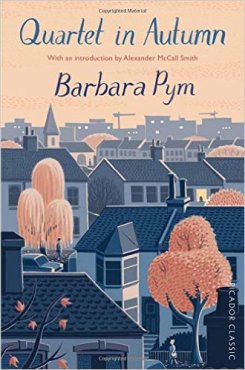
There was something to be said for tea and a comfortable chat about crematoria.
Early in Quartet in Autumn, Letty — one of the novel’s quartet of main characters — reflects on her past as an “unashamed reader of novels”: “she had come to realize,” we’re told, “that the position of an unmarried, unattached, ageing woman is of no interest whatsoever to the writers of modern fiction.” They are of great interest, of course, to Barbara Pym, who could be considered the patron saint of all such overlooked and underestimated women.
Quartet in Autumn actually balances our attention between two more in Pym’s panoply of spinsters and two — what to call them? what is the male equivalent of a ‘spinster’? That we don’t really have one is suggestive of the ways in which aging alone is different for women than it is for men. Still, terminology aside, the characters have a lot in common besides having worked for many years in the same office (that we never learn anything about where they work or what they actually do becomes one of the novel’s tragi-comic aspects). Though one of the men is a widower, now they are all equal in their mutual isolation, and if that sounds like a paradox (how can they be so alone if they’re all together so much?), I think that’s one of Pym’s points: that simply sharing time and space, even over many years, does not in itself create meaningful connections between disparate people. And yet by the end of the book, which is certainly one of the gloomier Pym novels I’ve read, the connection between them has become something just slightly more than any of them thought or expected, and therein lies what small comfort a book about aging, retiring, losing one’s strength and faculties, and dying unmourned can offer.
I thought Pym was especially good — meaning both funny and painful — about retirement, which for many working people surely seems as much a looming threat as an anticipated promise. When Letty and Marcia retire, they are not replaced: “indeed,” we’re told, “the whole department was being phased out,” which raises discouraging questions for them about the value of the work they’ve done for all those years, and even about the reality of their entire working lives:
It seemed to Letty that what cannot now be justified has perhaps never existed, and it gave her the feeling that she and Marcia had been swept away as if they had never been.
This gives her, understandably, a “sensation of nothingness” that is hard to overcome despite the opportunity retirement affords “to do all those things she had always wanted to do” — “unspecified” things that turn out not to be all that fulfilling after all, and which hardly take up all the time she now has. Her first day of retirement is “as tiring as a working day” from the very effort to occupy herself, including during “a period between tea and supper which she did not remember as having existed before.” Perhaps because retirement is much in the air at my own workplace, with similar non-replacement policies raising questions both practical and principled, personal and existential, for all of us, her experience seemed particularly poignant to me: I know how much it can hurt someone to get the message the institution they have devoted themselves to can treat them as an expensive redundancy, someone to be urged out and happily done without.
Sad as the novel’s premise is — it is, indeed, autumnal, with its focus on unwelcome but inevitable changes in all facets of its characters’ lives — it is somehow never, or never completely, melancholy: Pym is too funny for that. There’s the saga of the misfit milk bottle, for instance, which I won’t spoil by relating — it’s not so much that I would ruin any suspense about it as that I could never capture quite why it is so daftly comical, but also so spot on about human nature. Alexander McCall Smith is quite right, in his introduction, to say that “we all have something that is the equivalent of that symbolic milk bottle.” It’s a smaller-scale comedy here than we get in Kingsley Amis’s Ending Up (which is the earlier book club choice that led us here), but it’s also kinder: wry, rather than bitter. Though Pym gives us one truly depressing story about ending up alone, she softens the blow by helping us realize that even in age there are choices, and as long as you have a little life left in you, there are still “infinite possibilities for change.” The novel ends up feeling like a calming cup of tea on an otherwise bad day: it can’t really fix anything, but in its own way, it is bracing.
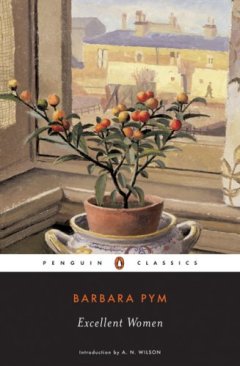
 As my mash-up title suggests, this is the basic plot outline of two very different novels: Claire Messud’s The Woman Upstairs and Barbara Pym’s Excellent Women (1952). I read The Woman Upstairs a month or so ago and though I found it a page-turner, I ended up not liking it very much. It’s not that I minded the “unlikable” narrator: as I said in
 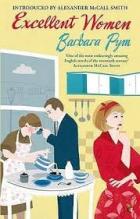 I think this is why I liked Excellent Women so much better. It’s so understated that a lot of it nearly slips past unnoticed, but as a result, while it lacks the driving forward momentum of The Woman Upstairs, its rewards are both more subtle and more surprising. We almost don’t know that Mildred is ever angry at the way those around her treat her as an accessory to their lives or assume they know what she needs or (most annoying of all) whom she loves. “Perhaps,” she observes dryly at one point, “I really enjoyed other people’s lives more than my own,” but over the course of the novel we can’t help but realize how tired she is of being one of the “excellent women” — the women who are always depended on but are somehow never part of the action on their own behalf – “excellent women whom one respects and esteems” but never truly sees. “I always think of you as being so very balanced and sensible,” says her friend William, “such an excellent woman.” “It was not the excellent women who got married,” Mildred reflects a bit later, “but people like Allegra Gray, who was not good at sewing, and Helena Napier, who left all the washing up.”

 Novel Readings