Money, money, money,
Must be funny,
In the rich man’s world.
-ABBA
My book club met this week to talk about Martin Amis’s Money, which we chose as a follow-up to Hernan Diaz’s Trust—though I think it would not have come to mind so quickly if Amis hadn’t died relatively recently, meaning we had been hearing a lot about him. None of us had read Amis before, which is perhaps not that surprising: we are all avid readers, but we are also all women, and mature women at that, so not what you might call his target demographic. (I actually can’t think of another book we have read for which our all being women has mattered so much, except perhaps—though for pretty much the opposite reason—Lady Chatterley’s Lover.) Also, then, probably not surprising: none of us liked it. Most of us really disliked it, or at any rate we really disliked reading it, which may or may not be the same thing. There was even some talk of burning our copies after the meeting . . . hyperbole, of course, but suggestive of people’s strong reactions!
It’s not (just) that we really disliked Money‘s obscene, offensive, ridiculous, pathetic protagonist John Self. We are good enough readers not to conflate the book with its first-person narrator, especially when it is as obvious as it is in this case that we are meant to despise him. (Also, Amis is not at all subtle about this distance, almost as if he wants to be sure we don’t think he approves of John Self: “The distance between author and narrator,” his avatar in the novel ponderously explains, “corresponds to the degree to which the author finds the narrator wicked, deluded, pitiful, or ridiculous.”) We got that point early on, though—but still had to persist in his insufferable company for another 400+ pages. Yes, there are some plot twists that complicate (maybe) our relationship with him. He does (arguably) become more sympathetic as it becomes increasingly clear that he is not just Amis’s fall guy for the greed and ostentation and misogyny of money men in the 1980s but the fall guy for the other scheming characters. Yes, too, there are signs of self-awareness, even self-criticism, if not necessarily self-knowledge, that (could) soften us towards him. “Look at my life,” he says;
I know what you’re thinking. You’re thinking: But it’s terrific! It’s great! You’re thinking: Some guys have all the luck! Well, I suppose it must look quite cool, what with the aeroplane tickets and the restaurants, the cabs, the filmstars, Selina, the Fiasco, the money. But my life is also my private culture—that’s what I’m showing you, after all, that’s what I’m letting you into, my private culture. And I mean look at my private culture. Look at the state of it. It really isn’t very nice in here. And that is why I want to burst out of the world of money and into—into what? Into the world of thought and fascination. How do I get there? Tell me, please. I’ll never make it by myself. I just don’t know the way.
Yes, the novel is subtitled “A Suicide Note” so we know he’s on a downward trajectory, with despair and abjection awaiting him. Yes, sometimes his exploits are LOL funny, and yes, “at the sentence level” (as some kinds of readers and critics like to say) Amis’s writing can be virtuosic.
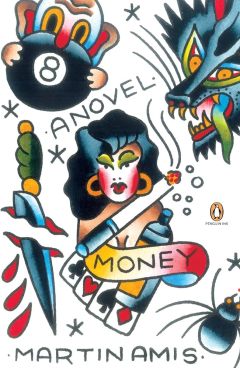 But it matters (to me, at least) what those sentences are about, and also what they are for, and for me and most of the others in my book club, this was really the sticking point. What is it exactly that we are being invited to participate in when we read this novel? How far does “it’s for comic effect” excuse offering up the things Self says and does for our (presumed) entertainment? What kind of implied author (to let Amis himself temporarily off the hook) thinks that we will laugh, not just at how stupid Self is at the opera but at his attempts at rape? that we will be engaged and rewarded by a monologue that (however energetic and rhetorically ingenious) is relentlessly sexist and racist and bigoted? Again, we get it: John Self is an anti-hero, mercilessly exposed in all his vices; the novel is satirical, Rabelaisian, Swiftian, pick your poison. It is poisonous stuff, though, and—to bring Amis back into it—there’s such a sense of gleeful bad boy “look at me” about the whole thing, with all the metafictional cleverness deployed as back-up in case the whole “I’m only joking” excuse isn’t enough. That it is such a popular book among (as far we could tell, only) male readers is disconcerting: it’s as if an uncomfortable number of them enjoy a chance to vicariously indulge the kinds of demeaning, exploitative, offensive attitudes (towards women especially) that they know better than to express in propria persona. As we discussed, we have all had the tediously unpleasant experience, at one point of another, of calling out sexism in conversation with men we know, or in TV or movies we are watching with them, only to be dismissed or shut down or worse—often, again, with “it’s only a joke.” The feminist kill-joy is a role we’d rather not have to play, but the alternative is to shut up and take it. Between us, too, we’ve had enough of the other kinds of bad experiences John Self inflicts on the women in his life not to find his shamelessness about them entertaining. We don’t need any lessons in how bad this kind of s–t is, after all, so what social or moral or other revelation can possibly come our way from approaching them by way of John Self?
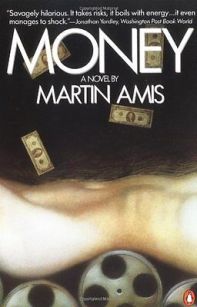 Our discussion wasn’t all negative. One member of the group noted that she felt John Self was a genuinely memorable, even iconic character, and we all grudgingly agreed that, hate him though we did, he was brilliantly executed: his voice (which is what Amis identified as the most important aspect of the novel, and fair enough) is distinctive and unforgettable. That we would like to forget it could, I suppose, be considered our problem, not the novel’s! Money also prompted a lot of discussion about the more general question of how far a novelist can or should go with an offensive character; we also considered why or whether Self is really so much worse than, say, the soulless ensemble of characters in Succession. We thought that Money would not have worked at all from the outside: what interest we took in Self, and any glimmering of sympathy we had for him, was entirely a product of our immersion in his point of view, which in turn became a test for us of Amis’s experiment, of how far he could go without losing us. We did all read to the end (though we mostly admitted having done some strategic skimming when it just got to be too much)—and our conversation was definitely lively. I don’t expect any of us will read anything else by Amis, though. (Years ago, I remembered, we read his father’s Ending Up, which we enjoyed thoroughly.)
I thought we needed a feminist palate cleanser after this, so I nominated Diane Johnson’s The True History of the First Mrs. Meredith, inspired by how much I enjoyed the Backlisted episode about it. Everyone was on board, so that will be our next discussion, probably in the new year.
 Novel Readings