Back from BAVS

I got back Monday afternoon from my long-anticipated trip to Birmingham for the British Association of Victorian Studies conference–and, of course, my stop-over in London for sightseeing and book shopping. I’m now in the midst of back-to-school preparations. Though I am feeling very glad that I did so much work for my fall courses before I left, inevitably there are still details to be finalized, and in fact it’s a good thing I didn’t quite finalize things like my syllabi, as for various reasons (such as the last-minute announcement from higher up that we are not renewing our contract with Turnitin.com for this year–ask me how good an idea I think that is…), a number of sections needed to be tweaked. So I ‘m doing that, and making plans for the actual classroom time on Friday and Monday, updating PowerPoint slides and lecture notes, and making sure I have things like sign-up sheets for presentations and attendance lists. It adds to the excitement that the printer in our main office is defunct: as Dalhousie does not provide individual faculty members with printers (or, more significant these days, with ink cartridges, which typically cost more to replace than the whole darned machine), I rely on the office printer for my course materials, reference letters, and so on, so this is pretty inconvenient. The workaround in place is our new copier, which is “networked” so that we can send documents to it straight from our offices–except that the networking is itself a work in progress, to be completed by the end of September, and my computer remains out of the loop. So there are various extra steps involved any time I want a document sharp enough to copy.  I know, you’re all fascinated by this trivia about the glamorous life of the professoriate! Anyway, bit by bit the pieces are falling into place, the handouts into the folders, the notes into order, the graphics into position.

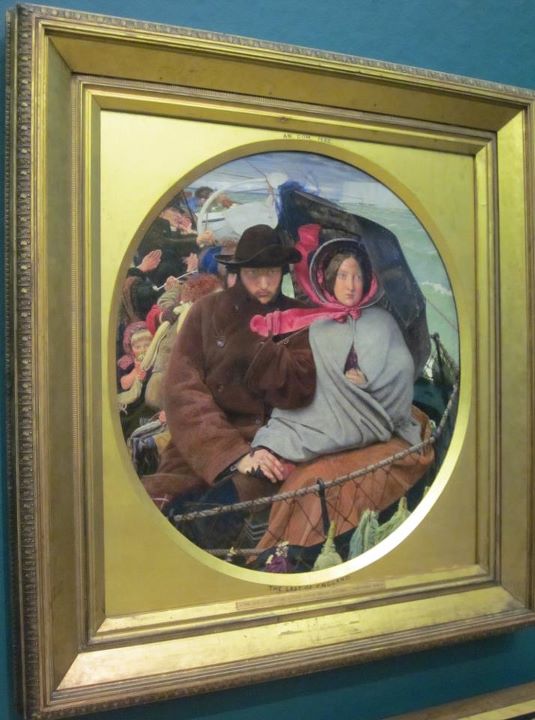
As for BAVS, I feel good about the experience. It was a big conference, with five parallel sessions running in most time slots and thus there was a lot of competition for everyone’s attention. In my own case, I find that my capacity to listen to specialized academic papers is somewhat limited at the best of times, and so I rationed out my attention a bit stingily, not attempting to attend a panel in every time slot but rather taking one break to go into downtown Birmingham to explore the Birmingham Museums and Art Gallery (which was wonderful, and topical, too, since it houses a terrific collection of Pre-Raphaelite art), and another to go across the street from the main conference site to the Barber Institute of Fine Arts (also wonderful, a real gem, as Ann promised when we met for our very pleasant dinner the night before the conference). The genre of the academic conference paper is, in my view, a somewhat problematic one. Typically, papers are highly specialized, and they are also usually very tightly crafted, polished to a high degree of rhetorical sophistication. As a result, I find it isn’t easy to engage with them, to see how to get into a conversation with (or about) them. If your own research isn’t highly proximate, it’s unlikely you know enough to get into the details, and if you’re interested anyway, you may feel kept at a distance by the effect of closure such a paper generates. I guess I wish conference papers were more like blog posts: preliminary or open-ended (or open-minded) enough that you feel invited into a conversation rather than impressed by a performance. That said, I heard some interesting papers, good things of their kind: they told me things I didn’t know or addressed questions I hadn’t thought of. A highlight for me was Colin Cruise’s plenary on ‘Arranging meanings: Pre-Raphaelite compositions and narratives,’ not only because it was intrinsically interesting and well presented, but because I had only just seen, in the BMAG, many of the paintings he focused on.

I think my own presentation went well. Our panel on ‘knowledge dissemination in Canada’ offered snapshots of three quite different projects, one the well-established Disraeli Project based at Queen’s University, presented by its director, Michel Pharand; another the Affect Project, a large-scale interdisciplinary endeavor recently launched at the University of Manitoba under the leadership of my good friend Arlene Young; and the other my adventures as an academic who blogs. We had a reasonable audience, considering the number of alternatives they had (if I’d had the choice, I too might have been at the Carlyle panel!)–around 20 people, maybe? I’m terrible at estimating these things, especially when I’m buzzed from nerves, as I always am when speaking in public. My prezi worked fine, which was a relief, after all that time spent on it, and I was even able to do a little last minute tinkering and get in a snippet from the Guardian piece that went up just that morning in response to my earlier post about Leonard Cassuto’s dismissive attitude towards blogs. There was some pretty lively discussion after. I was not surprised that the first couple of questions were, let’s say, skeptical–one of them was prefaced with a hope that it wouldn’t sound “too adversarial.” I didn’t think so, but I did think it skipped past a number of the quite careful framing statements I had made in order to present a kind of extreme worst-case scenario the logic of which, to be honest, I didn’t completely grasp. The concern seemed to be that somehow if we started doing something besides the conventional, highly structured and hierarchical and gated forms of academic publishing, we were heading down the slippery slope to having all our research funding and graduate programs cut — because (and this part of the question, or response, I do remember quite clearly) “in that case why would we need to do research or train graduate students?” As one of my main points was that the non-academic writing I’d been doing was closely integrated with, or reliant on, expertise acquired through my own specialized research, I don’t think I did, myself, offer evidence that such research was irrelevant or beside the point beyond the gates of the traditional publishing models. In fact, to the contrary, I was trying to make the point that such research has more value outside those gates than we typically believe, or at least than we typically let it. As for training graduate students, well, as readers of my blog know, I have a lot of doubts about whether we should continue to train graduate students in quite the way we have been doing for the last several decades, and it was really in service to those concerns that I emphasized my own belief that we need to make a place for (and make the case for) the value of unconventional scholarly practices including blogging in the overall landscape of recognized academic activities.

It struck me, listening to the more dubious voices in the audience, not just that they gave some signs of the defensiveness people like Alex Reid have written about, but also that they tended to talk about “the system in which we are embedded” as if we have no agency in that system. Has Foucault made cowards of us all? Who makes up the academic system, after all, if not the people who embody it? To be sure, there are all kinds of people in that system, often people with administrative or executive powers, who show no appreciation for the academic humanities. But if we really believe we can change our profession for the better, surely we should advocate for those changes, and seek to explain them in the strongest and clearest and most aggressive ways, rather than condemn ourselves–and, more pressingly, those coming after us–to persisting in a system we believe is dysfunctional. It may also be that breaking open the current rigid paradigms of academic scholarship and publishing will help us make the case for the value of our work to those administrators by showing it to be less insular, to serve a broader public. This is part of the logic behind the support structure for the new Los Angeles Review of Books, as I understand it; Tom Lutz, the founding editor, noted in his powerful essay on the state of book reviewing that academics are able to contribute to “as part of our commitment to the dissemination of knowledge that is integral to that job.” In any case, the questions were not, really, “adversarial,” but curious and eager to consider the further implications of the fairly modest proposals I specifically made, and it seemed worthwhile to have stimulated that kind of discussion. I think it’s telling that quite a number of young scholars, mostly continuing Ph.D. students, came up to me later to express their interest in what I’d said. Maintaining the status quo is not, overall, in their interests, I think, and their eagerness to think about how else things might be done was energizing.

Unusually for me, the conference felt most useful as an opportunity to have these informal exchanges, and also to meet people I knew from blogs or Twitter or the long-standing VICTORIA listserv, or from reading their scholarship, to make the personal contact that moves conversations and relationships forward — networking! It was a real pleasure putting faces to names, especially Rosemary Mitchell, whom I have ‘known’ for many years (since we both wrote essays on 19th-century needlework and historiography and decided we would be not competitors but allies) but never met in person. David Skilton was there! I was able to tell him how useful I have found his book Anthony Trollope and His Contemporaries. And I met Regenia Gagnier, whose book Subjectivities was one of the first critical books I bought when I was a student at Cornell, and Lyn Pykett, whose work on sensation fiction I rely on, and I was able to reconnect with one of my very best former students, now completing her Ph.D. in the UK (hi, Emily!).  I could wish there had been a bit more time for simply mingling, as we were either in sessions, standing in the crowded atrium eating the (very good) lunches provided, or seated at tables for dinner. Perhaps if I hadn’t been too tired from traveling to go to the pub …

Next up: some self-indulgent posts about my eagerly awaited visit to the London Review Bookshop and other bookish haunts.
“The Measure of Blogging”: More from Leonard Cassuto

Leonard Cassuto has published some further thoughts on blogging at the Guardian, with some specific attention to my response to a couple of his earlier comments in the live chat back in July.

I don’t have time to reply in detail right now as (ironically) I am at a conference in Birmingham heading off to give a presentation about blogging as knowledge dissemination. I will quickly say that the “critical error of fact” he points out (that “[his] writing for the Chronicle is in fact a column, not a blog”) doesn’t seem that critical to me, really, but I accept the correction. The difference between the two as he explains it has to do with only two things: where in the Chronicle his writing appears (including that it appears in the print version), and that it is edited by others (including fact-checked). That process, he notes, “almost always” improves the product. It’s true that my blog is not fact-checked except by me, and as it turns out, my attempt to identify just what the process was for his pieces was not thorough enough – I didn’t altogether rely on the statement in the Guardian that identified his pieces as a blog post for the Chronicle, but when I looked around the online version I didn’t see anything that clearly contradicted that description.  I guess the Guardian doesn’t fact-check very thoroughly either. In any case, it seems only fair to retract the suggestion of hypocrisy about that example. Now that he’s posted a declared blog post, he has also softened his general stance on blogging: “I mostly don’t read blogs. I’m reading this one right now, and I’m even posting to it.”

But the point of my previous post is not to determine exactly the right label is for Cassuto’s writing (as Cassuto acknowledges, “the world does not turn” on that question). The Chronicle publishes a lot of articles I think are surprisingly poor (many seem like nothing more than link-bait), despite whatever editing they have received, and by far the most valuable resource it offers, in my opinion, is the Profhacker blog. I don’t decide what to read based on the form or label.

There’s more I’d like to say, including about the model of “authority” Cassuto gives (how does “going viral” confer “authority,” for instance?) and the value of “visibility” (an argument which reproduces existing publishing and prestige hierarchies) as well as the assumption that to succeed, graduate students and junior faculty are best advised to continue in the most conservative way possible in their work. As senior, “established,” faculty, we are the ones in a position to encourage alternative models of productivity and scholarship, and if blogging is valuable to me in the ways I described, there would be real hypocrisy in my case if I didn’t consider it valuable work for people at earlier stages of their careers and work to recognize it as such when they do it.

Finally, I’ll note that I disagree with Cassuto’s conclusion that ‘if Dr Maitzen’s blogging is “unofficial,” then it doesn’t deserve the same kind of attention that her “official” publication does.’ I used “scare quotes” around “official” in my earlier comment for a reason: I don’t like that distinction, and one of the points I’ll be making today in my presentation is that I think we, collectively, as a profession, need to broaden our understanding of what counts as real, official, scholarly work. But more important, I think my blogging deserves as much, if not more, attention than my other publications. It’s more interesting and wide-ranging and intellectually curious, and it’s relevant to a wider audience. In many cases it is better written, too. It does indeed “demand a fair amount of attention” to follow blogs and to participate in the conversations that a post can generate. On that note, I think it’s interesting that Cassuto chose to publish his reply as a blog post in the Guardian but never engaged in the discussion that unfolded in the comments after my post went up last month.


This Month in My Sabbatical: It’s Over!

Six months ago, I posted the first in a series of updates on my progress (if that’s what it was) through my winter-term sabbatical. As of July 1, I’m back on regular duties. Though in some ways, unless you’re doing summer teaching (which I am not, this year), July and August have a lot in common with sabbaticals, the several hours I have already spent preparing for, attending, and following up on committee meetings are clear signs that times have changed.

Looking back at my original goals and plans for this “teaching-free” interval is sort of disorienting. As the subsequent posts in the series show, my actual accomplishments differ  somewhat from those on the list I made in January! I would not say, exactly, or only, that I did not get them done, but that the plans mutated or evolved. For instance, my top priority then was to finish my essay on Ahdaf Soueif and submit it to an academic journal. I did finish an essay on Ahdaf Soueif, but it was this one at Open Letters; I have yet to decide if I want to do more with the academic one.

My next stated priority was a series of essays on Virago Modern Classics, specifically Margaret Kennedy’s novels. I did read both The Constant Nymph and The Ladies of Lyndon, but Kennedy disappointed (or puzzled and stymied) me. Spurred on in part by what I read on other blogs during Virago Reading Week, I did look into other writers of this period: a great highlight was reading Testament of Youth and Testament of Friendship. I still aim to read more of the Viragos I have gathered, starting soon (I hope) with Rosamond Lehmann’s The Weather in the Street. I also read a biography of Dorothy Sayers, and this plus what I’ve read by and about Winifred Holtby and Vera Brittain and my general interest in the period has made me quite thoughtful about proposing an honours seminar on the Somerville novelists for 2012-13. I don’t think I could work up to the level of expertise necessary for a graduate seminar, but I think I’d be spurred on to read with more focus with such a course in mind, and an honours seminar can be a great venue for exploring material you are somewhat but not completely knowledgeable about. Branching out like this, provided it is done with due humility, seems to me a good thing on all fronts: students get exposed to something we wouldn’t cover otherwise, and I get the fun of feeling a bit like a student again as I learn my way into the material. Imagine: the reading list could include Testament of Youth, Gaudy Night, and South Riding, plus something by Margaret Kennedy so I’d finally have to figure it out.  I’m nearly through Testament of a Generation now–a proper post on that should follow before too long.

I did do a lot of the things described in my paragraph about refreshing my teaching. I reviewed and, to an extent, revamped my reading list for Mystery and Detective Fiction. The amount of time this took, especially surveying options for the anthology, reminded me why so often–especially as ordering deadlines for fall books creep further and further back into the spring–I just stick with what I’ve done before. This is a good example of bureaucratic processes hampering pedagogical innovation–that, and the absence of any kind of book-buying budget for course development, since I find “trade” publishers more stingy with exam copies than, say, the very helpful Oxford University Press, and popular titles are hard to get at the public library. I also did some extensive re-organization of my electronic files: instead of being filed by course and then year, now my syllabi, handouts, lecture notes, worksheets, essay topics, and exams are now mostly sorted by teaching area, and then by author or function. In theory, it should be quick to find lecture notes on Wilkie Collins or all the versions I’ve done of final exams for English 3031, without having to remember which year I taught which book or which course, or which year I did or did not give a final exam. We’ll see how this works out!

With an eye to my Victorian classes as well as my own edification, I looked at a number of new books in my field, mostly without much excitement, and I read, or at least skimmed, dozens of articles and reviews. What I realized, going through this material, is that most of it makes no difference to me at all. I don’t mean that there aren’t interesting individual insights or original readings, but most of it operates on a very small scale or turns on a very particular interest or angle. None of it is paradigm-changing; nothing I saw made me feel I needed to re-think (rather than, say, re-tool a little) the approach I take when I teach Victorian fiction. Much of it is filed away for me to come back to when or if I need to take my critical attention to the next level–in a graduate seminar, for instance, or in more specialized work of my own. I’m glad to know it’s there. But I’m also, truth be told, glad to discover that I don’t need to feel so anxious about “keeping up.” What’s the benefit to it, in general, if I can read so much after such a long gap and still be satisfied that what I have to say about Jane Eyre or Middlemarch to my undergraduate fiction class remains what I want to say, has not been undermined or rendered inadequate or outdated? A year or so ago I read two good overview texts on Victorian fiction (George Levine’s How to Read the Victorian Novel and Harry E. Shaw and Alison Case’s Reading the Nineteenth-Century Novel) and they were similarly reassuring. Note that I don’t conclude from the minimal significance of this published scholarship to my immediate pedagogical goals that it is insignificant in a more general way: its purposes are different, for one thing. But also, as I have written about here before (but where? I can’t find it!), the cumulative effect of specialized critical inquiries can be dramatic–the undergraduate Victorian novels courses I teach have little in common with the one I took at UBC, and sensation fiction (on which I teach an entire seminar) had no place in either my undergraduate or my graduate coursework.

One thing that went just as expected was the steady stream of thesis material from the four Ph.D. students I’m working with. It is a very good thing that they are all writing steadily, and they are all working on interesting and substantial projects–but I admit, I wasn’t always glad to see another installment appear, especially when it often seemed I had barely turned around the last batch. Speaking of which, there’s one waiting for me now…

I had a general plan to read a lot, because, I proposed,

the more you read the richer your sense is of what literature can do, of how it can be beautiful or interesting or problematic or mediocre. I am convinced that I talk better about Victorian literature because of the contemporary literature I read, and that I teach with more commitment, and more hope of making connections with my students and their interests, because I read around and talk to them about books as things of pressing and immediate significance

I think my reading this term definitely added to my intellectual life and resources in the ways I’d hoped. Besides Testament of Youth, I’d point to the Martin Beck books as a great “discovery” for me (thanks very much to Dorian for the prompt). I’ll be teaching one in my mystery class, and I’ve written an essay on them which will be appearing elsewhere later this summer. Among the other books that really made an impression are  Graham Greene’s The Power and the Glory, Elizabeth Bowen’s The Heat of the Day, May Sarton’s The Education of Harriet Hatfield, Brian Moore’s The Lonely Passion of Judith Hearne,  Shirley Hazzard’s The Transit of Venus, and Carolyn Heilbrun’s The Last Gift of Time. Less successful reading experiences included Jennifer Egan’s A Visit from the Goon Squad and Terry Castle’s The Professor, along with Christina Stead’s The Man Who Loved Children, which is the first book in a very long time I have deliberately decided not to keep reading.  I have my two book clubs to thank for steering me towards titles I might otherwise not have chosen, or not have stuck with. The Transit of Venus is one I’m especially interested in teaching, but it seems a risky choice, so I’d have to pick the right course.

While there are things on that original list that I did not exactly get done, I also accomplished some things on sabbatical that I didn’t specifically anticipate. I wrote three more pieces for Open Letters, including the Ahdaf Soueif piece already mentioned but also two book reviews, one of Sara Paretsky’s Body Work, the other of Marjorie Garber’s The Use and Abuse of Literature. Though not, strictly speaking, academic publications, both of these (like the Soueif essay) are based on my professional expertise. I wrote a number of posts on academic issues, including one on “The Ph.D. Conundrum” and two on aspects of academic publishing (“Reality Check: ‘The Applicant’s Publication Record is Spotty’” and the recent one on Leonard Cassuto and blogs). I got feisty about Rebecca Mead’s high-profile, low-substance New Yorker essay on George Eliot, and went on and on about Sex and the City. I kept on soliciting and editing pieces from other writers for Open Letters, a process that is always satisfying. Finally, I accepted an invitation to participate in a conference panel, submitted a proposal and then the funding applications. Now I’m beginning to organize my miscellaneous notes and links into what will eventually be my lively, coherent (!) presentation. Along with my next essay project for Open Letters (on gender, genre, and novels about Richard III–no, really!), preparing this presentation will be my priority for the next few weeks–that, and getting things in order for my return to teaching, by which I mean preparing Blackboard sites, updating syllabi, keeping on top of waiting lists, and psyching myself up for the return to the classroom. I’m actually happy to be heading back: I have missed teaching a lot (remind me in October that I said this, will you?)

And so, onward! If I’m counting correctly, I am eligible for another half-year leave in 2014/15, provided the powers that be are convinced that I used the time wisely this year. Here’s hoping. I know that I feel pretty good about it. I have indulged my intellectual curiosity, expanded my horizons as a reader and a writer, and contributed in a variety of ways to discussions I think are very important to my profession and my discipline. I have advanced projects I’m excited about and discovered literary interests I didn’t know I had. I am eager to get back to teaching. To me, that adds up to a pretty productive sabbatical.

Cassuto On Blogs: “I have nothing against them, but I don’t read them, either.”

The quotation is from a comment by Leonard Cassuto in a recent Guardian “live chat” on academic publishing. Here it is in full (he’s responding to an inquiry from Melonie Fullick about “how academic blogging might fit in with a kind of publishing ‘portfolio'”):

Another thing about blogging: lots of people with certain reading habits don’t read blogs. I have nothing against them, but I don’t read them, either. This is as much a function of available time as anything else. By restricting myself to published writing (whether digital or print), I am in effect ascribing value to the gatekeeping function of editors. I don’t do this because I’m a snob, but rather because there are only so many hours in a day.

Especially in the context of a discussion explicitly intended to address how academic publishing is changing in the digital age, this remark strikes me as both disingenuous and disappointingly narrow-minded. To begin with, he does have something against blogs: he does not consider them “published” (huh?), and they haven’t been seen by an editor, and thus he doesn’t consider them worth reading. At all. The first objection is incoherent, especially as he later goes on to say that blogs lack prestige because of “the absence of intermediaries between writing and publication”–in other words, they are published, but without (to use his vocabulary) gatekeepers. He doesn’t read them because they are self-published. The second objection is understandable from a pragmatic point of view: there is a lot of writing out there, on and off the web, and as he says, “there are only so many hours a day.” It’s not as hard as all that, though, to do a little filtering yourself, and to me it bespeaks an astonishing lack of intellectual curiosity not to look around to see which blogs might be of professional and/or personal interest and value.  (It turns out he is able to name at least two bloggers with “street cred,” Brad DeLong and Michael Bérubé–which dates his info a bit, as Bérubé has, at least temporarily, stopped blogging–so he knows where he might start looking for others, or he does if he understands the function of the “blogroll.”)

There’s also some lurking hypocrisy here: the Guardian feature opens with a link to a “blog post” by Cassuto himself, at the Chronicle of Higher Education. Now, I don’t know the mechanics of publishing in the CHE. Perhaps there’s a careful gatekeeping process there, determining which pieces deserve to appear under that illustrious banner, or perhaps there’s at least an editor who mediates between Cassuto’s unfiltered thoughts and his posts–which he calls “columns.” (I hope so, else by his own logic, why should we read them?) Perhaps the gatekeeping process begins and ends with the invitation to write for the Chronicle, which gives you a general stamp of approval. In that case I’m sure Cassuto scrupulously edits his posts columns himself, after writing them and before posting publishing them: he’s an experienced professional writer, after all, and well-qualified to do so. If so, it might occur to him that there are others who can do so as well and get good results, even without the Chronicle‘s sheltering umbrella of authority.

Here’s the exchange that followed (in the original thread, of course, it’s interspersed with the rest of the ongoing discussion):

RM: I know this is common (I have many colleagues who say the same thing), but this attitude implies, even assumes, “blogs” as a category have nothing in them worth competing for that time with other forms of writing/publishing–which is odd, since we would never trust in such wide generalizations about “magazines” or “books” or “articles”–the content should matter, not the form. It’s an odd, and inherently conservative, form of complacency, I think.

LC: You’re missing my point about teh [sic] value of the gatekeeping function. In general, I like to invest my time in writing that an editor has seen first.

RM: I agree that editors can provide a valuable service, and that it is helpful given the array of reading options out there to let someone else provide a filter, but in 20 years as an academic I’ve also read plenty of poor stuff that somehow passed through that gate! But my main point is just that people should be wary of generalizing about (or making decisions about) blogs if they don’t read any. Kathleen Fitzpatrick’s Planned Obsolescence has some really good discussion of the ways peer review (as one kind of gatekeeping) can hold back innovation and new ways of thinking.

LC: I don’t want to overwork this, but part of my point has to do with the credibility of blogs in the larger world of publishing, which is what we’re talking about. Some blogs (Brad DeLong’s and Michael Berube’s come to mind) have huge street cred that has been built up not only through years of steady and high-quality output, but also (and this is significant to me) by the work that these prolific and influential scholars do outside of their blogs: in other words, lots of people read the blog because they already respect the writer’s scholarship. Of course there are good and bad blogs, just as there is good and bad refereed scholarship and good and bad articles in the TLS, but the relative lack of prestige of blogs as an outlet has at least partly to do with the absence of intermediaries between writing and publication. You might think that prestige deficit a bad thing and I might disagree, but it’s a fact that bloggers need to consider as part of their decision to devote their time and energy in that direction.

So again we have a veil of pragmatism thrown over an argument for accepting (even reinforcing) the status quo–pragmatism, at least, from a careerist perspective (see digiwonk‘s comment on that post column). Yes, it’s true: there is a “prestige deficit.” But I would have expected a discussion about ways the digital age is changing academic publishing to at least evaluate, if not actually challenge, that normative thinking. Once you acknowledge the imperfections of the gatekeeping system (“of course … there is good and bad refereed scholarship” [emphasis added]), you should be open to more imaginative ways of conceptualizing the processes or forms of scholarly discussion and knowledge dissemination. Based on Cassuto’s own admission, the presence of “intermediaries between writing and publication” is no guarantee of quality in communicating the results of specialized research. We might also consider whether there are other goals in academic publishing (particularly related to work in progress or collaboration) or other values (such as open access) that are better served by non-traditional forms including blogging. Nobody that I know of is trying to argue that blogging in general, or even particular highly scholarly blogs, should replace traditional publications. But surely it’s time people stopped saying “I don’t read blogs” as if there’s nothing questionable or retrograde about that.  At the very least, if you don’t read any of them, there’s absolutely no way you can know what their value is, which means you aren’t really qualified to speak about the place they should have in academic publishing–only to pass along the news (which is no news to bloggers) that most academics are prejudiced against them.

Cassuto is actually inconsistent about all this, though. In the comments I’ve quoted so far, he sounds resolutely against the professional utility of blogging–again, narrowly construing ‘utility’ to mean ‘useful in building a professional resume.’ Upthread, however, he makes what I thought was a very encouraging statement about avoiding preemptive assumptions based on the form of someone’s writing:

For me personally, I now judge everything case by case. if I were reviewing the work of a job candidate who writes a blog, I’d want to see if it were a good, substantial blog, and evaluate accordingly. But there are plenty of people in my discipline who would simply say that blogging is not scholarship, however broadly conceived.

Here, then, he differentiates himself from  his stodgy colleagues. Here’s my pleased reply to that earlier remark:

It is good to see you say you would actually *read* the blog to evaluate it. This seems crucial: those who simply dismiss blogging as “not [being] scholarship, however broadly conceived,” at least in my experience are usually people who don’t read blogs and make assumptions about their content and their value (and their potential role in scholarship and scholarly communication) based on what they think they know about the form of blogging.

Later on, he sets himself up as the champion of a “new world of possibilities.” A participant in the discussion proposed that it would be good if graduate programs encouraged

digital writing as part of a research portfolio. Academia will still push for “traditional” publishing outlets[;] however blogging, video and other media formats help students collect, archive and curate knowledge – which helps with research and publishing goals.

“Yes, it would,” Cassuto says:

I’ve been writing about this in my own columns in hortatory tones. But most of my peers don’t know how to teach “digital humanities.” I’ve just started to take my own advice and encourage it, but there’s an entrenched population who has to be educated about the new world of possibilities.

Perhaps it’s not really an inconsistency but rather a slippage between the broader category of “digital writing” in the first comment and Cassuto’s use of the term “digital humanities,” which (to me, at least) means something rather different. Though there are digital humanists who blog, there are many bloggers (myself included) with no particular affiliation to digital humanities as an area of specialization. At any rate, his comments specifically about blogging do not suggest he is quite as different from his “entrenched” colleagues as he believes. Blogging is a part of that “new world”; the way to be educated about it is to actually read some blogs. He has some catching up to do. One place to start, if only for its historical interest, might be here (on the internet, 2005 is pretty ancient history!).

Like Cassuto (who, to be fair, is rather taking the fall here for the many other people who have said similar things to me about their “reading habits”), I don’t want to overwork this, particularly as I understand the main purpose of the Guardian chat was to give advice on how to be a successful academic, and all practising academics know that the safest strategy is to do the most familiar (and prestigious) things.  But even so, there are no guarantees, and I do find it discouraging that, a few years after the MLA issued its own recommendations on rethinking how we approach academic publishing for tenure and promotion (PDF) (see also Stephen Greenblatt’s 2002 letter) , the conversation here unfolds in a way that ultimately reinforces not just traditional but constraining and conservative ideas about how to “get ahead.” Despite gestures towards “portfolios” and nontraditional forms of scholarly writing (both of which the MLA encourages), the emphasis is on placing articles in journals and book manuscripts with publishers–the more prestigious, the better. Even in these forms, priority is given to print over online or electronic forms. From one press rep: “most authors and academics have a preference or taste for printed books”; Andrew Winnard of Cambridge UP also  comments that:

Digital developments continue apace but print has a suprising [sic] resilience. In terms of academic career progression in the humanities, there is still, it seems, nothing that quite replaces a physical book when presenting evidence to one’s Head of Department. Compared to 300 pages in a weighty binding and an attractive cover, a ‘click’ struggles to compete.

Again, they all seem to be strangely deferential to people’s habits, which I can see if your business is marketing, but not so much if your interest is (as Aimee says at the Chronicle) “to disseminate good ideas and advance our collective understanding of the world.” (The recurrent assumption that form determines the value of content–or its prestige, if that’s any different–is increasingly bizarre to me. How many of these folks go get the print journal if they can download the PDF of the article they want? Why should this be different for another source just because it’s book length?) Blogging is approved of as a “marketing tool,” with a couple of arguments floated about the way it proves interest in (and perhaps facility for) communicating with wider audiences. When/if a blog has any “street cred,” it’s because of its author’s previous success in traditional forms of scholarship and publishing–which  creates something like an ‘argument from authority’–these must be good blogs (because “of course” there are both good and bad blogs) because they are written by people whose other work was good. And so now they don’t need editors to come between us and them! Hooray! We can read them happily–even though they’re online!–not because they are good in themselves (though they may well be) but because they come trailing the clouds of their authors’ reputations–never mind what problems there might be with the system of peer review on which conventional academic publishing (and thus prestige, and reputation) depends. No need to go looking for the little people. They’re out there, though, and in fact one great thing about blogging is that while the attention is often hierarchical, the form is not–and the results can be surprising. Even lowly graduate students can sometimes use it to clamber out of obscurity! There are more kinds of prestige, perhaps, than are dreamt of in our conventional philosophy.

In some of the recent discussions among bloggers about hostility towards academic blogging (some good links are helpfully rounded up here), some raised the point that to some (non-blogging) academics, blogs are seen as self-aggrandizing. I should be clear that I don’t defend blogging in these discussions because I think of my own blog as exemplary as an “academic” or scholarly blog. It would be a mistake, that is, to look here and draw general conclusions about whether blogging “counts” as a kind of academic publication. My particular style of blog makes that issue harder to puzzle through than blogs like, say, Timothy Morton‘s that are more (if not exclusively) oriented around specialized research interests and projects. Though I do find writing my blog helpful as I think through ideas for my academic work, I don’t use it primarily as an outlet for that academic work. Instead, particularly in the past year or so, I have been using it to different ends (see here). I don’t think those ends are irrelevant to my work as a teacher and scholar, but I think my interest in redefining that work–getting away from specialization, writing more for a broader audience, and so on–is somewhat different. Somewhat–not entirely! Given the traditional parameters of academic publishing, I could not practice (or share with readers) the kind of writing I want to do without an outlet of this kind. From that perspective, then, my blog is exemplary of the kinds of things that are shut out by the preoccupation with prestige and gatekeeping reflected in Cassuto’s comments. I have my own recent experience with the consequences of my decision to “devote [my] time and energy in that direction.” So I agree that bloggers need to be realistic about the place of blogging in their overall professional development, including about the widespread assumption “that blogging is not scholarship, however broadly conceived.” But I think it does both bloggers and the profession a disservice to let “realism” be an excuse for leaving people’s (or our own) habits and prejudices unchallenged.

And with that, I’ll edit and proofread this post, hit ‘publish,’ and welcome (as always) your comments.

Reality Check: ‘The applicant’s publication record is spotty’

To those of you who are also my  Twitter friends, I apologize: I said I was finished with this issue and moving on, but it turns out it is still going around in my head and needs a bit more sorting out–not because I feel aggrieved (that, I’m basically over), but because I think it is symptomatic in ways that are worth further disucssion.

My immediate situation is this: I was invited to participate in a panel  on ‘knowledge dissemination in Victorian Studies in Canada’ at the upcoming British Association of Victorian Studies conference. Specifically, I was asked to present a paper about my experience as a blogger and how it connects to broader issues about research, writing, and ‘knowledge dissemination.’ I was also invited to propose a workshop for graduate students on academic blogging (or, as I like to think of it, blogging as an academic). Naturally, I think this is all good. For one thing, it is encouraging to find that my blogging seems interesting and significant enough to other academics for them to want to hear more about it. Also, it seems like evidence that this activity of mine, which is not by any conventional definition “scholarship,” can nonetheless open a door for me into an event like this–at least to the organizers, that I have been blogging was a reason to include me in this gathering of scholars, not a strike against me. The panel was duly accepted by the conference organizers, and I spent some substantial time last month putting together the materials required to apply for funding to cover travel expenses and the conference registration (which in this case is quite a substantial sum, as it includes on-campus accommodation as well as a registration fee). Times are hard and budgets are tight, but participation in conferences is a recognized professional activity, the kind of thing we are supposed to do, to share our ideas and learn about other people’s. I do it rarely, because my experience is often disappointing, but BAVS is just the kind of conference that promises to be really worthwhile. Our attendance at international conferences also does a little to raise the profile of our home institutions–though in this particular context, I think it’s worth pointing out that my blog, where my name and institutional affiliation are clearly displayed, also does this. (I think it’s safe to say that many people who read my blog had never heard of Dalhousie University before they came here–though perhaps I underestimate the successes of our PR team in getting the word out. I’d actually be interested to know from readers if I’m right about this.)

Anyway, the long and the short of it is that the institution I sort of work for that I don’t regularly name here, the University of King’s College (please don’t ask me to explain the Dal-King’s relationship–nobody can do it–let’s leave it at saying that I’m a member of the “Joint Faculty”) promptly coughed up the money I asked them for. Since they are a small institution and in particularly challenging financial circumstances right now, their commitment to supporting faculty research and conference travel is particularly appreciated. Thanks, King’s! But they have a cap on these grants, and just getting to the UK is very expensive these days, even though it’s a modest 5-hour direct flight from here to Heathrow. Luckily, there’s a special fund available through Dalhousie for international conference travel, specifically intended to help with the likely shortfall between a standard-sized travel grant and the real cost of even a short trip. I applied for a modest additional sum from this fund, to make up the difference between the King’s grant and what I anticipated the whole trip would cost. This application was turned down.

This is perhaps an unnecessarily long preamble, especially since the real point of this post is not to complain about this outcome–or at least, not exactly. I understand that universities do not have enough money to pay for everything, and I’m actually readier than most of my colleagues to point to conference travel as something that ought to be more rare than it is, given the multitude of ways we can communicate with each other for free, or at least for no more than the already budgeted overhead costs for internet access. I myself last attended a conference in 2009. (That doesn’t mean that there is nothing valuable about bringing a community of scholars together, though, and providing the occasion and support for focused and also serendipitous face-to-face engagement.) Given the shortage of funds, I also see that applications have to be ranked and there will be some that aren’t ranked as high as others. I do think the rationale for these decisions should be explicit and transparent,  so that we put in the best applications we can and can realistically assess our chances of success before going to the trouble of applying again. So on getting the bad news that I wasn’t getting any more money from my university towards this trip, I fired off a request for the reviewers’ assessments of the application, and here’s where I got my knickers in a bit of a twist, because the single negative comment in the two otherwise perfectly positive evaluations was, under Quality of Applicant,”The applicant’s publications record is spotty.” Given that neither reviewer objected to my budget or to anything about the conference or to my proposed participation in it (“the conference and the applicant’s contributions seem noteworthy,” remarked the same person), it doesn’t seem far-fetched to conclude that the “spotty” publication record accounts for the relatively low rating assigned the application by Reviewer #2 (of course they are anonymous, though my application wasn’t) and its mediocre overall final rating. Did that perception “cost” me the grant? I’m not sure, since I don’t know precisely where the cut-off point was for the fund/don’t fund decision, but something did, and that’s the only clue I have about what it might have been.

But here’s the thing. Yes, absolutely, my publication record over the last 5 years (which is what they asked about) is “spotty” if by that you mean that I haven’t published a peer-reviewed academic article since 2007. My anthology of Victorian writing on the novel did come out in 2009: I’m not sure where editorial projects rate on the whole academic prestige scale, but I can tell you it was a pretty big undertaking and included a fair amount of original scholarship, particularly of the “reading things from old periodicals and figuring out if they are somehow significant, based on research into secondary materials about Victorian theories of the novel” kind. During that 5-year period, though, I have also published 5 essays and 4 book reviews in Open Letters Monthly. Actually, those are all since October 2009–so in the past 18 months or so, I have been more active as a published writer than during any previous time in my life. Because the application asked us to highlight publications especially relevant to the proposed conference, I listed my essay on Ahdaf Soueif as well as my review of Brenda Maddox’s George Eliot in Love and my pieces on Felix Holt and Vanity Fair (remember, the panel is on ‘knowledge dissemination in Victorian Studies’).  Though the blog is discussed in the description of my paper I submitted for the panel (included in the application file), I did not attempt to declare it a “publication” on the application form, even though it is in fact the writing most relevant to a paper about my experience as an academic blogging in Canada. As a blogger, there’s nothing “spotty” about my record at all: I have posted 2-3 pieces (sometimes more) every week on my blog since 2007, for a grand total of 600 posts (601, counting this one!). Some of them are incidental, some of them are substantial. Some reflect original (if sometimes incomplete) thinking about scholarly problems, many of them address critical and interpretive questions. I think I could make the case that on this occasion, I have every right to identify this material as in an important sense a relevant “publication”–but I didn’t. There’s no place on the form, after all, to justify doing so, and the package overall is pretty clear about the relevance of blogging because that’s what I was invited to the conference to talk about. Maybe I made a tactical error in trying to avoid directly confronting the whole “a blog is just meaningless self-publishing” thing, but you’d think a careful reviewer might have thought a little outside the box provided and seen that in this case, that “spotty” comment was kind of missing the point.

I did, however, present my Open Letters pieces as publications, though I did not put the little asterisks next to them to indicate “peer-reviewed.” I think this is  where the “spotty” comment really comes from, and here’s where I think our reliance on (or our faith in) peer review does a disservice, not just to those of us doing other kinds of publishing, but to the principle that what matters is the quality of the work, not the system that grants it (or doesn’t grant it) an extrinsic stamp of approval. Nobody is going to actually read any publication I list on something like this, starred or not. The task of deciding whether I’m doing good work or not has been outsourced to the readers of academic journals. I’m sure I don’t have to tell an audience of bloggers that there are serious flaws with peer review (see here for lots more about it). There’s no good reason (except efficiency and habit–and I don’t underestimate the weight of these) to assume that the little asterisk means “job well done” while its absence means “not a real contribution to the academic enterprise.” Or, we shouldn’t assume that if we understand “the academic enterprise” a little more broadly than perhaps many people do. Consider the panel topic again: “knowledge dissemination.” That’s an ugly coinage, but basically doesn’t it mean getting the word out about what we know? Who says that the only important thing is getting the word out to other academics? (Indeed, who says that other academics get their information exclusively from academic sources?) In fact, though probably the humanities were not at the forefront of anybody’s mind when worrying about this, there’s been a national discussion in recent years about the importance of communicating scholarly research beyond the traditional frameworks (for example).  My review of Brenda Maddox’s book has been viewed 561 times since it went live. As academic blogger Alex Reid has reported, statistics show that 93% of humanities articles go uncited. That doesn’t mean they aren’t read, but if they were serving the purpose they are supposed to, e.g. furthering academic understanding and debate, their citation rate would surely be close to their viewing rate. I can’t know what the results were of those 561 “hits,” but it seems fair to say I disseminated something there. My essay on Gone with the Wind has been viewed more than 9700 times since it went live, and though you would have to read it to know, it offers an extensive ‘expert’ reading that is enmeshed in my work on fiction and ethics, as well as on historiography: it just presents that expertise in an accessible, jargon-free (well, nearly!) way. The Ahdaf  Soueif essay has been viewed a modest 282 times–but reading it over, I am convinced it makes an original contribution to our understanding of Soueif’s novels, and 282 is not bad if Alex Reid and his respondents are right that the average readership for a humanities article is somewhere between 2 and 7. Why would it be better if I had padded it around with footnotes and laid it to rest in the Journal of Middle Eastern Literatures? Of course, I realize it might have been rejected if I had sent it to the Journal of Middle Eastern Literatures. The whole thing would have been a much slower process, certainly: not just writing the kind of paper that can compete for space in such a publication, but waiting to see how I did. Heck, I waited 5 months for a reply to a preliminary inquiry about submitting it to another journal, one that claims to ‘welcome’ such inquiries and even to recommend them prior to our undergoing the full submission process.  By writing it on my own terms, subjecting it not to academic peer review but to the scarily rigorous review of my co-editors at OLM, and then publishing it there, I seized an important moment and, yes, disseminated my knowledge. The only way in which I think it would be preferable to be in, say, JMEL, would be that an essay there would be found and cited by other scholars working on related topics in a way that probably the Open Letters piece won’t be–it won’t show up in the MLA bibliography, right? That said, any scholar with anything on the go these days will do a range of searches including a web search, so someone writing on Soueif is surely bound to find my essay if they are doing a half-decent job of research.

I can’t help but be aware, though, that to some extent I am rationalizing my own recent choices, the way I have prioritized my time. It has turned out that for me, it is not possible to do everything. One rationale often heard for academic blogging is that it can further a ‘proper’ research and publication agenda. This has happened for me to some extent, especially in the early days of my writing about Soueif and while I was contributing at The Valve, but that’s not really how I have been using my blog for some time. Instead of writing posts about Victorian literature, or Victorian studies, I have been writing about Vera Brittain and Elizabeth Bowen and Maj Sjowall and Per Wahloo–and Salley Vickers and Jennifer Egan and Morley  Callaghan and Brian Moore. I have chosen to do this, as I have chosen to write essays and reviews for Open Letters on both Victorian and non-Victorian topics, in the full knowledge that I have only so much time for reading and writing and that these are not the kinds of reading and writing that will serve me best professionally. I know perfectly well that the kind of writing I’ve been doing doesn’t “count”;  I feel guilty and inadequate and defensive about not having been equally productive at the kind that does, and I can hardly pretend to be surprised that there are consequences to this.I have thought often about how my decision to use the security of tenure to experiment with the parameters of my work as a critic will affect my chances of any further promotion: it’s ‘research and publications’ (that is, research that leads to academic peer-reviewed publications) that will count for that, no matter how enriched my teaching is as a result of my other intellectual explorations, or how good and even well-respected my non-academic essays might become.

A couple of my “tweeps” have kindly suggested that it’s not easy being “in the vanguard” or being an innovator in a system that is as rule-bound as academia (I’m extrapolating a bit from their 140-character replies to my venting!). I think that without making exaggerated claims for the value of the writing I’ve been doing, it’s safe to see the reviewer’s response to my profile as symptomatic of something like this. The categories and labels in use are no longer sufficient; the boxes we are given to fill in do not fit what all of us are doing; the patterns we are expected to follow need to be altered. A productive, respected (if I may?) blogger presenting a paper on blogging at a panel on knowledge dissemination should not need a string of unrelated peer-reviewed publications to prove herself.

And that really is my  last word on this incident! (Well, except for any responses I might have to comments. And any follow-up tweets …. )

Terry Castle, The Professor

Here’s a passage from Terry Castle’s “The Professor”–what genre  is it? essay? novella? screed?–that displays most of the qualities that made me dislike it so much:

So what to say about the Dear Lady herself, now that more than three decades have elapsed? True: one feels a bit like Sir Walter Scott putting the question so sententiously. One imagines a title: Dumped: Or, ‘Tis Thirty Years Since. Also true: that the matter evokes contradictory feelings in me. Having now described the fiasco with the Professor at length [she’s not kidding–the piece goes on for almost 200 pages], I confess, I feel on the one hand a bit embarrassed by its sheer triteness: my own sitting-duckness, my seducer’s casebook callousness. As I expected, revisiting Ye Olde Journals has indeed been lowering–not least because they tell such a dreary old-hat tale. Who hasn’t clawed at one’s pillow in anguish at a lover’s faithlessness? Had one jumped off a cliff that long-ago winter–Sappho of Lesbos-style–one would simply have ratified it: one’s lack of originality; one’s tedious by-the-bookness.

What don’t I like? First, the Capital Letters. This is a trick Castle uses frequently in this volume when she wants to use terms she knows are trite and so decides to code as ironic: “Core Emotional Truth Time,” Still Too Much Going On,” “Trial of Taste,” “The Worst Song Ever Written,” “Wild and Fun and Oh-So Grown-Up.” It’s self-mockery, sure, but also a parade of intellectual superiority (“don’t worry, I know better than this“). Then the pronoun: why, in such an intimate tale, switch to the pompous “one” when the subject is clearly, as in every essay here, Castle herself? Again, it’s self-mockery, but the sententiousness is not any less because of the off-hand and unjustifiably condescending reference to Scott. (Scott’s version of Dumped would have been far less obsessively whiny and self-absorbed: think how foolish Our Hero Edward Waverley looks as he mopes about after Flora MacIvor!) Then the faux-apologies for the triteness of the tale told–faux, because she takes 200 pages to tell her side of the story, and while the visceral energy of the piece is undeniable, she’s right that it’s not, or is not made into, something extraordinary: there’s no broader implication, no lesson learned (for her or for us), no strong attribution of cause and effect between the miserable affair and her understanding of relationships or her development as a person or an intellectual. “Ye Olde Journals”? OK, we get it: you are keen to distance yourself from the woman you were when you wrote them. There’s no need to be so arch about it. And the Sappho allusion is the pretentious cherry on this dreary sundae of self-pity and vengefulness. Though I’m not nearly as interested in Terry Castle as I would have to be to find these nearly 200 pages truly compelling, I would at least have preferred that she write them with less effortful self-conscious posturing and more sincerity. Perhaps it’s the Victorianist in me confronting the 18th-century satirist in her, but there’s no sense that she got anything intellectually or morally out of either the experience or the narration of it. Fair enough, but then it’s hard to see what we can get out of reading this, except sordid voyeuristic excitement.

I liked the first essay in the collection much better: that’s the one I quoted from before, that includes her thoughts on Vera Brittain. I was mildly to moderately engaged by the other ones, though “Desperately Seeking Susan” also struck me as self-absorbed and unpleasantly voyeuristic–I was left with the feeling that Castle is kind of a difficult person to know, and certainly a dangerous person to cross or disappoint. I really enjoyed parts of “Travels with My Mother,” but in the end I couldn’t forgive Castle her overt condescension–again, being self-conscious about it does not undo it. She’s just so pleased with herself for being able to like Georgia O’Keeffe in spite of herself:

But something odd is happening. The paintings, when I get to them, are not, I notice, as huge and blowsy as I was expecting. Several in fact are quite small. Not Vermeer small, but definitely smallish. And one or two, I have to admit, are pleasing, especially the pre-New Mexico ones from the 1910s and ’20s. Hmmm. Addled connoisseur-brain starts gently powering up again, trying to process the unanticipated subtleties of the situation. Okay, they’re all still flowers, but aren’t some of them at least as good as ones by those American Modernists you like so much? You know: Marsden Hartley, Arthur Dove, Charles Demuth? If you didn’t know they were hers, wouldn’t you be impressed? Aren’t you being hard on her–as is your perverted wont–because she’s a woman? I keep looking for more of the expected monstrosities–lewd river basins, vaginal canyons–but have only intermittent success. A few throbbing pink and yellow horrors float in and out of view in the distance, of course, but the worst offenders in the O’Keeffe Anatomical Fixation Department don’t seem to be here…

And she’s so pleasantly surprised to learn that her mother (who does crafts–the horror!) shares her enthusiasm for Agnes Martin, the “anti-O’Keeffe” who serves as her “ultimate Connoisseur’s Good Taste Vaccine”: “Yea, though I walk through the Valley of Southwestern Style, I will fear no evil.”

To my surprise … [my mother] is an Agnes Martin aficionada. . . . My snob-self is frankly stunned at this unexpected display of maternal hip: it’s as if Wally and Charlie, my dachshunds, were suddenly to begin discussing Hans-Georg Gadamer.

The flourishes of knowingness, the display of recondite expertise, the distancing irony, the snide self-mockery supplementing but never supplanting the self-absorption: the impression I get from this volume is that these qualities are not stages in Terry Castle’s life but define her personality. Judging from the effusive blurbage on the book, for people who like this sort of thing, this is really the sort of thing they like, but that turns out not to include me.

This Month in My Sabbatical: Reading and Writing

Though nothing especially momentous marks this month in my sabbatical, I am pleased that I have continued to move fairly steadily through the various projects I set for myself back in January. Though I appreciate having the time to read, reflect and reconsider, though, I have to say that this month I have felt particularly isolated, because it’s the two aspects of this job that you are relieved of on sabbatical (administration and teaching) that actually bring you into regular contact with other people. Without classes and meetings, much of what we do is strictly solitary, and during a regular term that quiet can be very welcome, precisely because teaching and committee work are hectic, demanding, and often as annoying as they are stimulating. At first, it was just a relief to be free of the incessant demands on my time and attention. But after a while, it’s lonely, even a bit depressing, puttering away by myself. That’s one reason this post on academic blogging (thanks to Jo VanEvery for the link) resonated with me, especially this bit:

a college of one’s own is essential to scholarship. Sometimes we get lucky and our collaborators are able to participate in that world, but more often they need us for narrower purposes: our technique, students, or grants. Who then to bump ideas off of? Who to share our latest little discovery or epiphany? How to communicate the interest of an article or book? Where to find a reader? Who will forgive us our latest and dumbest ideas? How to feel that slight flare of getting the last word in a debate among learned colleagues?

It’s true, as the author continues, that “a blog can provide those things, and more besides,” and I’ve been grateful for the interest and input I receive from so many of you on my posts here. (The post I link to also gives a thoughtful account of changes in the culture of academic life that have made that collegial interaction more difficult to achieve–if anything, I think he underestimates the role played by sheer day to day busy-ness.) I was thinking that it’s no accident I first began blogging on my previous sabbatical: without really knowing much about it, I was looking for more ways to communicate with other people, and it was exhilirating to discover the conversations going on online and then to become part of them myself. I wonder sometimes why I feel this lack, even when I’m not on sabbatical, and (as far as I can tell) most of my colleagues don’t. It’s true I’ve always been a chatty type (if my parents are reading this, they are muttering “no kidding” and recalling their coinage “talkit” … ) so there’s that; some of my colleagues are just more reclusive or scholarly by instinct, happy to burrow away in their research; some, I think, for whatever reason have a better network of peers and collaborators that provide input, support and energy; others might enjoy blogging but haven’t tried it, or think it would be a distraction from their “real” reading and writing. In any case, the solitude of sabbatical work has made me appreciate my online network more than ever. And it has also made me realize how much of the return I get for my investment in this career comes from my students, from the challenge and the fun of getting them involved in our readings, from their curiosity and energy and enthusiasm. I miss students! (Remind me I said this when I’m whining about grading their assignments in the fall, would you?) I miss my colleagues, too, a little bit … but it’s not like we do spend much time on the kinds of conversations evoked above. When we do talk about work-related topics, it’s more often griping conferring about workload, curriculum, or policy issues, about pedagogical problems–or about each other! Well, it’s a workplace, after all. (Those colleagues who are also personal friends are another matter, of course.)

So: what have I done? I’ve read and commented on more thesis material–and another 120+ pages sit in my inbox at this minute. I’ve read, or scrolled through, a large number of the nearly 100 reviews and articles I downloaded, getting “caught up” on–or at least refreshing my sense of–recent work in Victorian studies. That has not been as disheartening as I frankly expected it to be. The sheer quantity of scholarship in this field is potentially overwhelming if the idea really is to internalize all of it. It quickly becomes apparent, though, that most of it is of peripheral signifiance: the accumulation of it, trends and directions, are more revealing than any particular arguments, and even at that level I haven’t seen anything that suggests a paradigm shift on the scale of, say, feminist criticism or post-colonial criticsm: I haven’t seen anything that makes me think I need to fundamentally change what I think about or say about the material I teach. It’s possible to acquire lots of little insights, or to file things away in case they become relevant to some future class or project, but most of what I’ve read has left me unmoved. This result, in turn, has me reflecting on the pleasures of learning new topics. I have one colleague whose list of teaching interests struck me, back when I was first interviewing for my job here, as astonishingly diverse–but there’s an intellectual buzz that comes from discovery, and it’s hard to get that feeling at the level of highly specialized research. On the other hand, it is easy to get it when you don’t already know the central problems and paradigms of a field you are just starting to explore for yourself, so I can see the appeal of turning to new things, like a kind of learning junkie who can’t be satisfied anymore with yet another way to read the economics of Bleak House or the poetics of Goblin Market!

I’ve read more books that I thought might be appropriate for my classes, including Walter Mosley’s Devil in a Blue Dress and more of the Martin Beck mysteries–and in the last week or so I’ve drafted up a schedule for the course that actually includes Devil in a Blue Dress and The Terrorists. Other course-related reading included most of Rhoda Broughton’s Cometh Up as a Flower (which I ultimately decided not to assign),  a text book called Close Reading and the TOCs of numerous anthologies of crime fiction. I haven’t made the call yet about Close Reading but I did finally discover a Dover anthology of crime fiction that includes all the authors I wanted and is economical too–this is one more small testimony to the value of a sabbatical, because it took me ages to find and consider the alternatives here and if I had been in the midst of teaching, I would have given up and stuck with one of the books I’ve used before, even though for various reasons I wasn’t happy with them. (I have now ordered almost all the books for my fall classes and set up preliminary websites for them.)

I’ve also read a lot that wasn’t strictly for teaching or research, but then, as I say so often, in this job you never really know what reading will end up affecting your work, and I’ve been finding Vera Brittain and Winifred Holtby so interesting I am now wondering if at some point I could put together a course on the “Somerville Novelists”–not least because we have no in-house specialist in 20th-century British literature (crazy, I know) so I’d actually be helping round out our curriculum a bit if I did so. Just think: another excuse to assign Gaudy Night! (There’s that lure of the new, again: this would involve a whole process of learning and discovery.) Coming up for my two reading groups I have Somerset Maugham and Elizabeth Bowen–so more 20thC British fiction there too.

As for writing, well, there’s the blogging that goes along with all that reading, and I also decided to review Marjorie Garber’s The Use and Abuse of Literature after all. Following on my meditation about “giving myself permission,” I thought it might help overcome my writer’s block if I worked in a form I am very familiar with, so I did the review as a kind of feedback form. I thought it suited, because the book, though full of interesting and provocative threads, really read to me like something unfinished. I don’t understand why it got published without further revision, to be honest: what editor would be satisfied with something so amorphous? Despite my anxiety that it would seem unforgivably snarky to treat the book as I did, I did find it freeing to write it that way: for better or for worse, that is who I am, after all. And just as I do when responding to student work, I made sure to give credit for strengths as well as weaknesses, and to try to be constructive in my criticisms…

The Ph.D. Conundrum

I recently followed a link to yet another post giving advice on “what to tell your graduate students.” This is something I worry about a lot, not just for the Ph.D. students I currently advise but for the B.A. and M.A. students who come asking for advice and reference letters, so I clicked over with interest. This latest one, at Inside Higher Education, responds to an earlier piece by Lennard Davis in the Chronicle of Higher Education, in which Davis explains how he tells students the secret to their future success:

First I inform them of the current job situation, whatever that is at the time. I don’t sugarcoat the dismal nature, say, of today’s academic market. But I also say that I have had very good success in placing my graduate students. Then I make it clear that the first thing they need to do is start thinking about the minimum requirements for going on the job market.

They often look a little stunned to be getting a lecture about professional development when they have just come in to ask me if I’ll be on their master’s-thesis defense. But I think it’s not just the early bird who gets the worm; it’s the very, very early bird.

The next thing I do is set the bar for the minimum requirements in my field. To even get into the race, I tell students, you need three published articles, two or three book reviews, attendance and paper presentation at professional conferences, and, ideally, a contract for the publication of the dissertation.

As others (including some in the comments) have discussed, these days even a student who meticulously and miraculously accomplished all of these things still might not win the job lottery; Davis’s piece problematically implies that students themselves bear the responsibility for their success or failure on the job market, that if they only do everything right, they will be OK. Plenty of “very, very early birds” will go hungry because there are so few worms at all; the idea that the best, or earliest, are the ones who are rewarded is one of the more demoralizing aspects of a failed job search. Davis also shows a discomfiting anti-intellectualism, in the guise of pragmatism, in his suggestion that students should be “strategic” in selecting their thesis topics. His advice here is also not as practical as he makes out: academic fads come and go, and by the time the student has completed 3-5 years (or more) of research and writing on that trendy topic, the jobs might all be in a different area. With outcomes impossible to predict or control, I’d think the only certainty is that students should do work they are passionate about and think is intrinsically interesting and important, so that whatever happens on the job market, they won’t regret the investment of their time and passion.

I do think we need to tell our students something like what Davis says: they need to understand that there are very few tenure-track positions available, and that if they hope to be competitive, they have to professionalize and publish. But we shouldn’t tell them, or even let them persist in thinking, that there’s any formula that guarantees they will win. The majority of them will not end up in tenure-track positions. So what else should we tell them?  In the Inside Higher Ed piece, Christine Kelly offers a corrective to Davis’s essay, focusing in particular on what she feels is his belittling of non-academic options:

First, tell them that even if they follow all your advice and build a strong C.V., the reality is there are not enough tenure-track jobs for all the Ph.D.s, so many candidates will not receive offers. Let them know that if they do not get a tenure-track job they are not failures. . . .

Second, tell your students there are viable career alternatives where they can use their skills. Don’t suggest that their options are between a tenure-track job or a low-level dead-end job . . . Tell your students that while they prepare for their academic career, they should also explore their alternatives. While they are doing all the activities that may help them land a tenure-track job, they are also developing skills that will be useful in other professions.

Kelly’s piece seems sensible and level-headed to me, overall, especially her point about having “honest and open” discussions about career prospects and non-academic options. I don’t think I’ve personally ever belittled or shut out anyone who talked to me about non-academic options, but there is a sort of cult-like assumption within the academy as a whole that anyone who’s got anything on the ball intellectually ought to want to join us, and it would be better all around if we stopped imagining that our goal as departments is self-replication. One of Kelly’s comments points out that she “still seems to regard careers outside academia as consolation prizes when she talks about students who seek ‘non-academic careers when they don’t land faculty positions.’ What about those of us who wanted the PhD but not faculty position?”I agree that her phrasing reflects the assumption that the first choice of all Ph.D. students is a professorial career.

That said, I myself have never once met with a prospective or current Ph.D. student who wasn’t primarily interested in the Ph.D. as preparation for an academic job. At least in my field, in my experience, people want a Ph.D. because they want to become professors. They are the ones who see non-academic options as second-best, because that is not what they were aiming for when they started down this path. And if someone came to me and said they had different career goals but thought they’d do a Ph.D. along the way, I would discourage them.

It’s not that I see no portable value in the deep learning and intensive skills training acquired through graduate work in English. But at least as currently constituted, Ph.D. programs in English (at least all those with which I am at all familiar) are designed as professional training, and the profession they train you for is Professor. I’ve already written at some length about my dissatisfaction with the “skills argument” when applied to graduate school; here’s an excerpt from that earlier post:

[D]oing a PhD in the humanities will certainly enhance a student’s critical analysis and writing skills. But . . . the particular specialized demands of a PhD make it an astonishingly indirect and inefficient way to master those skills[.] Most PhD students in the humanities complete at least a year of coursework, to increase the breadth and depth of their expertise in the materials and methodologies of their field.In English, that will almost certainly include not just sustained attention to literature from the medieval to the contemporary period, but also exhausting (if not, probably, exhaustive) engagement with esoteric theorists and critics of all persuasions. One goal is to become reasonably fluent in a style of argumentation and writing that is not universally practised, as anyone who has ever coached a student initially trained in, say, . . .  philosophy, to do work in literary criticism (as I have) would know. A related goal is mastery of, or at least familiarity with, a vocabulary that really has little or no place outside the academic study of literature. [2011 update: in fact, if you use it elsewhere, people typically stop listening to or reading you!] Then follows a year of really intensive reading in preparation for a set of qualifying exams. Precise requirements vary: at Dalhousie, our exam lists are field-specific and teaching oriented. The exam itself is a grueling combination of written essays and an oral examination–aha! writing to deadlines and oral presentation skills! And of course the final phase is the production of the thesis, a 300+ page document demonstrating your ability to first create and then resolve a critical ‘problem’ or ‘crux’ that hasn’t yet been addressed, or at least not from your unique angle. Anyone who has revised a PhD thesis into an academic book knows that even that step requires changing almost the entire tone, not to mention the supporting apparatus, of the original work, and probably expanding its scope.

Arguments for treating Ph.D.s as reasonable preparation for non-academic careers continue to abstract general skills from the work we specifically ask our students to do, as if the particulars don’t matter. For instance, a colleague directed me to Kel Morin-Parsons’ essay “Infinite Hope – and for Us; or, Come on in, the Real World is Fine.” Morin-Parsons did a Ph.D. in literature but decided to seek out non-professorial options and, at the time of the article’s publication, was “the manager of the Aid to Scholarly Publications Program, part of the Canadian Federation for the Humanities and Social Sciences.” Morin-Parsons is very happy with her decision and urges those of us “who teach PhD students [to] think beyond the pointless dichotomy of a PhD put to ‘proper’ use in the academy versus a PhD ‘wasted’ elsewhere.” Again, I think it’s the students themselves at least as much as their faculty advisors who consider an academic job the ‘proper’ use of their graduate training, but setting that quibble aside, here’s Morin-Parsons’ case for the benefits of the Ph.D.:

the graduate programs made demands on us that developed tremendously applicable capacities. As most of us not only took seminar courses but taught or assisted with undergraduate courses, we all had experience in organizing teaching material, developing it and presenting it as lectures, managing people, and managing time. Added to this experience were the skills developed by all graduate students as they learn to conduct research—the gathering and analyzing of information and the transformation of that raw data into coherent pieces of writing. On top of all of this is the fact that those of us trained in literature can, as a rule, write well—something not always a given—and tend to understand the basics of good communication. In a world inundated with information and people trying to extract from the pile some genuine knowledge, a graduate degree in English literature can situate a person beautifully. What I have not yet mentioned is what underpins all of this—the deep and wide understanding of connections, narratives, and the world in general that comes with humanities education. This is not some sop to the high-mindedness of higher education in some degraded context; this is the thing that seals the deal for those taking the things they’ve developed inside the academy and applying them outside. I have grown to cherish more and more warmly a notion which, I think, we have largely lost sight in the early twenty-first century—that which proposes that a liberal arts education, as we once termed it, is to fit people not just for a particular institution but for the world. The long view of history and the insight into human action nurtured by such an education combine with the often incredible demands for production, organization, and analysis now made upon graduate students as they turn into well-trained scholars. The world needs this, and wants it—not just in the classroom but virtually everywhere else.

Though I don’t doubt she’s right that graduate students have and hone those core skills, what I’m missing is why Ph.D. work that also involves (and indeed explicitly prioritizes) expert knowledge of highly specialized kinds is the best way to “deep and wide understanding of connections, narratives, and the world in general.” I don’t actually think understanding of “the world in general” really describes Ph.D. work very well: this all sounds more like what we hope a good undergraduate liberal education will achieve. Maybe the subtext here is that undergraduate education can no longer be counted on to turn out good writers (not with classes of 1500, that’s for sure!) or a “deep and wide” engagement with ideas and narratives. But many specific elements of Ph.D. programs still seem to me not so much unsuited as unnecessary to the “long view and insight into human action” Morin-Parsons emphasizes. Is this really what preparing for comprehensive exams gives us? What about writing a thesis? I’m not saying that doing this work in any way makes Ph.D. students unfit for the world, but I have a hard time finding it reasonable that someone should deliberately undertake it if they have already ruled out academia as a career path. It’s too much work, not just for them, but for me, as I would have to treat them (unless we institute streaming of some kind) as pre-professional students. Their course papers would have to be just as academic as anyone else’s. They would deserve just as much time for coaching sessions before their comprehensive exams. Their thesis would still need to be defensible to a panel of academic experts, so I’d give their drafts just as much time, and guide them in the same academically-approved directions. I guess if they were self-declared non-academics I wouldn’t urge them into publication, but they couldn’t escape the pedagogical training or experience. Well, marking stacks of first-year essays is good for time-management, after all.

Now, maybe there are people who are happy to do all the specific components of an English Ph.D. with no intention of going into academic work, who find it (or imagine they will find it) intrinsically interesting and rewarding enough that they don’t mind deferring the start of their actual career for seven years or so. My disbelief probably stems from my own Ph.D. years, which were marked by unhappiness, self-doubt, and intellectual uncertainty. I actually had it pretty easy: I had an excellent funding package, a supportive supervisor, small classes, lots of flexibility in setting up my exams and thesis topic. And even so I can’t imagine anyone choosing to do a Ph.D. for the sheer intellectual satisfaction of it! But maybe there are such people, and if so, may they flourish as Morin-Parsons has. I do consider hers a good-news story (and it’s one that also takes a stand for values I share); I think it’s a story we should share with our current Ph.D. students, as part of our attempt at having those open and honest discussions Kelly mentions. They can do other things with their Ph.D.–in fact, most of them, by recent statistics, will have to–and they can be happy doing them. Happier even, perhaps, than their tenure-track or tenured friends, who are expected to do more and more for more and more students with less and less encouragement and support. We should do everything we can to encourage and help them (including, of course, steering them to the many websites and resources now available to guide and assist them, like Versatile Ph.D or Jo VanEvery’s Conscious Career Course).

Still, I wonder if a different kind of program wouldn’t make more sense for those who are really after the broadly applicable skills Morin-Parsons (and those I cite in the earlier post about the “skills argument”) focus on. Even in today’s difficult circumstances, we do need Ph.D. programs to continue training new professors (don’t we?), but we could conceivably work on streaming students into academic and non-academic tracks. However, not only are the logistics and the differentiated curriculum hard to imagine (how many academics would know how to proceed? our training has been of a different kind), but the Ph.D. means certain things, professionally, academically, so I’m not sure any single institution could just transform what they considered worthy of the degree. And what if students didn’t know, or changed their mind about, their desired goals? Maybe multidisciplinary MA programs could be devised to provide the enhanced “liberal education,” with a focus on ‘deep wide understanding’ of ‘the world in general,’ that Morin-Parsons talks about. They could include a lot of research and writing–not of the micro-specialized, often highly technical / jargon-filled kind we generate for academic publication (which has its own value, but is not of universal application or interest), but work aimed at smart nonspecialists, with lots of emphasis on editing and revision, and more focus on fitting people for ‘the world’ than (as per Davis’s advice) molding them for departmental positions.

And these remain, for me, hypothetical cases. Again, in my 16-year experience, I have only ever met with students whose interest in a Ph.D. is as a path to the professoriate. (In fact, almost all of the undergraduates are primarily interested in it as a path to a teaching career: undergraduates are often quite surprised to learn that the Ph.D. is primarily a research degree, and that the work they see us doing in the classroom, the work that inspires them to follow in our footsteps, is a fraction [and the least valued fraction, at that, professionally speaking] of the job we have.) Those who actually want to do something else are making different choices earlier on. It’s not easy to counsel someone to want something else, but that still makes more sense to me than encouraging students to pursue a Ph.D. because while they struggle through their specialized coursework, teaching, and research, acquiring deep literary expertise, they will also be, as Kelly says, “developing skills that will be useful in other professions.”

This Month in My Sabbatical: Not a Bad Start

I’m sort of missing the routine of my weekly teaching posts–not just writing them, but the act of taking stock that they represent. So I thought I would have a go at a similar exercise reflecting on my  progress (if that’s what it is!) through my sabbatical term. It may be even more useful, in a way, to make sure I am self-conscious about the passage of time, because my days are much less structured and my goals are in some ways more diffuse! So here goes.

Ongoing Business: Despite what non-academics often think, being on sabbatical does not mean not being at work–it means shifting the focus of your work, particularly by re-allocating the time usually spent in class prep, teaching, marking, and administration to research and writing tasks. Most of that time, that is, because there are always teaching and administrative tasks that still need to get done. For instance, this month we were asked to turn in our course descriptions for next year, which means I have already spent some time thinking about reading lists. Book orders will be due later this spring, so at this point my choices are only tentative, but I did brood about how things went with specific books or courses the last time and make some changes accordingly; I also researched and then wrote away for exam copies of some alternative texts, particularly for the Mystery and Detective Fiction class. I set up and marked a make-up exam for a student who had a family crisis right before our December final. I worked through 100 pages of a draft thesis chapter from one of my Ph.D. students and about 40 pages from another (and I attended a colloquium paper presented by yet another whose committee I am on). I wrote a lot of reference letters (and have three more I plan to finish up today or tomorrow).

Housekeeping: During teaching terms, though I stay on top of the day-to-day business pretty well, I find there’s not a lot of time to spend thinking about how I organize things, or sorting through old materials to see what needs to stay and what can go. After 15 years in this job (and 10, now, in this particular office) stuff does rather pile up. One of the first things I did in the new year, then, was to begin going through my filing cabinets: so far I have three bags of paper ready for recycling, and much less duplicate or unnecessary material taking up space. I’ve also donated (or at least put out on our “help yourselves” shelf in the department lounge) an array of unwanted books. Equally important now that we do more and more of our work electronically, though, is electronic filing, and here I have begun a big project of reorganizing my files of course materials. Long ago I decided to keep my paper notes and handouts in files by author and text, rather than course, which has worked very well for me: if I’m teaching, say, Great Expectations, I pull out the DICKENS GREAT EXPECTATIONS folder and in it I find old lecture notes, discussion questions, overheads, essay topics, etc. But my computer files have always been by course and then by year. This worked well for a few years, but now I often find myself puzzling over which year it was that I taught The Tenant of Wildfell Hall or where the latest version of the exam questions on Jude the Obscure are filed. Of course, you can simply search for key terms, but inefficiencies still emerge if you’re trying to browse your materials for a particular text or topic–plus there’s redundancy here too, as I end up with many files of lecture notes revised, expanded, or improved on over the years but still stored in multiple versions. So I’m re-sorting all this stuff into the kinds of groupings that I think will help me quickly gather what I need when I’m prepping for class and deleting outdated or duplicate files. Once the teaching ones are better organized, I’d like to do the same for my research materials. Many of these files I might copy into OneNote, which is where I now organize my new notes and draft materials.

Research: My main research project for this sabbatical is getting a version of my essay on Ahdaf Soeuif ready for submission to a peer-reviewed journal–at least, I think that’s what I want to do with it, though I admit, the revolution still unfolding in Egypt has made me feel dissatisfied, somewhat, with what I’ve been doing. More about that later, perhaps. In any case, I have finished taking my fresh set of notes on The Map of Love (on January 25th, as it happens, I was just working through a scene of intense political discussion in the novel, a debate about the future of Egypt and the possibility of change). One of the challenges of academic writing is figuring out, not just what you want to say, but when you’re ready–or allowed–to say it, given the array of contextual and critical material that already exists. When can you stop reading, in other words, and feel entitled to contribute to the discussion? There is no right way to answer this, of course, and it is easy (at least for me) to get so overwhelmed by the vastness of the existing scholarship and the difficulty of drawing lines between what’s relevant and what’s peripheral that I can’t put two words of my own together. I find what helps me most, in this situation, is to go back to my primary text, allowing whatever else I’ve been reading to buzz around in the back of my mind and help me notice things and generate questions as I go. I make detailed notes, going page by page through the novel, and along the way I usually begin to see where the main questions are for me, and how I might begin to answer them. Then I am better able to see what I don’t have to read, and to position myself in the discussion I want to be a part of. In this case, because I am starting from my analysis of In the Eye of the Sun, I wanted to stay in roughly the same territory, thinking about the relationship between Soueif’s work and the English literary tradition she repeatedly invokes. But The Map of Love is a very different book, particularly in its form, and it seems much less confident about the idea of common ground (or ‘mezza terra’) that I argued is central to the earlier novel. Towards the end of last week I started roughing out the new section of the essay.

Other Reading and Writing: I’ve done quite a bit of reading this month. I began looking at some recent books in Victorian studies, in keeping with my goal of refreshing my own expertise for both teaching and criticism in “my” field. One was Patrick Brantlinger’s Victorian Literature and Postcolonial Studies, but it ended up not being of great interest, as it recapitulates texts and debates that I had already become reasonably familiar with. He’s a good writer and it’s a good overview, to be sure. I’ve begin Rachel Ablow’s The Marriage of Minds: Reading, Sympathy, and the Victorian Marriage Plot, and I have James Eli Adams’s A History of Victorian Literature out from the library–another overview, but given how specialized critical work has become, I thought I’d start big and zoom in. But, speaking of specialized, I saw Julie Fromer’s A Necessary Luxury: Tea in Victorian England in the library while I was browsing around and couldn’t resist checking it out as well. Necessary indeed! I’ve documented most of my other reading on this blog already, including the beginnings of my Margaret Kennedy project–I’m two books in and feeling, frankly, underwhelmed, but I will persist! And if the essay that results is along the lines of “Margaret Kennedy: As Well Known as She Deserves, Actually,” well, that will be as interesting in its own way as “Margaret Kennedy: Underappreciated!” Among the other books I’ve read and written up are Graham Greene’s The Power and the Glory and Tove Jansson’s The Summer Book, for the book clubs I now participate in, and I’m now reading Henning Mankell’s Faceless Killers, not really for fun (how could it be? too grim!) but with an eye to my mystery class in the fall.  In addition to the ‘other writing’ that I have done here on Novel Readings (including a long piece on Sex and the City 2), I also wrote a review of Sara Paretsky’s Body Work for Open Letters Monthly–though this is not an academic publication, it certainly draws on the work I’ve done preparing for my courses on detective fiction.

Overall, then, though I’d like to be a bit further along in the rough draft of the Soueif essay, and though I feel I have not, actually, done as much reading as I’d like, or (with the academic reading) as much as I probably should have, I think I have made a reasonable start on accomplishing my goals for this sabbatical. A lot of time I might have spent working on other things, I spent reading and watching coverage of events in Egypt–I’m not inclined, actually, to see that as in any way irresponsible. I’ve also been going fairly regularly to the gym, where I run around the dreary concrete track, and I’ve made good progress on my cross-stitch “Bookshelf” sampler, including changing the pattern to include more of the books and authors I like best! Maybe next weekend I’ll get the binding on the quilt that has been sitting unfinished on my sewing table for months, and then I’ll really feel I’m getting things done…

Sabbatical!

Today is the first day of the rest of my sabbatical! Much as I love being in the classroom (usually, anyway), it’s a good feeling to confront a term in which my time will not be overwhelmed with teaching tasks and I can concentrate on the other parts of my job description–particularly, of course, research and writing–that tend to get crowded out the rest of the time. The sabbatical system is a wonderful and very valuable feature of academic life. It’s impossible to imagine sustaining the commitment, creativity, and intellectual integrity that’s necessary to do this job well without these intermittent opportunities to update my own knowledge and exercise my own skills as a researcher, scholar, and writer. We bring our whole selves to the classroom; the richer, more energetic, and more imaginative our own intellectual lives, the more worthwhile that teaching time will be for everyone involved, but especially for our students.

Not that my teaching life screeches to a halt, of course. For one thing, class descriptions and book orders for the fall term will be due before too long, which means I’ll have to make a number of important decisions about how to approach the three classes I’m slated for. It will be nice to make those decisions a bit more reflectively, and in fact one of my sabbatical projects is to refresh my ideas and knowledge about the course topics by reviewing recent critical work as well as work on effective assignments and teaching strategies. All three are courses I have taught repeatedly in recent years, so it would be easy just to do basically the same readings and course structures as before, and to some extent I am likely to rely on the materials I’ve already developed (it’s not as if I have any reason to think they are no good at all!). But it’s important not to fall into a rut, or to assume I don’t have anything more to learn myself about the texts and topics I teach. Yesterday I began compiling a list of recent books in my field that look interesting, and I even picked up a few of them from the library, so I’m ready to get started on them. Also continuing is my work with four Ph.D. students, all of whom are in the thesis-writing stage of their degrees. At this moment I have about 140 pages of their draft material waiting for my input, and I expect more to come in pretty steadily over the next few months, as at least a couple of them hope to wrap the whole thing up this year. This is another task that will be much more pleasant–not to mention efficient–without the pressing distractions of a regular teaching term, and without competition for my time from M.A. students (my most recent one successfully submitted her thesis just before the break–hooray!). Requests for reference letters continue to come in pretty steadily. Otherwise, however, this term is clear of a number of the usual ongoing chores and commitments. Least missed will be marking undergraduate essays, with attending committee meetings a close second!

So, in addition to refreshing my stock of information and ideas for teaching, what are my sabbatical plans?

First of all, I’m committed to finishing the full version of the essay I’ve been working on for a couple of years on Ahdaf  Souief and George Eliot. I had worked through a lot of what I wanted to do with In the Eye of the Sun, but I want to cover The Map of Love also and have not come to terms yet with how it complements or complicates the arguments I made about the earlier novel. And then I stalled as I tried to figure out how to balance all of the potentially relevant aspects of this project, which include theoretical issues in postcolonial criticism,  postcolonial critiques of Victorian literature including George Eliot’s novels, historical and theoretical questions about Arabic literature and the novel tradition in Egyptian literature, work on neo-Victorian novels and on travel writing and on imperialism and on women travellers, specific interpretive questions about both In the Eye of the Sun and The Map of Love… Well, clearly one essay can’t do everything, and I don’t need to know everything about all of these topics before I can write my essay. But I need to regroup, review the work I’ve already done, and then go back to the novels themselves and focus on explaining what interests me so much about them, how they work both formally and thematically to get us somewhere new in our understanding. In order to write the essay I also need a target publication venue or two in mind; the decisions I make about where, finally, to place the emphasis of the essay (particularly its theoretical framing) will determine (or be determined by) the kind of journal I hope might accept it. I have been thinking about Edebiyat, but the Journal of Postcolonial Writing seems like another possibility. (Other suggestions?)

My second research and writing commitment is to a series of review essays I want to do for Open Letters Monthly on some titles from the Virago Modern Classics back catalogue. Looking at these early 20th-century titles will take me outside my usual Victorian beat, but I’ve spent more time in the modern period since working up my British Literature survey lectures, and I’m very interested in learning more about these texts and writers. I have been dithering about where to start, and yesterday I finally decided that absent any overwhelming reason to do anyone in particular, I’d just have to choose, so I’ve chosen Margaret Kennedy as my first subject, because Together and Apart was the title in the very enticing pile of VMC’s Steve Donoghue recently sent me that for whatever reason piqued my curiosity the most. I don’t intend to do a complete survey of all of her work, but I got The Constant Nymph from the library yesterday (it seems, also, to be the only one still in print at Virago), and I hope to read that, Troy Chimneys, Together and Apart, and The Ladies of Lyndon. My second pick, I think, is Barbara Comyns, for the excellent reason thatI loved the first line of Our Spoons Came from Woolworths. But Antonia White (whose Frost in May was the first VMC published) is another possibility. The key here, though, is committing to whatever I’ve chosen, so Margaret Kennedy it is, a writer I’ve never read and indeed had never heard of until Steve’s parcel arrived in the fall. Though I will do some light research, into both Kennedy and Virago (I’ve already read a very interesting interview with Virago’s founder, Carmen Callil), I want to focus more on the reading experience here than on contextualizing or theorizing–all part of my project to gain confidence in my own critical voice and perspective. Happily, there isn’t nearly the weight of critical opinion on Kennedy as there is on George Eliot or Virginia Woolf anyway, so the whole anxiety of authority is somewhat allayed from the start.

I have a third writing project on the go, of at once narrower scope and grander ambition, based on my years of reading and loving George Eliot’s novels. But at this point I think it’s too soon to make pronouncements or declarations about how or when this will get done. And I’m also wondering if I can or should make anything more solid out of the fairly substantial archives here at Novel Readings. I was struck by the opening line of Zadie Smith’s Changing My Mind–that she didn’t realize she had written a book. Blog posts aren’t ‘literary essays,’ but they can be revised into them. But then, I’m not Zadie Smith (or James Wood or Michael Dirda or whoever) and who would want to read a collection of my reviews and essays? But it’s something to think about, anyway.  I’ve been writing this blog since January 2007: I started it at the outset of my last sabbatical, and in fact my very first post was a short one on none other than Zadie Smith! When I look back at just how much I’ve written, I’m not altogether happy to let it just fade into the distance, as blog posts inevitably do.

In addition to writing projects, I have many reading plans–too many to list, and more flexible, not so much commitments as ambitions and interests. For an English professor, time to read widely and curiously is enormously valuable. You never know what books you read ‘just’ for yourself will end up infiltrating your research and teaching life (many of the books I now teach regularly, such as Atonement or Fingersmith, I first read purely out of interest). But also, the more you read the richer your sense is of what literature can do, of how it can be beautiful or interesting or problematic or mediocre. I am convinced that I talk better about Victorian literature because of the contemporary literature I read, and that I teach with more commitment, and more hope of making connections with my students and their interests, because I read around and talk to them about books as things of pressing and immediate significance. So I’ll read a lot, I hope–and write about it here! Up soon are two books for reading groups: Graham Greene’s The Power and the Glory for the local in-person group, and Tove Jansson’s The Summer Book for the Slaves of Golconda.

And with that, I’d better get going–apparently it’s going to be a very busy term for me!