 Or maybe not. I hope not. I don’t mean that my students in the classes that started up today made a bad impression on me–far from it, in fact, as they seemed pretty attentive and ready to go, which is impressive considering the circumstances of my first class meeting this morning, at least. But their first impressions of me probably could have been better, and given the research that shows students make up their minds about professors pretty quickly (for better and for worse), it’s a bit discouraging to start the term off this way.
Actually, maybe it wasn’t so bad. My afternoon class seemed basically fine, though in an ironic contrast to the sweltering room my morning class was in, its room was so cold it gave me the sniffles! I was more comfortable in other ways, though: my afternoon class is 19th-Century Fiction (Austen to Dickens), and especially once I got to talking about our actual novels, I felt my own enthusiasm for the new term rising. I didn’t choose the reading list to follow any deliberate theme (not like last year’s Dickens to Hardy version, for instance, which focused on ‘troublesome’ women). It’s just a greatest hits list, starting with Persuasion then moving through Vanity Fair, Jane Eyre, North and South, and Great Expectations. There are definitely some common threads, as I began pointing out today: one will be the Napoleonic Wars, another the ‘condition of England,’ another paths (and impediments) for women, and another versions of the Bildungsroman. Because students arrive in this class from so many different paths now, I typically begin (as I will on Friday) with a capsule history of the 19th-century novel. Then it’s on to Austen on Monday and away we go!
 My morning class was Close Reading. I don’t think it was a disaster–I did more or less get through my introductory lecture, in which I lay out the underlying concepts of the course as I’ve developed it–but it did not go well. One problem both was and wasn’t my fault. It was my idea to find us a new room when I saw that we’d been assigned to one of the dreary (and very dusty) rooms in our Life Sciences Centre (which is where pedagogical dreams go to die, in my experience). Don’t let the picture fool you: there may be perfectly nice, bright, airy rooms somewhere up high, but the ones we’re typically stuck in are at ground level or below, and they are terrible. I taught Mystery and Detective Fiction once in a windowless concrete block that might as well have been in a prison–which I guess was thematically appropriate, but it was no fun, and neither was teaching Bleak House in a similar room another time. Anyway, with the help of my indefatigable colleague in our department office I was able to move out of LSC into what sounded like a much better room, upstairs in the library, with windows all around (to the library, not to the outside, but still!) and recently refitted technology. Unfortunately, though my class is sized for the room’s theoretical cap, there was barely room for everyone, and the poor students were crammed in cheek by jowl as the temperature rose steadily to a truly unhealthy level. Not good! Then, as I was sweating my way through my lecture, my laptop froze, which has been one of the regular perks of my recent “upgrade” to a Windows 10 machine. I managed to reboot it without too much trouble and more or less managed to carry on with my lecture–I think! But I was so overheated and flustered by that point that I can only hope I remained coherent.
 Well, I’m sure they’ve seen worse–right? I did at least cover what I’d meant to, and I think I made helpful noises when students asked questions, and now we are working on relocating the class again so none of us have to endure quite that level of discomfort again. Ironically, the only room that is currently available is the same one in Life Sciences that I worked so hard to get out of. If it’s big enough and not too hot, I guess I can put up with having a chalk board instead of a white board and needing to sign out cables any time I need to hook up my iPad for slides. (I won’t be using my laptop again, that’s for sure: I don’t need that extra layer of worry!)
And so here we are: another year begun. To be honest, I hadn’t been feeling that excited for the start of term: I’ve been feeling tired and mopey for much of the summer, and the shadow of my promotion debacle still hangs over my relationship with some of my colleagues and with Dalhousie as a whole. Once upon a time I was ready and willing to put my work for the university ahead of almost everything; looking back, I actually regret the extent to which I made it a priority, and now when I’m asked to do things that aren’t necessarily in my job description I find myself reflecting on the sacrifices I made to be in this profession (which are never acknowledged as such by universities)–like settling far from my family–and thinking maybe that’s actually enough “extra” commitment for one lifetime! It really helped my attitude to see students again, though. My goal for the year is to do as well by them as I can. I feel pretty confident that if I put my energy where they are, it will have a good effect on other aspects of my life and work as well.
 There was an undeniable nip in the air when I went on my run this morning–the overnight forecast even included the ominous words “risk of frost.” Though we are sure to have some more warm weather as September unfolds, it will be nice fall weather: the season is definitely changing. The other sure sign of that, of course, is that classes start this week. I’ll have more to say about that soon as I begin the 11th season of posts about ‘This Week In My Classes.’ Before summer has completely receded, though, I thought I’d take a look back at its reading highlights.
 Katherena Vermette’s
  It’s a bit misleading to call Rhoda Broughton’s
  Last but not least, I read Sylvia Townsend Warner’s grimly charming
  Of the books I read for reviews, the one I enjoyed the most was Gillian Best’s The Last Wave; my write-up will be in the next issue of Canadian Notes and Queries. Adam Sternbergh’s
 Once Lolly has removed herself from the benevolent tyranny of her family, establishing herself in the wonderfully-named town of Great Mop, she reflects on their disapproval:
 Lolly’s final dialogue with Satan (winningly in the guise of a common gardener) is the pay-off for the somewhat slow burn of the first two thirds or so of the novel. In fact, it’s mostly a monologue, in which Lolly makes a compelling case for Satan’s intervention. “It’s like this,” she explains:
 Only two chapters of The Optician of Lampedusa are about the rescue. The rest of it is about the context of the event, both personal (in the lives of the Optician, his wife, and their friends) and moral. The first chapters focus on normalcy: the everyday business of the Optician’s life, the nice dinner out before the boating trip, the pleasure of the time away from land and work. The chapters after show the same life stripped of its protective layer of willed ignorance. Once the Optician hears the roar on the other side of silence, he cannot go back to his previous wadding of stupidity. He can’t understand how he could have been so impervious to so much nearby suffering. He can’t understand why the catastrophes have continued for so long, why the response of governments and aid agencies and local people hasn’t been better, or done better. He can’t bear the memories of the people they couldn’t save; the only saving grace, for him and all those on the boat that day is the connection they maintain with the people the could save–and that doesn’t seem like much when so many were lost.
 As usual, the unusual stretch of radio silence here means that I have been writing: the good news is a proposal I sent in some months ago was unexpectedly accepted last week, but the challenge was they wanted it by today and I hadn’t really thought about it once the initial proposal had gone unanswered for a while. I have been focusing pretty hard since then–which was nice in a way, as I’ve been writing on Daphne Marlatt’s Ana Historic, a book that I have thought about a lot since I first read it and loved it when it was just out. As I have also found with the essay I’ve been writing on Dorothy Dunnett, though, loving and having a long relationship with a book can if anything make it harder to say something you’re pleased with, especially under tight space constraints!
 There were certainly things I liked, admired, and was interested in with The Trespasser. French is great at jump-starting her books with a strong sense of the narrator’s individuality (if you haven’t read them, though the books do connect, each of them is told by a different member of the Dublin Murder Squad). The strongest element in The Trespasser was the gradual undoing of its narrator’s own perspective–not on the case, but on her place in the squad. The whole book is about interpreting events, about considering competing stories and weighing them against both the fixed point of fact and one’s own sense of the teller’s character and of what, more generally, makes a plausible or significant story. Our narrator here, Antoinette Conway, operates under assumptions about the people around her that turn out to be both largely mistaken and debilitating; that “reveal” is more important, ultimately, than the unraveling of the crime itself.
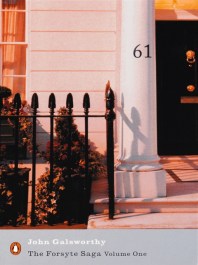
 In his introduction to the Oxford World’s Classics edition of The Forsyte Saga, Geoffrey Harvey explains that we owe the saga in its completed form to Galsworthy’s goddaughter, Dorothy Ivens. The Man of Property had been published in 1906 but Galsworthy’s attention had moved on. Then in 1918, he published Indian Summer of a Forsyte as part of a volume of stories; when Dorothy read it, she urged the author to “give us more Forsytes!” In Chancery followed, in 1920, then To Let in 1921.
 The relationship between these two forlorn souls is delicately drawn. It’s unusual but not improper: Jolyon wants nothing more than to be in Irene’s company, and she seems to understand and to take comfort herself in sharing what remains of the old man’s time, in making this interlude more beautiful for him:


 This is the world these “maidens” know, and also the one they are each, in their own ways, trying to leave, or perhaps (though they haven’t quite seen it this way yet) to change. Gardam limns their individual characters effectively, along with the other people in their lives: Una’s flighty hairdresser mother; Hetty’s kindly father, returned from the trenches “unscathed in body but shattered to bits in mind” and reduced to eking out a living as a gravedigger; Hetty’s pious, meddling mother; the kind and principled Quakers who took Lieselotte in but cannot wholly comprehend what it means to have her experience of the world. It is a differently eventful summer for each of the girls; little happens of immediately visible moment, but by the end of the novel you can feel them all settling into firmer forms, asserting more clearly who they are and will be.
 I didn’t like the crow. I understand that it is the central conceit of the novel; it’s an effective metaphor and clever, probably more than I appreciate, as a way of figuring grief as something that has a real presence, that plays tricks, that demands attention, that even, in its own way, connects you to your loss. I think I would have liked it in a poem. Here I found it a distraction–too clever, with its multiple modes of discourse and its allusiveness. Is grief really so literary? so metatextual?
 My edition of The Sympathizer includes as appendices a New York Times opinion piece by Viet Thanh Nguyen called “Our Vietnam War Never Ended” and an interview with him by Paul Tran called “Anger in the Asian American Novel.” I read both of these through before I read the novel (cautiously at first, ready to turn away if there seemed to be significant spoilers). I did this because I thought I might not recognize important features of the novel given my own limited knowledge of the Vietnam War, or of other representations of it. I have never, for example, read Graham Greene’s The Quiet American or Denis Johnson’s Tree of Smoke (both discussed in these articles); I have never seen Apocalypse Now, and though I’ve seen Platoon, I have no particular memory of it. Growing up in Canada, the Vietnam War was never a big part of my historical mythology except insofar as it featured largely in American history, particularly (in my own intellectual experience, anyway) in the form of anti-war protests and draft dodgers.
 Novel Readings