“Germany Had Awoken”: Sally Carson, Crooked Cross

Lexa, carried away by the thrill of it all, did not know that Helmy’s triumphant shout at the door–so spontaneous and joyful as it had been–was the signal for the upheaval of the country, for the disappearance of logic, individuality, of freedom itself.

She did not know, nor did Helmy, that the simple words he cried were to announce a spring not only of buds and warm winds but of violence, bloodshed, and foolhardy actions of stupidity which were to make the rest of Europe recoil from the friendship she had felt reviving in her for German.

Germany had awoken. Hitler had spoken. And Hitler was now the rightful spokesman and leader for German.
I’m always a bit skeptical about a book touted for the beauty of its sentences: that’s not what I read novels for, or at any rate, beautiful sentences are neither a necessary nor a sufficient condition for me to love or admire a novel. It matters a lot to me what the sentences say, what they are for! Sally Carson’s Crooked Cross is a good reminder to me that the opposite is also true: it isn’t enough for a novel to be earnestly, even passionately, in service of something important–especially if it’s something as obvious as “Nazis bad!” which is pretty much the level of subtlety I found on offer in Crooked Cross.

I mean, yes: Nazis are bad! And it’s not that I think we should stop telling stories about this. It’s odd how the badness of Nazis makes it hard to say “this book is bad,” though. I do kind of think it is, however. It’s just so obvious. It’s true that Crooked Cross was initially published when it would not have been so obvious, its stories not so predictable. The novel first appeared in 1934: in her preface to the new Persephone edition, Laura Freeman notes that the most astonishing thing about the novel and its two sequels is “how closely they follow events.” Readers today have read (and seen) a lot of stories about this period of history, and there is something startling about the raw immediacy of Carson’s account of the events of the short period from Christmas 1932 to the summer of 1933, which transform–deform–her small cast of characters. Those who join the Nazis are, she makes clear, being destroyed from within; those who oppose them and those who are their targets and victims are first ostracized, then persecuted, then either sent to the camps or murdered.

It seems wrong to say “OK, so?”–and to be fair to Carson, she does tell her story with enough finesse that even knowing its inevitable outcome, I felt some grim dread about how exactly those inevitabilities would play out. She also does a good job bringing out what Freeman identifies as the unheimlich qualities normal life takes on in an abnormal world. Even as the two eldest sons, Erich and Helmy, become increasingly complicit in Nazi ideology and atrocities and the daughter, Lexa, sees her fiancé Moritz, a Catholic, pay a higher and higher price for his Jewish surname, the Kluger family celebrates holidays, goes to dances, enjoys favourite meals, goes swimming at the local pool, and generally carries on like any ordinary family–at least until they, or Lexa, can’t keep it up any more. Lexa’s devotion to Moritz is initially sweet, innocent, naive–but as circumstances get harder, Lexa’s courage rises to match her outraged principles as well as her love. Their attempt to escape over the mountains into Austria is suspenseful and its outcome is unequivocally tragic, and also rendered with rare restraint by Carson.

If that sounds like the stuff of good fiction, it is! Too bad Crooked Cross is not. It’s leaden, plodding, heavy-handed. Does it just seem this way because we already know? Maybe–but in that case, it is also dated, right? Its interest is perhaps more documentary than literary.

I realize that someone who loves Mary Barton should be careful criticizing writers for being heavy-handed. I believe Gaskell is just a much better (more interesting, more artful, more stylish) writer than Carson. Your mileage may vary. I will quote a few bits of Crooked Cross that I flagged as both particularly lumpish and decently representative. First, here’s a bit that follows on from the excerpt I chose as my epigraph:

Now the Nazi Party with Hitler at its head and the bulk of the nation behind it could march to triumph. The stage was set for a fresh game; the press was silenced; ears were deafened to foreign voices of protest.

Like a gigantic operation the work of rejuvenating Germany began: a blindfold surgeon began to cut at her behind closed doors, chopping away everything he thought unfit, with no thought for her future life, her future vitality, with no idea that the horrible scars on her body would be noticed by her friends–never forgotten, probably.

No matter. There was to be a boycott of Jews beginning on April 1st; there were to be new passport regulations, fresh censorship on newspapers. There were to be murders.

The bursting accumulation of fanatic energy, held in leash so long, was to be let loose. It could no longer be controlled. Patriotism must run its course. All was open and free for it.

I don’t know, maybe that’s not so bad? But I do think it is not good. Why is it so hard to be sure? I have been wondering if I would be less judgmental about Carson’s prose if it were in translation from German: there’s something (to my ear) stilted about the cadence as well as overly insistent in the tone. Here’s another bit that strikes me as, again, not quite getting it right:

As the suspense which swept through the country was heightened into excitement there were more cases of bloodshed in strife between the parties. People like Helmy and his friend, Otto Streicher, performed their tasks with a fresh, hopeful energy. In quite homes like the Klugers [sic] it began to be difficult to ignore the political situation.

Open taunts to Jews and Communists were made, and there were isolated cases of people like Moritz who began to suffer while the days of doubt, hope, indecision, bravado drew January to a close. The country was like a person tossing in a frightened sleep, half conscious yet half unconscious of the nightmare into which, on awakening, it was to be so abruptly plunged.

For me, the worst parts where those where Carson was the most ambitious, moving from her characters’ situations and reactions out towards larger moral or even philosophical insights. Again, I am aware that a Victorianist, and especially a lover of George Eliot’s fiction, could be on shaky ground criticizing a novelist for doing this–but (for me) George Eliot’s philosophical commentary is never thin and reedy, like this:

[Lexa] did not realize that the blessing which appears in times of trouble–that of being only able and forcibly made to live in the present–made the extraordinary behaviour of life possible. She did not know that that is nature’s own anaesthesia; the mind and the heart–holding too much of the past, too pregnant for the future, as external pressure of circumstance increases–gradually reach a point of satiety. Events of the past slip quickly as into a life unknown, become a part almost of a previous existence; the future no longer holds fears and doubts; it is for the moment non-existent. [It goes on like this for two more paragraphs.]

Again, I wonder: how easy is it, to make the case that this is bad writing? Maybe it is more convincing for you! Also, I think it makes a difference pulling these clips out of context. It was not any one moment, any single clunky passage, that made me conclude Crooked Cross was a badly written book. It was the whole reading experience, which left me thinking maybe it was a “lost” book for good reason. A few years back, writing about some re-published novels by Rosalind Brackenbury, I asked

what, besides nostalgia, makes a good but not great novel from a century ago more appealing than an equally middling one from this year? More generally, what qualities make the difference between a lost classic – a work that resists or subverts standard assumptions about literary value – and a period piece whose interest is primarily as an artefact of literary history?

Decently readable though it is, Crooked Cross seems to me an example of the latter, an artefact, perhaps worth recovering for the interest of seeing what could be said about the badness of Nazis and the horrors they wrought as early as 1934, but not standing out as a novel of real literary value, in spite of those currently hailing it as a recovered masterpiece. We have better books to read about its topic: novels like Hans Fallada’s Every Man Dies Alone, or extraordinary works of non-fiction like Daniel Mendelsohn’s The Lost. Sorry, Persephone: once again I think there may be something to the concept of the “Whipple line”–even though it seems somehow rude or even faintly unethical to invoke that for a book on a subject that matters so deeply.
Taking the Plunge: Daphne du Maurier, Mary Anne

“I’ve taken the plunge,” she thought, “and there’s no returning. I’m out for what I can get, and I’ll see that I get it. I’ll pay back in kind, I won’t cheat, I won’t be dishonest. No one will claim I haven’t earned my money. Value given for value received. It’s one trade like another, the butcher, the baker, the candlestick maker. We’ve all got to live.”
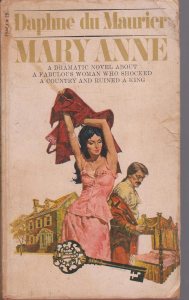
Mary Anne is the fictionalized story of Daphne du Maurier’s great-great-grandmother, Mary Anne Clarke. It is quite the rags to riches to (near) rags again saga. Mary Anne is born into poverty and clambers up the social ladder with the tenacity of Becky Sharp. She is conscious from an early age of the disparity of power between men and women and she uses charm, subterfuge, threats, manipulation, bribery, seduction—basically, every trick she has!—to get what she wants, which is not so much money as security, for herself and her family. She loves luxury, she loves power, but at every turn she learns how fast she can lose her grip on both. Like Becky, she never stops, and also stops at nothing, fighting to keep them. Many powerful men enlist her in their own schemes, but they usually betray the promises they make her; it’s hard to feel any pity for them when they find themselves, in turn, exposed or betrayed for Mary Anne’s own purposes.

The pinnacle of Becky’s career is her presentation to the Prince Regent. Mary Anne goes one better, becoming the mistress of his brother Frederick, Duke of York. The chief engine of the plot from this point on is her participation in a scheme to profit through his influence over military appointments and promotions. This eventually becomes a huge public scandal, with hearings in the House of Commons; Frederick eventually is driven to resign his position as Commander in Chief. By this time he has severed his connection with Mary Anne, who gets her revenge by being the chief witness against him; she goes on to publish pamphlets and memoirs, which I assume were key primary sources for du Maurier’s novel (I would like to know how many of the letters and speeches in them come directly from contemporary materials).

Mary Anne has little of the lush atmospheric writing of Jamaica Inn or Frenchman’s Creek, or the delicious suspense of My Cousin Rachel or Rebecca. It has its own energy, though: like its protagonist, it just keeps moving forward, restlessly, relentlessly, on to the next thing, and the next, and the next. Mary Anne’s father lets the family down; she picks up the work. Mary Anne’s husband turns out to be a weak drunken fool; she figures out how to support the family. When there seem to be no better options, she “takes the plunge” and becomes a courtesan; when the opportunity arises, she wins the Duke’s favour and works tirelessly to keep it, even though the allowance he gives her is not enough to meet his expectations and (again like Becky) she looks to be winning the game even as she is getting deeper and deeper into debt. When her royal “protector” cuts her off, she just keeps going. She is not particularly likeable and she’s certainly not admirable, but I couldn’t help rooting for her. All those men, for one thing: they just use her and lie to her and break their promises and go home to their wives and then sit in judgment on her.

Mary Anne isn’t just plot points, though: there are passages that definitely have that du Maurier flare. Here’s her description of the back streets of London where Mary Anne grows up, for example:

The streets were mentor and playground, teacher and companion. Rascals picked pockets on the streets, beggars were given alms, goods were bought, rubbish was sold, men laughed, men cursed, women whined, women smiled, children died under wheels. Some men and women wore fine clothes, some wore rags. The first ate well, and the others starved. The way to avoid rags and starvation was to watch, to wait, to pick up the coin dropped on the pavement before anyone else, to run swiftly, to conceal quickly, to smile at the right moment, to hide at the next, to keep what you had, to look after your own. The thing to remember was not to grow up like her mother, who was weak, who had no resistance, who was lost in this world of London that was alien to her, and whose only consolation was to talk of the past, when she had known better days.

Right there we can see the lessons Mary Anne remembered for the rest of her life and her determination to do whatever she can not to be weak, which means having money: “Not money to pinch,” as she later reflects, “but money to spend.”

And here she is at the end of her own “better days,” bathed in the pathos of someone who has played and lost, but still too game to be pathetic:
I remember . . . Then she’d stop herself. The young are bored with reminiscences. Who minded whether dandies in Vauxhall had stood on tip-toe once to watch her pass? What did it matter if a gaping crowd had climbed her carriage-wheels in Palace Yard? Or that she’d queened it in the House of Commons, the only woman in that world of men? . . . But sometimes, in the night, and no one with her, a strange nostalgic yearning came for the past; and baffled by the silence, oddly lonely, a church clock in Boulogne chiming the hour, she thought, “There’s no one left who gives a damn. The world I knew has gone. This is tomorrow.”

That’s splendid stuff.

“The Rest is Chaff”: Jo Harkin, ‘The Pretender’

Has his kindness gone? Maybe. Each of his selves took something from him as it fell away. He left his confidence on the farm with John Collan. His innocence drowned on the floor of the house in Oxford, as Lambert Simons covered his eyes. His happiness is still locked in Edward, Earl of Warwick’s bedchamber in Dublin. When Simnel quits here, his goodness and his faith will be left in one of Henry’s strongboxes.

What has he got now? His hatred, and his love. That’s all he needs. The rest is chaff. Like Joan said, he’s better off without it. He should have brushed it off sooner.

I’ve never read a Ricardian novel quite like The Pretender. That’s saying a lot, considering I’ve read quite a number of them: there was a time when any Richard III-related fiction was irresistible to me. (I wrote about this preoccupation of mine long ago in Open Letters Monthly and had just so much fun revisiting and rethinking some of my favourites.)

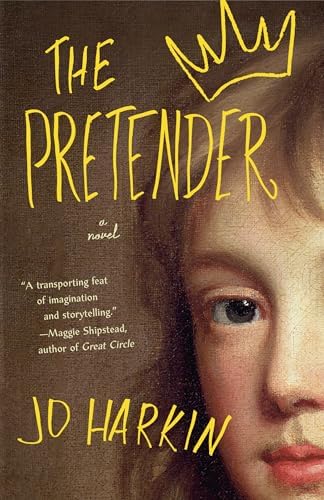
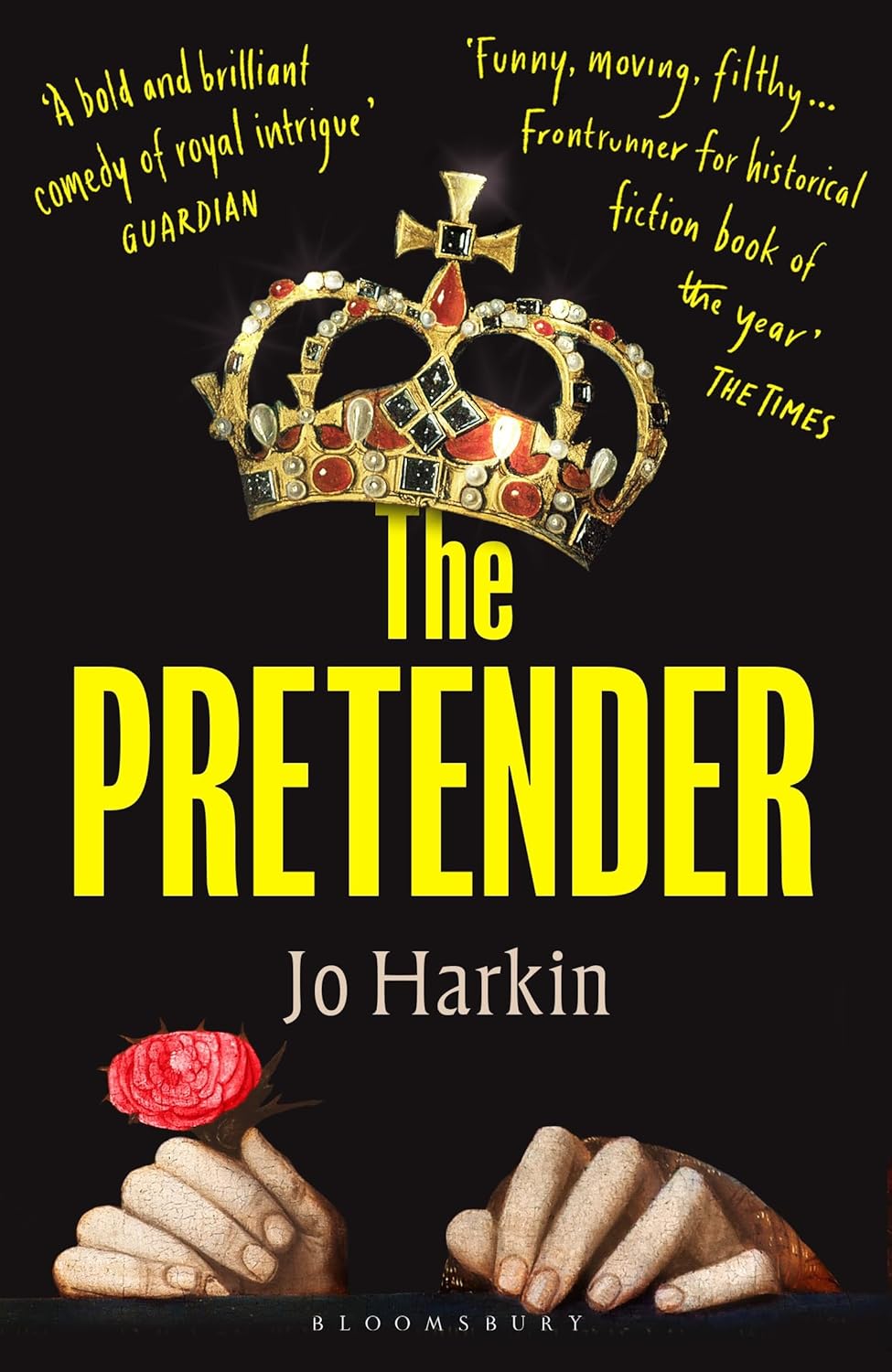
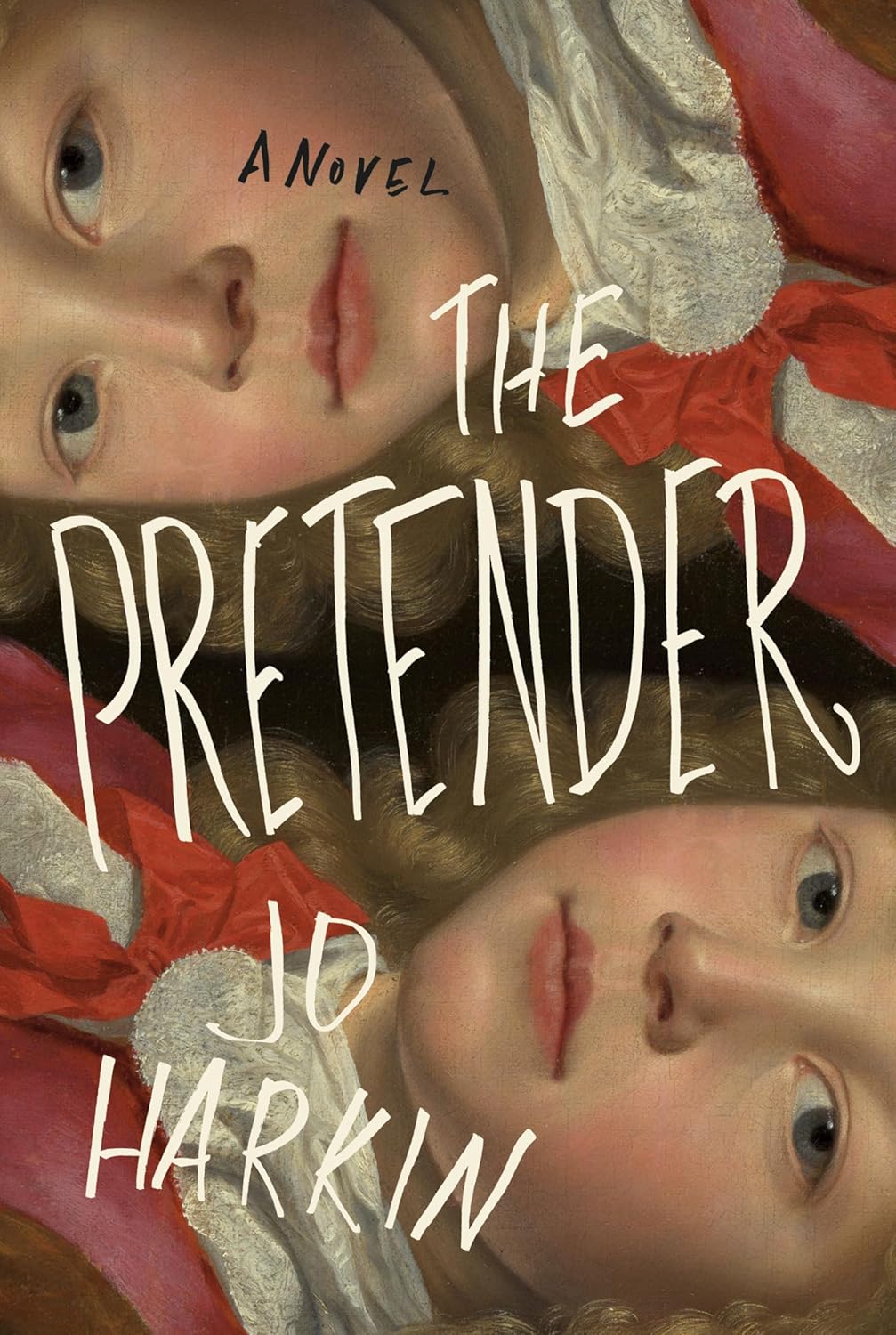
The Pretender isn’t exactly ‘Ricardian’: it’s more accurate to call it ‘Ricardian-adjacent.’ It includes the York and Lancaster family trees I used to be able to reproduce handily on my own without looking them up, but its protagonist is at most a peripheral character in the story of Richard himself. Harkin has chosen Lambert Simnel as her focus, one of the young fellows put forward after Richard’s death claiming to be a lost Yorkist heir: Perkin Warbeck, for instance, purported to be Richard, Duke of York, younger son of Edward IV and one of the two famously vanished ‘Princes in the Tower.’ Lambert Simnel claimed to be Edward, son of George, Duke of Clarence (the ‘drowned in a vat of malmsey’ one)–nephew to Edward IV and Richard III. Both were figureheads for rebellions against Henry VII; Perkin Warbeck was executed, but Lambert Simnel was pardoned and put into service in Henry’s household. Wikipedia helpfully notes “almost no information about his later life is known.”

I’m not sure if it is a spoiler to say that Harkin leaves the question of whether Simnel was or was not actually Clarence’s son unresolved. She opens when the boy who would end up a claimant to the English throne is living an unremarkable life as John Collan, the son of an inexplicably prosperous farmer whose wealth turns out to be due to the service he is doing for the mysterious nobles who show up one day to turn John into ‘Lambert Simons.’ This temporary alias is to shield him from notice or scrutiny while the tutor they have appointed, Richard Simons, polishes him up, a process the boy enjoys only because it broadens the scope of books he can read.

Each section of the book follows him through a new phase as he is groomed and trained and readied for the ultimately unsuccessful rebellion in his name, and then becomes (in Harkin’s version of his life story) not just a servant but a spy for Henry, sussing out treasonous activity, including among those who at least claim to still be working for his own ultimate victory. Why, you might wonder, would a Yorkist serve Henry’s interests in this way? Since much of the fun of The Pretender lies in the convolutions of the plot, including lies, deceptions, betrayals, and revelations, all I’ll say is that like Arya in Game of Thrones, by the time this is John / Edward / Lambert / Simnel’s life, he has a long list of people on whom he would like to take his revenge.

When I say I have not read a book quite like this one before, it’s the style I mean more than the story. Harkin might not appreciate this characterization but one way I found myself thinking about her style, or at least her style here, is ‘Wolf Hall Lite.’ It is in present tense and also in close third person, much like Mantel’s brilliant series. It also adopts an archaic style, especially in the dialogue, though never to the point that Mantel herself warned writers away from–or at any rate it did not put me off, or seem overly mannered. Here’s a small sample from near the beginning that shows how she uses medieval (or pseudo-medieval) words or idioms:

The future, though bright, is also a little frightening. It’s an inquieting thing to pass out of the bounds of the farm, out of sight of the waving Emma and his father. The men beside him terrify him. Even his horse is intimidating, as beautiful as it is. Its hooves are oiled; its mane traps the light in tiny pieces. The only reason it hasn’t bucked John’s grubby body off its elegant back is because it’s too gentil.

One word she uses a lot is “maugre,” meaning something like “ill will” or “quarrel,” as in “he had no maugre with Philip” (looking it up, I see dictionaries trace it to “Old French” and define it as “bad pleasure”). I was able to enjoy this strategy for evoking a long-ago idiom because there is also a lot of crisp, effective, highly evocative writing and the novel as a whole moves briskly along. It’s a violent time and death is often both sudden and arbitrary (as Simnel learns, grimly, early on). Here’s another small sample, from when the army raised in his name is marching towards battle:

The atmosphere is different with no women around. The boozing is harder and wilder. The japes are crueler. Edward sometimes sees common women leaving tents at dawn. Sometimes the women are weeping. When the men aren’t singing ballads and playing dice games, they’re arguing, or fighting. He passes an affray: shouting, pushing, then–unexpectedly–one man sticking his halberd into the other man’s throat. The body is carried away. Then the men go back to the dice, and Edward to let out his shocked tears in his tent.

There’s a metallic tang in the air; he can feel it. Like swords being sharpened.

Like coming war.

That note about his “shocked tears” reminds us that he is still only a boy (he’s fourteen at this point), and also that he was not raised to be a soldier, that he is–initially at least–loving, imaginative, vulnerable. Until late in the novel, none of what is happening to him is by his own choice, or under his control, even when he thinks it is (something else he keeps grimly learning). The family he thought was his turns out (or so he’s told) not to be; his new caretakers are ruthless; his partisans are manipulative and self-interested; those he fears and those he loves prove equally untrustworthy. So there’s an underlying poignancy to this adventure tale. History tells us he fails, labels him a “pretender,” lets him vanish into obscurity, but Harkin makes us root for him, not least because he is himself self-conscious about his likely narrative fate:

[L]ater, when Simnel’s with Beatrice, he returns to his maugre against history.

We might know the truth,’ he says. ‘But in a few hundred years, Richard will be a hunchback and I’ll be a scoundrel. Those people won’t know anything else.’

‘Write your own history, then,’ she says.

‘I’d be writing my own head onto the block.’

It is sad but not surprising that he becomes hard, cynical, even murderous himself: so many people “have lied to him, goaded him, gulled him, terrified him, confused him,” and also taken away “anyone ever loved or might have loved–and left him alone, more alone than anyone, because they even parted him from his own self.”

It sounds great, right? So why did I call it “Wolf Hall Lite”? I don’t mean that The Pretender is a cheap imitation or a knock-off, just that Mantel’s books have a darkness to them that The Pretender does not, while Harkin’s has more humour than Mantel’s. The Pretender is perhaps more easily entertaining, but it’s also less engrossing. Nothing in The Pretender thrilled me the way parts of Bring Up the Bodies did. That said, like Wolf Hall when I first read it, The Pretender surprised me, in a good way. It is nothing like the pedestrian or formulaic historical fiction that can give the genre a bad name. It felt adventurous to me as writing, and it tells a lively and complex story. Would it be too complex for someone who had never heard of the Duke of Clarence or the Duke of Buckingham or Stanley or Lovell or Elizabeth Woodville before? Impossible for me to know!