There is more to life than great chess. Okay, great chess is still a part of life, and it can be a very big part, very intense, satisfying, and pleasant to dwell on in the mind’s eye: but nonetheless, life contains many things. Life itself, he thinks, every moment of life, is as precious and beautiful as any game of chess every played, if only you knew how to live.
It’s a real challenge—one that I’m sure Sally Rooney is more aware of than anyone—to read a novel by Sally Rooney without being distracted by the Sally Rooney phenomenon. That seems hardly fair to Rooney, who doesn’t seem like a writer who set out to be a phenomenon, to be taken up as some kind of representative or generation-defining voice. At the same time, it doesn’t seem right to feel sorry for someone because of their success! But there’s a kind of haze or buzz around her books that strikes me as similar (if obviously on a smaller scale) to the hype around every new album Taylor Swift puts out. A lot of people seem to be responding to how they feel about what they think about the phenomenon, rather than to the new work in front of them. How does an artist keep creating, with that kind of spotlight on them, never mind keep trying new things? And yet both of these women somehow do just that.
I am neither a Rooney-ite or a Rooney hater. As I’ve written about here before, I didn’t finish Conversations with Friends and I had a mixed experience with Normal People; but then I really liked and admired Beautiful World, Where Are You, which was enough to make me want to read Intermezzo when it came out. I have started it a couple of times in the past year, but the reason I’m only just posting about it now is that each of those times I had to put it aside: for all my determination not to practice “avoidance” in my reading because of Owen’s death, the character of Ivan made me think of my brilliant, loving, socially awkward chess-playing son too much, too intensely. This time I persisted, and now that I’ve read the whole book I see Ivan as being quite different from Owen; for one thing, Ivan is what we might call ideologically problematic (one reviewer described him as an “incel,” which I did not pick up on and which seems unduly extreme, though perhaps I missed some signals or clues), whereas Owen was very far left, very passionately (if ultimately pessimistically) progressive. Even so, following Ivan’s story, which turns out to be very tender, uneasily and then eventually unapologetically romantic, made me so sad for the hopes and the chances for happiness Owen had and lost.
It’s Ivan’s older brother Peter who, under a gloss of charisma and professional success, is actually finding it hard to keep himself alive. I didn’t like the style of the Peter parts: if you’ve read the novel, you will know that Rooney alternates between a fairly conventional narrative close third person for Ivan’s sections and something like stream of consciousness for Peter’s. I didn’t dislike this as much as the reviewer in the TLS, who really hated Intermezzo—although it’s her review, which I reread after I’d read the novel for myself, that prompted my initial musings here about how people see Rooney. I have no objection to a negative review, and I can’t rebut any of Manov’s specific descriptions or criticisms, but the tone of her review is really hostile. From the outset, it reads more like an attack on the Rooney phenomenon than a critique of Intermezzo:
As in Sally Rooney’s previous novels, the main characters in Intermezzofall in love quickly, tidily and passionately. They meet, their outfits are described, they exchange clipped dialogue and are soon free to engage in ever so slightly masochistic (but mutually satisfying) sex, climaxing in perfectly symmetrical and somewhat juvenile confessions of affection. This is a pretty little world in which the girls wear lots of nice skirts and the boys are real softies and the worst thing that can reasonably happen is that it gets rainy in Ireland, as it tends to do at sad moments.
Then, later on:
Intermezzo is being trumpeted by the publishers as Rooney’s Great Leap Forward, and I suppose it will be seen as some sort of accomplishment that she writes about characters who are not literature students at, or graduates of, Trinity College.
OK, but why shouldn’t she write about characters like that? She isn’t the only novelist in the world, after all; she doesn’t have any obligation to cover the whole range of society in her novels. Can’t she write about what interests her? It’s a separate question how interesting we find it, or how well she does it. (Also, isn’t “write what you know” standard MFA advice? I don’t much like it, as it means constantly risking solipsism, which seems to be Manov’s chief grip about Rooney—but at the same time, writers can also get slapped around these days for venturing to write about people too much unlike themselves.)
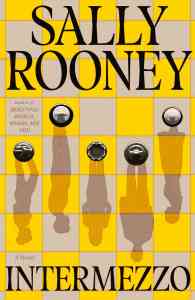 Like Rooney’s other novels Intermezzo takes people’s intimacies and relationships and feelings very seriously. It is a novel on a small scale, about two brothers muddling through some deeply felt but inadequately processed grief for their recently dead father while also muddling through their romantic entanglements, Ivan with an older woman, Margaret; Peter with a younger woman, Naomi, as well as his ex-fiancee Sylvia. I wasn’t always interested enough in Peter to care about his struggles, though that might have been the fault of the awkward style of his sections (Manov: “more Yoda than Joyce”—ouch!), or maybe it was due to my own greater sympathy, just instinctively, for Ivan’s story. Compared to Beautiful World, Intermezzo seemed less expansive, not in length but in reach. It didn’t convince me that the problems of these particular little people amounted to more than a hill of beans—and yet something felt true about its preoccupation with their problems, which really just reflects their own preoccupation with their own problems. We do, mostly, live like that, right? Even those of us who in some sense are committed to “the life of the mind” spend most of our time immersed in the petty and personal.
Not much actually happens in Intermezzo. The biggest “event” of the novel is a quarrel between the brothers; it gets physically rough, but the serious violence is emotional. Ivan and Peter’s relationship is the most important one in the novel, although somehow it didn’t feel that way to me until nearly at the end, when I discovered I was more emotionally invested in their potential for understanding or reconciliation than I expected. I found the final section quite moving, so something about the novel was working for me.
I feel as if I’m not actually saying much about Intermezzo. I’m ambivalent about it: it didn’t enthralled me, but I was consistently interested in it, and that’s not nothing. I also liked that it did something different than Rooney’s other novels, that she was continuing to experiment stylistically as well as thematically. I thought it was pretty astute about grieving, too. Ivan starts to worry that his memories of his father will fade: “Sometimes,” he laments to Margaret,
an hour will go by and he won’t even come into my head. The honest truth. The hour is gone before I even think about him.
But that’s normal, she says. When someone you love is still alive, you don’t think about that person every hour of the day either.
Because a living person has their own reality, he says. The person who’s gone has no reality anymore, except in thoughts. And once they are gone from thoughts, they actually are completely gone. If I don’t think about him, literally, I’m ending his existence.
I understand Ivan’s fear: remembering is hard, but forgetting would be worse, which I suppose means it’s a good thing, even though it made me so sad, that Owen was so much in my thoughts as I was reading.
 Novel Readings
Not sure I’ll ever try one of her books (the fact my teenaged daughter reads her is a hint to me that she may not be to my tastes), but you’re right that she does seem to be judged more on perceptions than actual content…
LikeLike
My daughter (who is 22) also loves Sally Rooney 🙂
I read her first two books and do remember enjoying them but not being enthralled as you say, a nice distinction.
Your review does make me want to read this one too. So I may borrow my daughter’s copy.
LikeLiked by 1 person
I had never read a Sally Rooney novel and saw her books in the library just before Christmas and decided I would try this one. I persevered despite the first 100 pages being somewhat tiresome and repetitive, with all the awkward sex scenes, but the longer I read the more intrigued I became with it as a psychological examination of a significant turning point in the relationship between two brothers, marked by their upbringing, their mother’s decisions and manner, now navigating the grief process and their own intimate, messy relationships.
It seemed like the timeframe of the novel was a snapshot of grief and an arc of – how can these two brothers step up and out of their current relationship with each other, will it lead to estrangement or support. And they do through the challenge of their romantic or intimate relationships, thats what provides the growth points. And they do it in very different ways, because they are very different characters.
At first I didn’t get the clipped style used with Peter, until I went back and reviewed it and realised how opposite it was to Ivan. Peter who locked horns with his mother, both trying to assert dominance, the now practiced lawyer, schooled in the art of winning an argument, of using language that withholds, that aims to win and Ivan, the chess player, used to meandering in his mind, exploring options, checking, verifying, self conscious and awkwardly but touchingly able to express his feelings, if somewhat long winded.
But through the relationship with Margaret he grows and gains in confidence and she can not deny the peaceful effect he has on her, her troubles are of her own (and society’s) making, can she sit with that discomfort? It reminded me of Winterson’s title ‘why be happy when you can be normal’, that tendency people have to choose unhappiness and supposed normalcy over growth and happiness.
I thought it was well done, eventually – to take characters you know readers are likely to judge and then carry them through this process, put them in these situations and make the reader see them grow and maybe change a few perspectives along the way, as the character of Margaret realises, when she comes to terms with her own projections.
LikeLike
Thanks for this thoughtful analysis, Claire!
LikeLiked by 1 person
It was top of mind since I just wrote my own review. 🙂
LikeLike
Thank you for this thoughtful review. This book has been on my list for a while. Loved your comparison of Rooney hype to Taylor Swift. And funnily enough, I loved Normal People but did not find Beautiful World Where Are You to be that gripping (although the title of the novel is just so perfect).
LikeLike