You must have a plum. Or three. Only they’re so ripe some of them burst when you pick them. Ripeness is all, I said. Men must endure their going hence even as their coming hither. I’d managed to get it into my Oxford entrance exam, my idea that Lear is a darker play than Hamlet. Readiness is all, Hamlet says, and readiness is voluntary, an act of will, where Lear’s ripeness happens to us as to plums and pears, regardless of agency or volition.
I had hoped to do a “proper” review of Ripeness but it didn’t work out. (Honestly, you’d think some editor might have thought of me for it, instead of my having to scout for a venue, given that I have not just read all of but also reviewed several of her books, including Ghost Wall for the TLS – which, sort of ironically, is why there was no chance I’d be reviewing Ripeness for them, as they have a policy that you can’t return to an author you’ve already reviewed, which means no more Sarah Perry or Emma Donoghue or Jo Baker for me there either, sadly.) Of course, I wanted to read it anyway, as Moss is one of my favourite contemporary writers. And I admit: alongside my peevishness about the non-review I now feel a bit of relief, because I think it would have been challenging to think through what to say about it in the kind of tight, unified way a “proper” review requires.
 I don’t mean it would have been hard to express an opinion about its merits. I would not say I loved the novel, but I have never read anything by Moss that isn’t both meticulously crafted and convincingly intelligent. Every book of hers has left me appreciating the undercurrent of ideas in it, the sense throughout that something interesting is at stake. The same is true with Ripeness, on both counts, and in addition I think there is more lushness in her prose this time than in either Ghost Wall or Summerwater, both of which left me wishing she would return to the more expansive scope of her 19th-century series.
This is at least in part because half of Ripeness takes place in a villa in the Italian countryside, which for Edith, narrating her youthful experience there, offers many contrasts with her staid, bookish life back home. A sample:
Lucia set me on the path leading across her meadow. It was full of flowers I couldn’t name and grazed by small pale cows with dramatic eyelashes who watched me with mild curiosity. The day was warmer now, but still I caught the seasons turn on the air like Maman’s perfume after she had left a room. As the path rose, I looked straight over the lake to the more serious peaks on the other side, where patches of snow lay between rocks and clouds tangled around cliffs. I had never in my life been so high up, never seen water from so far away. I stopped to listen: wind, birds, faint goat bells. I could tell where there were boats on the lake from the lines their wakes and the folding of the water, traces, trails, passage.
On, up, until there was nothing behind the hill rising in front of me, until I came out on the top and could see in every direction, across a sea of summits, over the other lake into Switzerland, hill calling to hill, a new country at altitude. I turned slowly, delighted to be me, delighted to be there in that hour. I found a rock and sat on it, turned to the call of a bird and saw some great hawk, something that could have been an eagle, turning and passing below me. To see from above a bird in flight, to see the sunlight on its dappled back, to see the spread of its wings above the earth!
Is it just me, or is there a clear echo there of Hopkins, both the “dappled things” of “Pied Beauty” and the sigh of “ah, bright wings!” that so movingly concludes “God’s Grandeur”? There are several more explicit allusions to Victorian texts in Ripeness (including to Middlemarch), so this doesn’t seem like a stretch.
 Edith is in Italy to help out her sister Lydia, who is in a kind of moral as well as literal exile because she is unmarried and pregnant and it’s the 1960s. Their mother has made “arrangements”: when the child is born, the nuns will spirit it away and pass it on to its new family. Lydia is fine with this: the pregnancy is not just unwanted and awkward but the result of an assault, and all she wants is to be done with it and return to her life as a ballerina. She and Edith are not close and are not drawn closer by this interlude. When it is done, she returns to her dancing; it is Edith who is haunted by the baby she cared for when Lydia would not, and who writes her account of those strange months “for Lydia’s son to find if he comes looking.”
That (though we don’t know it at first) is the premise of the chapters of the novel that are narrated in first-person by Edith, in retrospect. These chapters alternate with chapters in close third-person, following Edith decades later, divorced, retired, living in Ireland now, enjoying her lover Gunter and her friendships. One thread in this section is an uncomfortable encounter she has with her good friend Méabh, who she happens upon protesting outside a hotel that has been designated as housing for African immigrants—”it’s not right,” she explains to Edith, “there’s been no consultation,” it’s not like the Ukrainians, “we all understood that,” and though “Edith knows her lines” and says what she can to counter Méabh’s bad faith justifications for this public display of bigotry, she’s left “shaky, nauseous.” “Can she still be friends,” she wonders, “with someone who thinks the problem is refugees?”
The answer, it turns out, is yes, and other main plot element in this later timeline also turns on Méabh, who is contacted unexpectedly by a man who has discovered by way of DNA testing that he is her brother, given away by her mother for adoption long before she became Méabh’s mother. He wants to come to Ireland, to meet her and see the place he is from, to reclaim his Irish identity, though what right he has to it is the subject of some pithy comments.
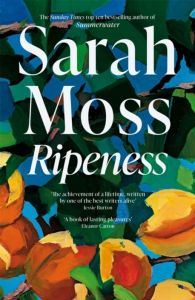 If I were properly reviewing, I would reread the novel until I could explain better how the parts hang together. Big words like “belonging” or “identity” feel relevant but also too general. Lydia and Edith’s mother was herself a refugee, sent away from France just in time to save her from the fate the rest of her Jewish family met. She thought often of her own mother and sister, who were put on trains and then put to death. Whose claims to refuge are met with kindness and whose with protest? Who has the right to say that they are “from” anywhere? What does it mean to be separated from your family, by violence or by the kind of cold pragmatism that removes tiny Gabriel (named by Edith, as Lydia refuses to care, or at any rate to acknowledge her care, for him) and sends him off to strangers? But then, as Méabh’s new-found brother’s story highlights, how much does it matter where you were born, or to whom, if that has never been your home and they have never been your family?
Edith herself does not idealize or romanticize family or motherhood. If anything, what she witnesses of Lydia’s childbearing and birthing alienates her from the whole process. Looking through the book that has been her only guide to what to expect and do, she is put off by its critical tone towards women who “might take childbirth as an excuse to rest and slack off the housework”:
It was the first time I thought that I would not have children, that I would rather go to my grave without the blood-wrestling of birth and the appalling responsibility of infant care . . . [and] I’m not sure I was wrong. I have not been good at motherhood, certainly not in the Irish fashion. I was not a good wife. I did the correct things, mostly, but I did not give myself. I did not merge myself with my son, there was no abnegation.
“I remained,” she reflects, “more of a narrator than a participant. Self-centred to the end, you might be thinking. I am. I narrate.”
I would say, though, that Edith’s narration does not show her as self-centred, even if she is “the main character,” even if, as she proposes, “the scratches in the mirror centre around the candle of my version” (see, Middlemarch!). Maybe the Edith who leaves her account for Gabriel (“To be opened after my death“) is a construct—all narrators are, but also, all of us are, in some sense, right?—but the tenderness she shows to her sister’s unwanted baby hums through that account, which conveys with both delicacy and poignancy the astonishing fact of a new person coming into being, having needs, having hungers, having them met or not. The older Edith of the other chapters is not particularly warm, but she’s always thinking things through. She has that in common with her author, and that makes her good fictional company.
The title is obviously a clue to how to read Ripeness, to how to make sense of it as a whole (how many times have I said that to my students, that novels teach us how to read them, an enterprise that begins with their titles?). I found Edith’s comparison between ripeness and readiness thought-provoking, but I can’t quite figure out how it organizes the novel’s different elements. Lydia was ripe but not ready, I suppose, but it’s Edith’s novel, isn’t it? I don’t mind that I’m left with questions, with things to think about myself.
 Novel Readings