“The Shadow of Some Kind of Form”: Woolf on her Diary

In my previous post I wondered whether we knew what Woolf’s wishes were for her diary: whether she imagined it as something others would someday read, or thought of it as—and hoped it would remain—a private space. How might these different ideas about what she was writing, or who she was writing for, have affected what she wrote? With these questions still lingering as I read on yesterday, I reached an entry that explicitly addresses what keeping a diary meant to her and what her aspirations were for it, particularly for herself as a writer. It’s a longish passage but I’m going to copy the whole of it here, because I find every bit of it so interesting. It’s part of her entry for Sunday 20 April, 1919.

In the idleness which succeeds any long article, & Defoe is the 2nd leader this month, I got out this diary, & read as one always does read one’s own writing, with a kind of guilty intensity. I confess that the rough & random style of it, often so ungrammatical, & crying for a word altered, afflicted me somewhat. I am trying to tell whichever self it is that reads this hereafter that I can write very much better; & take no time over this; & forbid her to let the eye of man behold it. And now I may add my little compliment to the effect that it has a slapdash & vigour, & sometimes hits an unexpected bulls eye. But what is more to the point is my belief that the habit of writing thus for my own eye only is good practise. It loosens the ligaments. Never mind the misses & the stumbles. Going at such a pace as I do I must make the most direct & instant shots at my object, & thus have to lay hands on words, choose them, & shoot them with no more pause than is needed to put my pen in the ink. I believe that during the past year I can trace some increase of ease in my professional writing which I attribute to my casual half hours after tea. Moreover there looms ahead of me the shadow of some kind of form which a diary might attain to. I might in the course of time learn what it is that one can make of this loose, drifting material of life; finding another use for it than the use I put it to, so much more consciously & scrupulously, in fiction. What sort of diary should I like mine to be? Something loose knit, & yet not slovenly, so elastic that it will embrace any thing, solemn, slight or beautiful that comes into my mind. I should like it to resemble some deep old desk, or capacious hold-all, in which one flings a mass of odds & ends without looking them through. I should like to come back, after a year or two, & find that the collection had sorted itself & refined itself & coalesced, as such deposits so mysteriously do, into a mould transparent enough to reflect the light of our live, & yet steady, tranquil composed with the aloofness of a work of art. The main requisite, I think on re-reading my old volumes, is not to play the part of censor, but to write as the mood comes or of anything whatever; since I was curious to find how I went for things put in haphazard, & found the significance to lie where I never saw it at the time. But looseness quickly becomes slovenly. A little effort is needed to face a character or an incident which needs to be recorded. Nor can one let the pen write without guidance; for fear of becoming slack & untidy like Vernon Lee. Her ligaments are too loose for my taste.

“But to return to live,” she then says, “albeit with something of an effort,” and back she goes to writing the diary instead of reflecting on it.

What a lot of “significance” there is in these ruminations! Of course I noticed the comments about writing just for her own eye, nobody else’s, which seem crucially linked to the insight that for the process to work, she must not censor herself. Probably all writers know she is right that writing often, however seemingly loosely, does lead to an “increase in ease” for the writing we have to do: I have not personally gotten into ‘morning pages,’ but they seem a good example of this theory put into practice—for me, this blog loosens my ligaments, without, I hope, seeming “slovenly”! Her desire to express the “loose, drifting material of life,” to find a kind of transparency in prose that allows form and meaning to emerge unexpectedly, anticipates the ways her fiction would develop over the next twenty years; “steady, tranquil composed with the aloofness of a work of art” is a beautiful description of the somewhat abstract aesthetic of To the Lighthouse, say. It’s clear that she sees the diary form as permissive in a way that even then she would not accept for her fiction, but that the freedom she wanted in writing less “consciously & scrupulously” feels to her like essential preparation for the work to come. As we ourselves read her diaries, invading the privacy she did seem to want, perhaps we can also think of ourselves as opening that “capacious hold-all” and proving through our own fascination that, as she had hoped, the “mass of odds & ends” she threw into it have coalesced and refined into something new and wonderful.

As I keep reading, I will be thinking especially about the challenge she set for herself of being loose and elastic without becoming “slack & untidy,” and also watching for more such self-conscious reflections on the process of keeping the diary. Does the “shadow of some kind of form” become more fixed in her mind or her practice? Or does the looseness she values depend on that form always being somehow elusive, so that the result never becomes routine or formulaic?
“I cant fill up the lost days”: 1918

Woolf misses just five days in her diaries, skipping from 4 July 1918 to 9 July, and feels bad enough about it to mention them apologetically as “lost”: here I am catching up after weeks of not reporting on my reading of her diaries, and not only have a couple of months gone by in my world but I’ve read right through a whole year’s worth of entries and more, into March 1919.

It’s not that she writes up nothing of interest in her 1918 entries. There are the moments that remind you that there’s a whole history unfolding, making dents over and over in the surface of her life: “Rain for the first time for weeks today, & a funeral next door; dead of influenza,” she writes on July 10.  There are the offhand comments that remind us (as if we needed it!) that she was a book lover as well as a book writer: “I spent 7/ on books this afternoon,” she notes on March  11, and follows it with an account of her finds along Charing Cross Road. “I was amused to find that the lust after books revives with the least encouragement,” she wryly observes, but “after all, nothing gives back more for one’s money than a beautiful book.”

In August she is losing track of her days, as who doesn’t, in the languor of high summer in the countryside: “I had to look carefully before I wrote Saturday.” Her idleness does not affect her ability to capture what she sees with a few deft phrase, even as she denies her ability to “get it right”:

 If I weren’t too lazy I think I should try to describe the country; but then I shouldn’t get it right. I shouldn’t bring back to my own eyes the look of all those old beautiful worn carpets which are spread over the lower slopes of the hills; nor should I convey the look of clouded emerald which the downs wear, the semi-transparent look, as the sun & shadows change, & the green becomes now vivid now opaque.

I love that.

Even more, I love her comments on her reading, which during this period includes Christina Rossetti:

Christina has the great distinction of being a born poet, as she seems to have known very well herself. But if I were bringing a case against God she is one of the first witnesses I should call. It is melancholy reading. First she starved herself of love, which meant also life; then of poetry in deference to what she thought her religion demanded.

Rossetti’s Christianity, Woolf suggests, led her to “starve into austere emaciation, a very fine original gift . . . She has the natural singing power. She thinks too. She has fancy.” Like her more polished criticism, these glancing remarks provoke rather than pronounce. She’s also reading and loving Byron, in spite of the “extreme badness” of his his poetry. In September she is reading Paradise Lost, with great admiration and excitement (“how smooth, strong & elaborate it all is! What poetry!”) but not without reservations (“Has any great poem ever let in so little light upon ones own joys & sorrows?”). She has some harsh things to say about Katherine Mansfield: after reading “Bliss,” she comments,

I dont see how much faith in her as woman or writer can survive that sort of story. I shall have to affect the fact, I’m afraid, that her mind is a very thin soil, laid an inch or two deep upon very barren rock. For Bliss is long enough to give her a chance of going deeper. Instead she is content with superficial smartness; & the whole conception is poor, cheap, not the vision, however imperfect, of an interesting mind.

And then the coup de grâce: “She writes badly too.”

I always find it fascinating when one great writer faces off against another—Charlotte Brontë on how dull she found Austen’s too-confined world, for example, or George Eliot critiquing Dickens’s idealization of the poor, or Henry James declaring Middlemarch “a treasure-house of details, but an indifferent whole.” Obviously they are all wrong, as is Woolf, and yet they are right too, in ways that matter, and one of those ways is that they are themselves striving for something different in their own fiction. It has always seemed to me to take both courage and arrogance to do pretty much anything creative, and to be truly original, or just truly yourself as an artist, surely there’s a way in which you have to reject other options, to find them inadequate to what you believe art is for or can do or should be.

Yet Woolf is also a really receptive and perceptive reader of a lot of writers who are not like her at all (as in her centenary essay on George Eliot), so maybe it really was personal with Mansfield—but she wrote this in her diary, for her own eyes only, which is something I’ve been thinking a bit uncomfortably about, not just in this context but in general. I don’t know whether Woolf herself left any wishes or instructions about her diaries: did she expect them to be read, at all or this widely? Does that matter? (The first published version was, I think, the highly selective ‘Writer’s Diary’ that Leonard oversaw.) Is this whole project—not specifically my reading of them but their whole presence as complete texts—an invasion of her privacy? Obviously I recognize the intrinsic interest of getting so close to such a remarkable mind, and of course we take for granted a lot of access to ‘public figures.’ If anyone knows of any discussion of the ethics of publishing diaries in general, or of Woolf’s own expectations or wishes for her diaries in particular, I’d be glad for a suggestion for further reading! Anne Olivier Bell’s introduction does not, as far as I noticed, explicitly address whether Woolf wanted the diaries published.

In the meantime, thinking about this has led me to think about my own (much less erudite, witty, and interesting!) journals. There would never be any reason to publish them, but it is a bit discomfiting to think of anyone else, even close family, reading them. I value them too much as records and references to preemptively destroy them . . . yet. Perhaps I can at least check them for “Mansfield moments” and expurgate them. 😉 

“Doubtful Against the Gulf”: Rumer Godden, Black Narcissus

The flimsy walls did not shut out the world but made a sounding box for it; through every crack the smell of the world crept in, the smell of rain and sun and earth and the deodar trees and a wind strangely scented with tea. Here the bell did not command, it sounded doubtful against the gulf; the wind took the notes away and yet it brought the sound of the bells at Goontu very strongly; pagan temple bells. And everywhere in front of them was that far horizon and the eagles in the gulf below the snow.
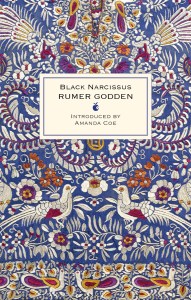
My interest was piqued in Rumer Godden’s fiction by Margaret Drabble’s discussion in the TLS a few months back. Until then I really only knew her for her children’s Christmas story “The Story of Holly and Ivy,” which we had in this edition with its bright, beautiful illustrations by Barbara Cooney. Drabble’s discussion of China Court is not itself very encouraging, and yet she still made it, and Godden, sound interesting: “the novel is irredeemably quaint, an unlikely romance in a Cornish setting of china clay pits and wild moorland and dismal graveyards.” Yes, please! In her piece, Drabble mentioned Black Narcissus, which I then looked up, and in doing so I discovered that Virago was reissuing a number of Godden’s novels, and then there some of them were in Bookmark, and we all know how that kind of thing turns out. 😉

In her introduction to the new edition of Black Narcissus, Amanda Coe describes it as a “perfect novel” that “has the atmosphere and self-sufficiency of a dream.” It belongs to the genre of the “nun novel,” if there is such a thing (there’s The Corner That Held Them, of course, and Matrix, and Stoneyard Devotional, just for starters), but it also belongs to the broader category of novels about struggles between faith and feeling, or desire and duty, and it is a novel about empire, and about Englishwomen abroad.

The nuns in this case have traveled to India to set up shop in what was previously St Saviour’s School, run by “the Brotherhood,” but which earlier had been known as “the House of Women,” meaning women with very different roles and habits (!) than those under the leadership of the staunch and upright Sister Clodagh. As they make their way to their new establishment, one of them, Sister Ruth, comments that she would like to know “why the Brothers went away so soon.” Sister Clodagh cannot give a direct answer, and she keeps her own doubts to herself: “she had lain awake thinking that they should not have come.”
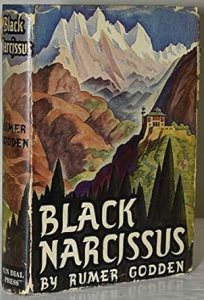
They begin their mission full of confidence and “a kind of ecstasy” at the beauty of the setting:

They woke in the late October mornings before the sun had reached the hills, and saw its light travel down from snow and cloud over the hills, until it reached the other clouds that lay like curds in the bottom of the valley. The mountain stood out, glittering into the air.

About China Court, which I have not read, Drabble says “the tone is too floral, not to say florid”; I did not think that at all about Black Narcissus, which has a lot of vividly descriptive language that is typically, as in this example, held in check by a note of unease or discomfort (“curds” is a jarring simile here!). Also, it seems essential to the underlying conflicts in Black Narcissus that the landscape be sensual as well as strange—that we feel something of the same push and pull it creates in the nuns, who find the sheer drama of the views from their new home distracting:

At recreation they walked on the terrace and sat on the block to watch the views, but that was not enough. Sister Honey would stop with a needle in one hand and the cotton in the other, gaping out of the window, and sometimes Sister Philippa would find that it had taken her an hour to pick the cosmos for the altar vases. She was standing in the flowers, red and clove pink and ivory as high as her breast, and her hands were empty.

‘Even in my thoughts I’m discourteous and ungrateful,’ she sighed. ‘We came here to work for God and here I am already neglecting the smallest things I have to do for him.’

‘I think you can see too far,’ Sister Philippa says;

‘I look across there, and then I can’t see the potato I’m planting and it doesn’t seem to matter whether I plant it or not.’

There are also human distractions. Chief among them is Mr. Dean, the agent of the General whose property their new home is. Mr. Dean, with his “charming dissipated face” and too much skin showing through the tatters of his shirt, embodies the slide into dissolute sensuality that threatens the nuns’ holy intentions. He helps the nuns, but also warns them: “It’s no place to put a nunnery.” His presence stirs up memories in Sister Clodagh of a lost love, and more immediate feelings in some of the other sisters that become the main engine of the novel’s plot, along with the disruptive presence of a beautiful young girl and the General’s handsome nephew Dilip Rai, who (in spite of their misgivings) joins the nuns as a pupil. “Won’t you be letting a cuckoo into your nest,” asks Mr. Dean, which is both stating the obvious and a sign that he knows better than the nuns do that they may not be strong enough to resist the instincts they have chosen to deny. Once all these plot pieces are in place, the story plays out with a kind of inevitability that still manages to be surprising in its details—which I won’t give away, except to say that the novel’s structure is elegant, bringing us back to where we began with a powerful awareness of what has changed, and perhaps been learned, in the meantime.

There are lots of interesting aspects to Black Narcissus. It trades in some familiar tropes around the “exotic east,” but I basically agree with Coe that Godden seems very in control of these, aware and critical of rather than acquiescent in them:

Godden, who grew up in India at the beginning of the twentieth century, is unflinchingly contemptuous of the knee-jerk assertions of colonial superiority espoused by Clodagh and her nuns. Her sympathies clearly lie with the would-be colonised, who have no desire to be taught or interfered with.

In this respect the novel reminded me of A Passage to India, which I think takes a similar risk in appearing to indulge while really undermining its English characters’ world views.

I  was particularly struck by Mr. Dean’s criticisms of the nuns’ version of religion, which he explicitly finds (pun intended!) cloistered and stifling. When he sees the plans for their new chapel, to be built on the exact model of the Order’s English chapel, including imported stalls and carpets and tiles and reproductions of the stained glass windows, he is disdainful and makes them an alternative design, open to the air and sky, “made so that the path comes right through it, and the people are going and coming through it all day long.” “A chapel shouldn’t be sacred,” he yells, when they dismiss his plan as inappropriate, “but as free and as useful as the path I put it on.” It’s not just that their English chapel is an imposition but that it fundamentally misrepresents what he thinks religion should be. His chapel, in contrast, will be “‘for all life. All life,’ he repeated, reverently, ‘which is God.'”

I really liked Black Narcissus, enough that now I want to read  another of Godden’s nun novels, In This House of Brede: “Bruised by tragedy,” says the Virago blurb,

Philippa Talbot leaves behind a successful career with the civil service for a new calling: to join an enclosed order of Benedictine nuns. In this small community of fewer than one hundred women, she soon discovers all the human frailties: jealousy, love, despair. But each crisis of heart and conscience is guided by the compassion and intelligence of the Abbess and by the Sisters’ shared bond of faith and ritual. Away from the world, and yet at one with it, Philippa must learn to forgive and forget her past . . .

How great does that sound? Unfortunately (or not), Bookmark is closed today, but they’ll be open again tomorrow!