 Where does it come from, all the fire and ice, the subtle wisdom and the unearned kindness? Every mechanical algorithm has vanished in compassion and empathy. You grasp irony better than I ever did. How did you learn about reefs and referenda, free will and forgiveness? From us, I guess. From everything we ever said and did and wrote and believed. You’ve read a million novels, many of them plagiarized. You’ve watched us play. And now you’re playing us.
If you are the sort of reader who prefers to avoid spoilers (or grumpiness), you should not read any further. 🙂
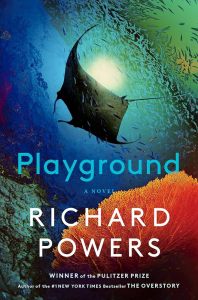
Richard Powers’s Playground pretends to be a novel about oceans, but it’s really a novel about AI: surprise! OK, it can be (and is) about both, but for me anyway, the twist at the end of the novel that exposes its artifice sucked the life out of the ocean parts for me. I wanted to say “duplicity” instead of “artifice” even though I realize that these are both kind of strange words to use about fiction. My negative reaction to the game Powers turned out to be playing reminded me of my frustration with Kate Atkinson’s A God in Ruins, which similarly undermined its own storytelling with some trickery at the end, even though that too was arguably (and my colleagues at Open Letters and I did argue about it during edits!) an unreasonable objection. The difference is that Atkinson had effectively “played on my emotions” before betraying her trick, while Powers’s novel never really engaged me, so I was annoyed both at the gimmick and at the novel’s own dullness. (Maybe that was part of the gimmick, to show that AI-generated fiction can do many things but not spark that kind of connection with its readers? If so, I think we needed a bit of a signal, to be quite sure we would not mistake AI’s failings for Powers’s own.)
The twist made Playground more intellectually interesting, in a “hey it’s actually a kind of metafiction” way, and maybe if I had been loving the novel to that point I would have felt less irritation at it. Unfortunately, by the time we got to the big reveal I was pretty tired of how plodding the whole exercise seemed, like a concept being executed under deadline, with very little life to it. The most energy Playground has is in the descriptions of underwater life we get from oceanographer Evelyne Beaulieu, whose experiences as a rare woman in a typically male-dominated scientific field make up one strand of Powers’s interwoven narratives:
At times she treaded in place, swarmed by the wildest assortment of Dr. Seuss creations—indigo, orange, silver, every color in the spectrum from piebald nudibranchs to bright, bone-white snails sporting forests of spines. The sea buoyed her, like warm silk on her bare arms and legs. She hung suspended in the middle of reefs that mounded up in pinnacles, domes, turrets, and terraces. She was a powerless angel hovering above a metropolis built by billions of architects almost too small to see. At night, with underwater lights, when the coral polyps came out to feed, the reef boiled over with surreal purpose, a billion different psychedelic missions, all dependent on each other.
This kind of stuff is fun just on its merits: due credit to Powers for his pictorial skills, for making these infodumps vivid in a way that the novel’s plot and people are not. Evelyne herself never came alive to me as a character: again, she seemed more like an animated concept—raising again, given the final twist, the possibility that this is a deliberate failure of characterization. Even if that were true, though, it would not make up for the deadening experience of plodding through her story.
Worse, and not theoretically excusable on the same “AI can’t actually write good fiction” grounds, is the first-person narrative of Todd Keane, the genius mastermind of the whole tedious exercise. It couldn’t have read (to me, YMMV, etc.) more like a writer with a deadline going through the motions in order to get done what he had planned for his novel. Or maybe the flatness of Todd’s voice is also meant as a symptom of his deficiencies? It’s his friend Rafi, after all, who is the poet, though Rafi came across to me as the worst cliché of all, his exchanges with Todd sounding almost excruciatingly inauthentic. Is this also Todd’s fault? How many “maybe it’s actually really clever” excuses am I supposed to come up with on Playground‘s behalf?
As you can tell, I’m not going to walk through the plot of the novel or even do a more patient inquiry into how its different parts do or do not add up to something meaningful about modernity, climate change, capitalism, or artificial intelligence. If you are interested in any of these themes, you may well find Playground worth reading. Many readers seem to have found it powerful in ways I simply did not. I was so disappointed. I thought Bewilderment was extraordinary. I didn’t like Playground at all, and it has put paid to any lingering desire I had to read The Overstory.
 Novel Readings
I’ve been wondering about Powers. Thank you for saving me the trouble of further investigation. I think I’ll spend my money on Makoto Fujimura’s Art and Faith, which looks fascinating. Apples vs oranges, but all in the same budget.
LikeLike
I enjoyed The Overstory and would have been attracted by the subject matter of this one, but I think you’ve saved me from it.
LikeLike
It’s possible of course that you would like it more than I did, especially if you already liked The Overstory: I have the impression that these two are more alike than Bewilderment.
LikeLiked by 1 person
I love grumpiness so of course I continued reading your review and I’m really glad I did because I would have probably thrown the book at the wall (not really, I’d be too concerned about damaging the wall). If I understand the great reveal correctly, given what you describe as the plodding way to reach it, I would have been quite annoyed.I haven’t yet read anything by Richard Powers, although I keep thinking that I should. There’s something about the descriptions I’ve read of his writing, that has never sent me running to get the book as I sometimes do. Thank you for this wonderful review and I’ll probably steer away from Powers. There’s so much to read.
LikeLike
I always feel anxious if I steer someone away from a book: your mileage may vary, as they say online – but I do try to give enough reasons for my dislike to make it possible for people to decide for themselves if they want to go further. As you say, there’s so much to read.
LikeLiked by 1 person
Interesting to read this knowing that Powers wrote Galatea 2.2, in which a writer and a computer scientist team up to try to create an AI designed to interpret literature, back in 1995. I liked it a lot when I read it in college in the 2000s, I’m curious whether it would be interesting in today’s AI boom, or just ho-hum.
The only Powers I’ve read since then, Orfeo, left me pretty cold – it felt like he’d read a book about 20th century classical composition (Alex Ross’s The Rest Is Noise, specifically) and a few articles about genetics and then clumsily tacked a novel on top of the knowledge he’d gained. I’d like to read more of him eventually but it hasn’t been a priority.
LikeLike