Recent Reading: Time, Murder, and Mayhem

Here’s a round-up of some of my recent reading, including some recent titles that had been on my radar for a while and finally popped up at the public library.

Time
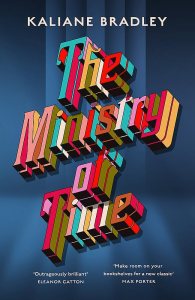
One of these was Kaliane Bradley’s The Ministry of Time, which I got interested in because Bradley was a brilliant guest on Backlisted. She was talking about Monkey King: Journey to the West—this was another instance in which I ended up more interested in the guest’s book than the book under discussion! I mostly enjoyed The Ministry of Time, until towards the end I got confused by the intricacies of its time travel plot and felt that I would have enjoyed a straight-up historical novel about the Franklin expedition more.

Reading Solvej Balle’s On the Calculation of Volume (Vol. I) for my book club last week I decided that for now I have reached my limit for novels that mess with time—I found Balle’s novel beautiful, meditative, and thought-provoking, but also annoying as I puzzled over the logistics and tried not to let what seemed like the improvisational or ad hoc nature of its underlying “theory” get in the way of what else it had to offer. At least Balle’s novel is deliberately anti-plot, which made it easier to let the metaphysics slide. Its focus on repetition and the consequences, especially psychological and emotional, of not being able to get back into time also made me think, often very sadly, of Denise Riley’s Time Lived, Without Its Flow, and my own struggle to fully re-enter time since Owen died.

Murder

Paradoxically, perhaps, given how regularly I teach our mystery & detective fiction course, I don’t read a lot of crime fiction these days, but I am always scouting for recent titles that might be useful for updating my reading list. This was part of what drew me to Kevin Powers’s A Line in the Sand, which sounded like a good combination of crime and politics—which it is. It’s a pretty good read, fast-paced and character driven. It turns on an attempt to cover up a massacre by private military contractors in Iraq: one of the witnesses was a former interpreter now in America who finds himself pursued by those who need that past erased to secure a massive new contract. So we get both the scary world of the shady companies profiteering from war and the interconnected (and also scary and shady) world of the politicians and military leaders who are also complicit. Most of the other main characters are also in one way or another suffering because of the Iraq war; its far-reaching consequences for those who fought and for those on the home front are among the novel’s themes. I thought it was a solid crime novel, if a bit too much of a thriller for my own personal taste: by the end the bodies have piled up, and the deaths are grim and violent, and the solution is action-driven rather than ratiocinative. If this is your kind of crime novel, I recommend it as a good example of the kind!

Mayhem
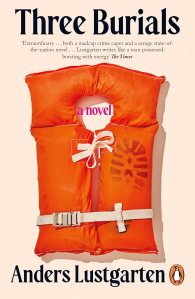
Anders Lustgarten’s Three Burials is also quite violent and action-driven, but underlying it is a less cynical or discouraging vision than I felt was at the core of A Line in the Sand. Its Thelma and Louise-style plot (a connection made explicit in the novel itself) focuses on Cherry, a nurse who happens upon the body of a murdered refugee (we already know him as Omar) on a British beach. Cherry is carrying a lot of grief and trauma, including her wrenching memories of the worst of the COVID pandemic (people currently downplaying the severity of the crisis and restricting access to the vaccines that have helped us get to a better place would benefit from the terse but powerful treatment it gets here). She is also grieving her son’s death by suicide, and the resemblance of the dead man to her son adds to her determination to somehow get his body to the young woman whose photo he was clutching when he died.

There are a lot of moving parts to Three Burials, including Omar’s story; the story of the two cops on patrol with an outfit called “Defenders of the Realm” to intercept refugees’ boats, one of whom is, as we know from the beginning, Omar’s murderer; and the story of Cherry’s husband and daughter, also mourning and now trying to figure out what to do when Cherry ends up on the run with Omar’s body, with one cop (initially recalcitrant, eventually repentant) in her car and the other, angry and violent, giving chase. It’s a zany plot; what I liked about it was that it is a kind of cri de coeur, not just on Cherry’s behalf but on ours, collectively. What is a person of conscience and compassion even supposed to do in a world full of so much ignorance, hate, mismanagement, suspicion, and malice? Why are we scapegoating people instead of helping them, turning them away instead of welcoming them, making things worse instead of making things better? Why is the world apparently trying to forget what we (could have) learned from COVID instead of applying its lessons? The weird thing about Thelma and Louise is that despite its tragic ending, there is something joyful about it; Cherry’s wild ride has something of the same quality as she is driven forward by despair but also by a hope she refuses to give up that there must be something she can do, some difference she can still make, no matter how small.

Metallic Thoughts: Helen Garner, The Spare Room

A huge wave of fatigue rinsed me from head to foot. I was afraid I would slide off the bench and measure my length among the cut roses. At the same time a chain of metallic thoughts went clanking through my mind, like the first dropping of an anchor. Death will not be denied. To try is grandiose. It drives madness into the soul. It leaches out virtue. It injects poison into friendship, and makes a mockery of love.
I was not prepared for The Spare Room. It sounds like the kind of book that is sad but uplifting: one friend, dying of cancer, comes to stay with another friend, who has a spare room and lives nearer the treatment center. We know this story, right? We have cried over variations on it in many films and novels, finishing them wrung out but also restored. Death is terrible, but friendship (or family, or love) is strong. Death always wins, of course, but that harsh truth can at least be reassuring cushioned with sentiment—I think (I know!) that is part of the appeal.

The Spare Room is about the strength of friendship, but not one harsh truth is cushioned with any softer emotion in Garner’s gut-punch of a novel. Helen’s good intentions towards her terribly ill friend Nicola are tested from the moment Nicola appears at the airport, “staggering like a crone.” “How long had she been this bad,” Helen wonders, after managing with great struggle to get Nicola into her nightgown and then into bed; “Why hadn’t someone warned me?”

It turns out that worse even than Nicola’s phases of debilitating weakness is her adamant refusal to acknowledge reality. The treatment she has come for is obvious quackery, a scam perpetrated on the desperate. The “medical” staff at the clinic are unqualified, uncaring, rapacious—and even their notes in Nicola’s file show that they know she is a terminal case, though this does not stop them from taking her money for their fraudulent services. What is a friend to do, in these circumstances, when the only honest path forward is to insist on the futility of hope?

And taking care of her is so much work! Nicola is beautiful, charming, extravagant, and in complete denial, including about the burden her visit is placing on Helen, who has to change her bedding repeatedly when she sweats through it or worse; tend to her through nights of wakefulness caused by intense pain Nicola insists on believe is caused by her treatments ‘driving out’ the cancer’; drive her to appointments, wrangle medications, struggle to find food she can tolerate. What kind of life is this, for either of them? “Death was in my house,” says Helen, but Nicola will not see it.

Helen gets some help when Nicola’s niece Iris and her boyfriend come to stay for a while. The logistical assistance is welcome but even more bracing for Helen is the reassurance that she is not a terrible friend, that Nicola’s demands and expectations are truly outrageous, that the rage Helen is feeling is a perfectly reasonable response to the combination of extreme pressure and Nicola’s relentless denial of reality. “Want to hear my theory?” Iris asks;

There’s a lot of horribleness that Nicola refuses to countenance. But it won’t just go away. It can’t, because it exists. So somebody else has to sort of live it. It’s in the air around her. Like static. I felt it when she walked into the house tonight. It was like I suddenly had a temperature. My heart rate went up.

I stared at her. “You mean it’s not just me?”

It turns out that being a real friend means doing something incredibly hard and, in a way, unkind: confronting Nicola with the truth. “Wake up,” Helen finally says; “You’ve got to get ready.”

The Spare Room still does not take the easy path: there are tears, but there is no epiphany, no bedside reconciliation or moment of grace.  Or not ‘on camera,’ as it were—not while Nicola is still in the spare room, not before Helen draws the line when Nicola proposes staying even longer while she has and then recovers from surgery:

“Will you fucking listen to me?” I said shrilly. “I. Can’t. Do. It. . . . I’m worn out. I can’t go on.”

Can you even say that, to anyone, much less to your beloved friend who is the one who literally can’t go on? Can you admit that she has asked for too much, that you have no more to give? Does telling her that make you a bad friend, or, worse, a bad person? Garner brings in, proleptically, a glimpse of the future that helps us answer this question kindly, thanks in part to some unexpected generosity from Nicola—who does not die in Helen’s spare room (as I’m sure the Hollywood version would want) but later, after Helen has taken her back to the airport and “left [her] place at Nicola’s side.” “It was the end of my watch,” Helen says; “and I handed her over.” After all they and we have been through, that seems like enough.

I haven’t read Garner before. I picked up The Spare Room at the library after listening to Claire Lowdon talk about her recently published diaries on the TLS podcast (which I always enjoy a lot). Lowdon confessed herself not a huge fan of Garner’s fiction, but she singled out The Spare Room as exceptional. I can see why. If any of you are Garner enthusiasts, which novel would you recommend I try next?

Uncategorized

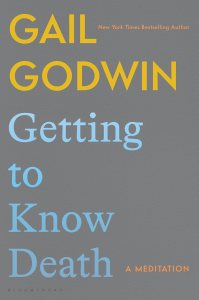
A Wobble: Gail Godwin, Getting to Know Death

You decide to water the little tree. You plan what is to be done. Take your walking cane for extrabalance security when you reach the ground cover and the rocks between the gravel and the faucet for the house. Then out the door, down the stone steps, turn right on the gravel, walk with cane thirty to forty feet to the spot at the corner of the house . . . 

Done. Then cross over carefully, still with cane, and bend down to grasp the faucet. Twist to the right.

Now for the retreat. Stepping cautiously backward through the thicket of vinca, avoiding the rocks.

You muster resolve. Gravel lies in front of you. Step into it with cane, and turn right towards the little dogwood tree.

A wavering pause. A doubt, a loss of nerve. A wobble through space, and you’re falling forward.

On June 6, 2022, novelist Gail Godwin, then 85 years old, went carefully out to her garden to do a mundane chore: watering a small dogwood tree. Wisely, she was using her cane for extra stability; unfortunately, her cane proved insufficient to save her from a fall. She landed face-first and broke her neck.

Godwin was not paralyzed: that was the good news. But a broken neck is still a significant injury, especially for someone at an age where bones are less likely to heal. She wore a neck brace for months, went through months of rehab, including a stint in a live-in facility, and eventually also had surgery. This was all, as you might imagine, extremely challenging not only physically but also psychologically and existentially.

Getting to Know Death is a record of Godwin’s experiences and thoughts as a result of her accident, though as its subtitle, A Meditation, signals, it is not a straightforward memoir. It is more episodic than unified, including recollections of the illness and eventual death of Godwin’s good friend Pat, of the deaths by suicide of her father and brother, and of the death of her husband Robert. It includes thoughts on writers and writing, incidents from her time in rehab, diary entries about her daily life—in other words, it is kind of miscellaneous.  I found the book interesting, because Godwin herself is interesting and—at least as important—interested, in what is happening to her and in other people and what happens to them. I am not entirely convinced of its substance or depth, though. Can you ask, about book like this, whether it deserved publication, whether it is or does enough to deserve that, to deserve our attention? Is that a fair question? It seems almost rude, given what the book is about and how personal it is. I am not sure of my own answer, although because I was reading them at the same time it is hard not to compare Getting to Know Death to Woolf’s diaries, which were never intended for publication and yet, cumulatively at least, seem richer or more resonant.

One thing from Getting to Know Death that I will carry with me from now on is the idea of the “year’s mind,” a term I had not encountered before:

Too many ideas to catch and hold. This is the countdown to April 22, Robert’s “year’s mind.” It will now be twenty-two years here by myself in this house. “Year’s mind” went out of popular use five centuries ago, but the phrase still survives in the Episcopal Liturgy. “We remember Robert Starer, whose year’s mind falls on this day” (April 22) . . .

“Year’s mind” means the day of one’s death.

“Anniversary” has always felt like the wrong word to mark the day of someone’s death, which is a day of remembrance, not ceremony or celebration; now I have a better one for the day that will be here again all too soon.

“Almost Motionless”: 1917

Sunday 9 September

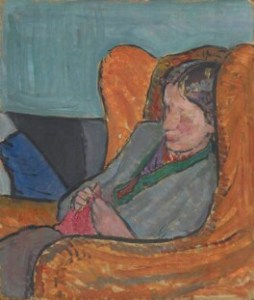
An almost motionless day; no blue sky; almost like a winter day, save for the heat. Very quiet. Over to picnic at Firle in the afternoon. Nessa & 5 children came after we had done; sat outside the trees. Walked home over the downs. Red sky over the sea. Woods almost as thin as winter, but very little colour in them.

Woolf’s diaries start up again in August, 1917, after the long recovery from her breakdown in February 1915. “For long time,” the editor notes, “there was no question of her writing at all, and then she was rationed, as it was thought to excite her.” (Readers of “The Yellow Wallpaper” are familiar with this theory—and with its debilitating effects.) This edition includes, as an Appendix, the “Asheham Diary,” briefer daily records covering some of the same period as her ‘real’ diary, where the entries also begin as quite brief, almost perfunctory logs of mostly mundane things: the weather, walks, mushrooming, taking letters to the post. Yet it’s still Woolf writing, with her observer’s eye:

We meant to have a picnic at Firle, but rain started, as we were ready, & so we went to post at Beddingham instead. Left my macintosh in the hedge, so it came down hard, & we were very wet. [I love that “so” there, as if—as we all probably feel sometimes—she had jinxed the weather by going without her raincoat.] It rained hard & steadily the whole evening & was raining violently when we went to bed. This is the first bad day we have had; even so, the morning was fine. The high wind of the last few days has broken leaves off, although only a few of the trees have begun to turn. Swallows flying in great numbers very low & swift in the field. The wind has brought down some walnuts, but they are unripe; the wasps eat holes in the plums, so we shall have to pick them. My watch stopped.

And so it goes until they move back to Richmond in October. At that point, the length and especially the energy of the entries picks up again, along with the Woolfs’ social life. On October 14 she reports “much argument . . . old arguments,” which the footnote explains “concerned VW’s thirst for social life and LW’s anxiety lest she should over-strain or excite herself.” What if the very thing that sustains you also exacts a price?

At first I was thinking that not much was really happening in this section, but then it struck me that of course there is a war on, as we are reminded by several passing references to German prisoners working on the nearby farms: “To picnic near Firle,” she reports on August 11, for example, “with Bells &c. Passed German prisoners, cutting wheat with hooks.” Also during this period Leonard is called up to military service, and their efforts to have him excused on medical grounds are repeatedly mentioned. Once they are back at Richmond, they are constantly on edge about air raids: on December 6, she is “wakened by L. to a most instant sense of guns: as if one’s faculties jumped up fully dressed.” They retreat to the kitchen passage then go back to bed when the danger seems passed, only to be once again roused by “guns apparently at Kew.” The raid, the papers tell her the next day, “was the work of 25 Gothas, attacking in 5 squadrons, and 2 were brought down.”
In the midst of this, the Woolfs are setting up their press and beginning to print. It is amusing to follow their frustrations with the apprentice they take on to “help” them with this work. “Our apprentice weighs rather heavily upon us,” Woolf notes, wondering if the discomfort she induces is because of her youth, or “something highly polished so as to reflect without depth about her.” She is “nice, considerate,” but not good at her job:

Today has been spent by L. in the futile misery of trying to print from one of her pages which wont lock up. As the other page had to be entirely taken down & re-set, her work amounts to nil; less than nil, considering L.’s time wasted.

The Woolfs also acquire and then lose a dog, Tinker, who goes missing the same day Leonard gets his papers stating he is “permanently and totally disabled,” so their relief at his security is “rather dashed by the loss of the spaniel whom we had come to like.”

The intermingling of different kinds of events and preoccupations—war and picnics, air raids and printing presses, soldiers and servants, book reviews and mushrooming—is one of the most interesting features of the diaries so far. In itself it is not, of course, surprising or unusual: we all live that way, after all, in the midst of events much larger than ourselves that affect us both directly and indirectly; whatever else is going on, we still somehow mostly keep up whatever counts for us as ordinary life. Sometimes we rise to the occasion, meeting history as best we can on our own terms, and other times we recede into pettiness. It’s reassuring to see that this is true for geniuses too. “I must again register my complaint that people wont write to me,” Woolf mopes on November 13; ‘I dont write to them, but how can one?” Fair! Especially if “one” is so busily writing one’s diaries. 🙂

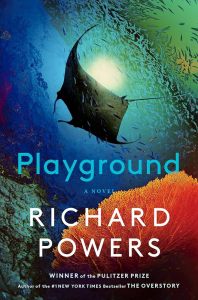
Playing Us: Richard Powers, Playground

Where does it come from, all the fire and ice, the subtle wisdom and the unearned kindness? Every mechanical algorithm has vanished in compassion and empathy. You grasp irony better than I ever did. How did you learn about reefs and referenda, free will and forgiveness? From us, I guess. From everything we ever said and did and wrote and believed. You’ve read a million novels, many of them plagiarized. You’ve watched us play. And now you’re playing us.
If you are the sort of reader who prefers to avoid spoilers (or grumpiness), you should not read any further. 🙂

Richard Powers’s Playground pretends to be a novel about oceans, but it’s really a novel about AI: surprise! OK, it can be (and is) about both, but for me anyway, the twist at the end of the novel that exposes its artifice sucked the life out of the ocean parts for me. I wanted to say “duplicity” instead of “artifice” even though I realize that these are both kind of strange words to use about fiction. My negative reaction to the game Powers turned out to be playing reminded me of my frustration with Kate Atkinson’s A God in Ruins, which similarly undermined its own storytelling with some trickery at the end, even though that too was arguably (and my colleagues at Open Letters and I did argue about it during edits!) an unreasonable objection. The difference is that Atkinson had effectively “played on my emotions” before betraying her trick, while Powers’s novel never really engaged me, so I was annoyed both at the gimmick and at the novel’s own dullness. (Maybe that was part of the gimmick, to show that AI-generated fiction can do many things but not spark that kind of connection with its readers? If so, I think we needed a bit of a signal, to be quite sure we would not mistake AI’s failings for Powers’s own.)

The twist made Playground more intellectually interesting, in a “hey it’s actually a kind of metafiction” way, and maybe if I had been loving the novel to that point I would have felt less irritation at it. Unfortunately, by the time we got to the big reveal I was pretty tired of how plodding the whole exercise seemed, like a concept being executed under deadline, with very little life to it. The most energy Playground has is in the descriptions of underwater life we get from oceanographer Evelyne Beaulieu, whose experiences as a rare woman in a typically male-dominated scientific field make up one strand of Powers’s interwoven narratives:

At times she treaded in place, swarmed by the wildest assortment of Dr. Seuss creations—indigo, orange, silver, every color in the spectrum from piebald nudibranchs to bright, bone-white snails sporting forests of spines. The sea buoyed her, like warm silk on her bare arms and legs. She hung suspended in the middle of reefs that mounded up in pinnacles, domes, turrets, and terraces. She was a powerless angel hovering above a metropolis built by billions of architects almost too small to see. At night, with underwater lights, when the coral polyps came out to feed, the reef boiled over with surreal purpose, a billion different psychedelic missions, all dependent on each other.

This kind of stuff is fun just on its merits: due credit to Powers for his pictorial skills, for making these infodumps vivid in a way that the novel’s plot and people are not. Evelyne herself never came alive to me as a character: again, she seemed more like an animated concept—raising again, given the final twist, the possibility that this is a deliberate failure of characterization. Even if that were true, though, it would not make up for the deadening experience of plodding through her story.

Worse, and not theoretically excusable on the same “AI can’t actually write good fiction” grounds, is the first-person narrative of Todd Keane, the genius mastermind of the whole tedious exercise. It couldn’t have read (to me, YMMV, etc.) more like a writer with a deadline going through the motions in order to get done what he had planned for his novel. Or maybe the flatness of Todd’s voice is also meant as a symptom of his deficiencies? It’s his friend Rafi, after all, who is the poet, though Rafi came across to me as the worst cliché of all, his exchanges with Todd sounding almost excruciatingly inauthentic. Is this also Todd’s fault? How many “maybe it’s actually really clever” excuses am I supposed to come up with on Playground‘s behalf?

As you can tell, I’m not going to walk through the plot of the novel or even do a more patient inquiry into how its different parts do or do not add up to something meaningful about modernity, climate change, capitalism, or artificial intelligence. If you are interested in any of these themes, you may well find Playground worth reading. Many readers seem to have found it powerful in ways I simply did not. I was so disappointed. I thought Bewilderment was extraordinary. I didn’t like Playground at all, and it has put paid to any lingering desire I had to read The Overstory.


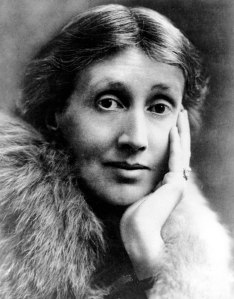
“W.C.’s, & Copulation”: Starting Woolf’s Diaries

I recently treated myself to the complete Granta editions of Woolf’s diaries. I wanted to mark the finalization of my divorce last month, and this felt right, somehow—more a reflection of the life I am trying to build now, in this room of my own, than, say, jewelry would be. I thought, too, that reading through them would make a good summer project for me, especially if I made writing about reading them a bit of a project as well. I say “a bit of” because I don’t have big ambitions for it. I don’t necessarily want to tie myself to a schedule or make promises, if only to myself, that I then don’t keep but feel bad about! But I do think it will be motivating to have the intention to post updates of some sort. We’ll see what unfolds.
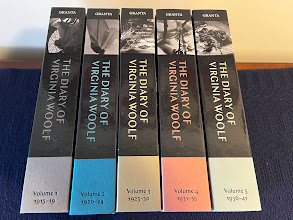
 This morning I started on Volume 1, which covers 1915-19. I read the foreword by Virginia Nicholson; the editor’s preface, by Anne Olivier Bell; the introduction by Quentin Bell; and then, finally, the first section of diary entries, from January 1915. They end abruptly because, as the editor’s note explains, Woolf “plunged into madness” in February; the diary does not pick up again until 1917. It seems inevitable that one key effect across the whole of the diaries will be this kind of dramatic irony: after all, it is impossible not to know, now, how her life ended. At the same time, and I think this is not as obvious as it maybe sounds, it seems important that she did not know this. When someone ends their own life it is hard not to see that as the most significant and meaningful thing, not just about them as people, but about the life they lived up to that decision. I’ve always been very moved by the conclusion of Winifred Holtby’s memoir of Woolf, which was published in 1932—Holtby did not know, and would never know (as she died in 1936), about Woolf’s suicide. “For all her lightness of touch, her moth-wing humour, her capricious irrelevance,” Holtby says,

she writes as one who has looked upon the worst that life can do to man and woman, upon every sensation of loss, bewilderment and humiliation; and yet the corroding acid of disgust has not defiled her. She is in love with life. It is this quality which lifts her beyond the despairs and fashions of her age, which gives to her vision of reality a radiance, a wonder, unshared by any other living writer. . . . It is this which places her work, meagre though its amount may hitherto have been, slight in texture and limited in scope, beside the work of the great masters.

“She is in love with life”: it would be too simple to say that this is exactly what the diary communicates so far, but it is certainly very full of living. A central preoccupation at this point is the search for new London lodgings that ends with the Woolfs leasing Hogarth House, where they also then launched the Hogarth Press. During this period The Voyage Out is moving towards publication, but she mentions it explicitly only once that I noticed; the editor suggests that nonetheless it was very much on her mind and that the stress of its impending release contributed to the collapse of her mental health.

Something that is immediately notable to me is how populated Woolf’s world is. I am torn so far between checking each footnote explaining who somebody is and just taking the cast of characters for granted, as she obviously does. It is interesting to know, but distracting to keep finding out, because Woolf mentions so many different people. My mother, whose interest in Woolf long predates my own,* explained once that part of what drew her to the diaries, in addition of course to Woolf’s voice—about which more in a minute—was being plunged into that community. I already see her point: everybody just seems so interesting, so busy with art and politics and love affairs. There is so much bustle, and while much of it (like the house-hunting) is quotidian and familiar, there is also something extraordinary about the way Woolf and her circle of friends wanted to be in the world, as intellectuals and creators and radicals—which is not to idealize them, or her, or to deny the privilege and snobbery that occasionally show through.

There are two related but separate things, I suppose, that make these diaries worth reading. One is Woolf—who she was as she wrote them and who she became. The other is the diaries themselves—what they are like to read, what they offer us as (if you’ll forgive the word) texts. Lots of people have kept diaries that are primarily of documentary interest; Woolf’s diaries, on their merits, are also of literary interest, or so I think it is generally agreed. It seems odd to say “they are great examples of the form” when that form is something so personal. The goal of keeping a diary is not generally to publish it, after all, and there can hardly be a model for how to write about and for oneself. But  Woolf is a good writer no matter the form or purpose of her writing, or perhaps it is more accurate to say that the kind of good writer Woolf is suits the darting, episodic, idiosyncratic form of a diary. Already the entries are shot through with evidence of her brilliance, from vivid bits of description (“the afternoons now have an elongated pallid look, as if it were neither winter nor spring”) to moments of acid social commentary:
We went to a concert at the Queen’s Hall, in the afternoon. Considering that my ears have been pure of music for some weeks, I think patriotism is a base emotion. By this I mean … that they played a national Anthem & a Hymn, & all I could feel was the utter absence of emotion in myself & everyone else. If the British spoke openly about W.C.’s, & copulation, then they might be stirred by universal emotions. As it is, an appeal to feel together is hopelessly muddled by intervening greatcoats & fur coats. I begin to loathe my kind, principally from looking at their faces in the tube. Really, raw red beef & silver herrings give me more pleasure to look upon.

My favorite bit in this first instalment was this thoughtful observation:

Shall I say “nothing happened today” as we used to do in our diaries, when they were beginning to die? It wouldn’t be true. The day is rather like a leafless tree: there are all sorts of colours in it, if you look closely. But the outline is bare enough.

Looking closely, seeing all the colours in an ordinary day: that sounds like an artist’s job to me, a painter’s but also a novelist’s, and it is something anyone can practice by writing in their diary, though the results are unlikely to be as scintillating as hers.


*Just as my father’s love of Trollope and the other Victorians predates mine—I am so fortunate, as I often now reflect, both in my parents themselves (much love to you both, if you are reading!) and in their literary influences on me. Their bookshelves were always both inspirational and aspirational to me when I was growing up, and important as it was that they read to us, I think it was even more important that we always saw them reading all kinds of books.

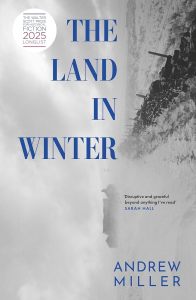
A Sadness: Andrew Miller, The Land in Winter

The car, the moon, Eric’s face . . . were all changed. She looked at him, his concentration (there was ice out there), his frowning into the onrush of night. She might just sit there, do nothing, say nothing, but it no longer felt inevitable. Her anger, at that precise moment, was absent. The anger, the fear, the shame, the wound that had to be tended like a wayside shrine. And what had replaced them? Only this: the rattling of the little car, the whirr of the heater, the shards of light beyond the edges of the road. A sadness she could live with. Some new interest in herself.

I greatly admired Andrew Miller’s Now We Shall Be Entirely Free and The Slowworm’s Song, so my expectations were high enough for his latest, The Land in Winter, that I treated myself to it in hardcover. For a while—nearly the whole first part of the novel, actually—I wasn’t sure if it was living up to them. I was liking it fine: Miller knows how to conjure both characters and settings with the kind of concreteness and specificity that I always appreciate. But it felt slow-moving. The novel never really changes its pace, but all the pieces so carefully assembled in Part One are put into motion in Part Two, the characters’ lives—fully of tensions, secrets, and lies as well as hopes and desires—intersecting in ways that become increasingly fraught, both for them and for us as we wonder how it will all play out. By the end I was thoroughly engrossed and, again, admiring.

The novel takes place during the legendary winter of 1962-63 in the UK. Bill and Rita live on a farm; Bill has stepped away from his family’s questionably acquired money and Rita has left behind a life of clubs and dancing and performances—also a bit questionable. Their closest neighbors are Eric, the local doctor, and his wife Irene. Each of them is uneasy in their own way: Eric, for example, is having an affair, while Rita, we learn, hears voices, which is particularly unnerving for her as her father is a patient at a nearby asylum. Rita and Irene are both pregnant. Across their current lives lies the shadow of the war, recent enough to have lingering effects; its horrors are most explicitly present through Eric’s colleague Gabby Miklos, who oppresses Bill at a party by cornering him and telling unwelcome stories about persecution and suffering:

When Gabby began again—HäftlingSonderkommandoJudenlager—Bill, staring at an abandoned cheese stick on the tablecloth, began to withdraw his heart. He did it as subtly as he could, an inching back that might, with luck, seem no movement at all, a disappearing act, a party trick . . . but all was glass to Gabby Miklos and he sensed it at once. He looked up and smiled at Bill. It was, after all, not his first failure.

I wondered for a while if Gabby was meant to be providing an interpretive key to the rest of the novel. “How it happens is perfectly understood,” he says to Bill; “There is no mystery. So please, tell me, what is the question we must ask instead?” It is easy to imagine a novel that explores possible responses to that question, and to the problem Gabby embodies of how people are supposed to carry on, to re-engage, “normally,” after what has happened, after what he has seen and knows. As The Land in Winter went on, though, that didn’t seem right to me. I’m not really sure, in fact, that the novel has any such focus or thematic core, that it’s trying to answer (or ask) any particular question.

This is not a complaint or a criticism at all. Some novels work that way; others don’t. My sense of The Land In Winter is that if it has a unifying idea, it is that we all get through winter (and life) as best we can, and that what exactly that looks like depends on who we are and where we are. By the end of the novel there was something very satisfying about the richness with which Miller showed me who his people were and how they were getting from day to day. There are plot developments, not twists so much as consequences or revelations, some of them wrenching but none of them surprising because they all come so organically from the world Miller has created.

In particular, it is a wintry world, and Miller writes about it meticulously and often beautifully:

In the afternoon, the blizzard blew away towards the north. For an hour the air was perfectly still. The ash tree was a frozen fountain. Several times they said to each other how beautiful it was. The dusk came swiftly. In the garden, the snow lay in subtle undulations, each with its deepening blue shadow. The cold descended and the land tightened.