 It has been a long time since I worked through Elizabeth Gaskell’s Life of Charlotte Brontë with a class. In fact, the last time I did so was the first year I began this blog series, in the fall term of 2007! In the intervening years, when I have put in to teach a graduate seminar (which is what Victorian Women Writers used to exclusively be) it has been one focused just on George Eliot—which is the course I will be revising next year for this new undergraduate / graduate format.
It is interesting reading through that old post: in its broad outlines, it describes pretty much exactly the same topics we’ve been covering. It is quite broad, and that class is so long ago that I really don’t recall how closely our specific discussions matched what we have been talking about this year. It seems as if we have ranged more widely—but we probably touched on a lot of things then too that aren’t captured in that summary. My sense is that this time around we are paying more attention to the variety of genres and layers in Gaskell’s text, to things like her reliance on extensive quotations from Brontë’s letters, for example, which, as we talked about today, don’t always self-evidently support the characterization of Brontë that Gaskell sets up. For one thing, the Brontë of the letters is bolder, friendlier, and funnier than the timid, shy, sickly little person Gaskell usually shows us in her own narrative. Today we talked about (among other things) what nature means, to Brontë and in Gaskell’s story of her and her family, as in moments like this, in one of Brontë’s letters to a friend:
For my part, I am free to walk on the moors; but when I go out there alone, everything reminds me of the times when others were with me, and then the moors seem a wilderness, featureless, solitary, saddening. My sister Emily had a particular love for them, and there is not a knoll of heather, not a branch of fern, not a young bilberry-leave, not a fluttering lark or linnet, but reminds me of her. The distant prospects were Anne’s delight, and when I look round, she is in the blue tints, the pale mists, the waves and shadows of the horizon.
Copying out that passage, I am struck by its power just as a bit of prose: how delicately infused it is with both the beauty of the moors and the pathos of Charlotte’s grief. 
Read right after Oliphant’s Autobiography, with its heartbroken lamentations for her lost children, Brontë’s life story feels like an extension of those lessons in loss, though Oliphant’s narrative itself is fragmented, broken into pieces by each new blow, while Gaskell carries us through the relentless sequence of deaths at Haworth with her own storyteller’s skill. And after they are all gone, each with an ending portrayed as intensely, almost unbelievably, characteristic—Emily fiercely resisting death to the very last, Anne leaving “calmly and without a sigh”—Charlotte (like Oliphant) is left alone with her writing:
She went on with her work steadily. But it was dreary to write without anyone to listen to the progress of her tale,—to find fault or to sympathize,—while pacing the length of the parlour in the evenings, as in the days that were no more. Three sisters had done this,—then two, the other sister dropping off from the walk,—and now one was left desolate, to listen for echoing steps that never came,—and to hear the wind sobbing at the windows, with an almost articulate sound.
“No one on earth,” Gaskell observes, “can even imagine what those hours were to her.” Maybe, but also, maybe not, as there is much that will be sadly familiar about that desolation to anyone who also grieves “the days that are no more.” Honestly, I think it will be a relief, not just to me but to the class, to move on to Villette next week. Not that Villette is a joyful romp! But at least it puts us back in the more familiar analytical territory of fiction, and if we like we can choose to believe that it has a happy ending: as Brontë says, “let sunny imaginations hope”!
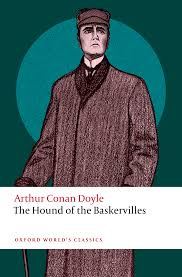 We started with Sherlock Holmes in Mystery & Detective Fiction this week. I’m not the world’s biggest Holmes enthusiast, but as I have documented here often enough over the years, I greatly appreciate The Hound of the Baskervilles, which we will get to on Wednesday. Today was “The Adventure of the Blue Carbuncle,” with its famous “interpret everything about a man from his hat” set piece, and “A Scandal in Bohemia,” with Irene Adler (“To Sherlock Holmes, she was always the woman”). These are good ones: I enjoy them. I think the class is going fine so far: it ought to be, considering how often I’ve taught it now! One thing I’m noticing is spotty attendance. It isn’t making me rethink my long-ago decision not to give grades for attendance, but it gives me food for thought in other ways, as this seems to be a trend in this class in recent years. Perhaps it’s because the course is an elective for pretty much everyone taking it, so they give it lower priority than their other obligations? Is it that students who don’t take a lot of English classes assume the pertinent course content is exclusively in the “textbooks” (what we call the “readings”!) and don’t expect our class time to offer much “value added”? I know that in some subjects lectures often do simply reiterate content in that way, but of course I’m not standing there rehearsing the plot of The Moonstone. Anyway, I try not to take it personally but it rather baffles me: what is the point in signing up to “take” a class but then not really “taking” it? Sure, you can read on your own (or, sigh, just search online summaries and call that “keeping up”), but unless all you are after is the course credit, aren’t you skipping the good part, not to mention the part you are actually paying for?
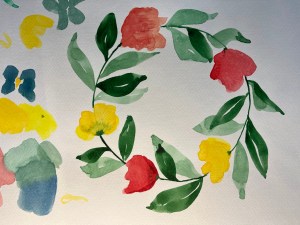
Speaking of taking classes, there’s one more class in my weekly schedule now: it’s the online one I am taking myself, Introductory Watercolour Painting. We met (via Zoom) for the first time last week and I have been diligently practicing colour gradients and one- and two-stroke leaves for my homework. Also (keener that I am!) I looked ahead a bit in our Brightspace site (yes, I have to use Brightspace now as a student as well as an instructor) and saw some examples of “loose floral wreaths,” which are on our lesson plan for this week, and I couldn’t resist giving it a try. This will be my “before” example, for comparison with the one(s) I make after I learn more about how to make the flowers and leaves fuller and looser, and also more layered and translucent, like the models.
 Novel Readings
Hmmm, Rohan, a wide-ranging set of comments.
Firstly, Gaskell (and Bronte)…How familiar are you (and/or how familiar are your students) with Knutsford (in Cheshire) and Bronte Country (on the hills and moors near Bradford, west Yorkshire)? Our favourite memory of Knutsford is an old antique shop where the old-fashioned painted sign in the window stated, ‘Unaccompanied Children will be sold as Slaves’. At the time we were accompanied by a 7-year old and a 5-year old (both at infant school then, so had learnt to read). The elder was unfussed; the younger somewhat frightened by such a bold statement.
Later that week we clambered around the grandparents’ farm in Bronte Country so that the elder child could do his project on ‘My Grandfather’s Horses’ and the surrounding dry-stack walls (of which he illegally snatched a sample to paste into his project). Those moors, with free-range sorrel in mass quantities, were our London-based children’s exposure to Bronte (or at least Wuthering Heights), mists and sloping cricket pitches and horses and tiny farms and…the Bronte House even.
Speaking of mists, Dartmoor was another piece of the countryside to which the children were exposed (mists and all) whilst their mother taught a couple of farmers how to prune their grapevines. Sherlock definitely experiences that bit of terroir. This reader would never have skipped a class, even if attendance was not ‘marked’, as long as the discussions are interesting. Which brings me onto the question of ‘Why bother taking a class if you haven’t any interest in the topics and the teacher?’ [Or is your Detective Fiction module a ‘Bird Class’, i.e., for credit only and so simple that anyone can ‘fly through it’? At my Uni, Detective Fiction was a ‘College Course’, that is, not within the English Department, but taught only at the College-level. But it was taught by the top-prof (A Shakespearean for the rest of his modules) and was phenominally good fun for a three-hour Seminar one evening per week for the 14 weeks.]
As an aside, are you familiar with James Fenimore Cooper’s The Spy, written in 1821 but set in Westchester County, New York during the USA Revolutionary War? A seriously excellent piece of historical fiction/early espionage, which should be read/studied as early American fiction, definitely. An international group of Trollope readers just finished reading and discussing it as Other Lit and we all agreed that The Spy is superb and should be more widely known.
Enough rambling, but I do love reading about your Uni experiences, so please continue?
LikeLike
I have never been to Bronte country but Haworth and the moors are high on my ‘bucket list’ – the next time I travel to the UK, I am determined to get there somehow. Yorkshire has always had a special place in my imagination, not just because of this connection but because I was fascinated with Richard III for many years and that was his territory before he took the crown.
I hope the course is not seen as a “bird course” but it might well be. It is through our discussions that I do the most to show what rigorous, engaged literary analysis looks like, but if all you want is the credit it is possible to do OK, which may be a flaw in my course design but also has to do with my own “leading a horse to water” beliefs about pedagogy. There’s a point at which is has to be up to them to want what you are offering.
LikeLike
Never really got into C. Brontë’s work (more of a Wuthering Heights fan!), but I really should give her a go at some point (a Penguin edition of Shirley has been hanging around my shelves for more than a decade now…).
LikeLike
If you haven’t tried Villette, that’s the one I’d recommend. Shirley is (in my distant recollection) not great! But Villette is a trip.
LikeLiked by 1 person
Surprised I don’t have a copy of ‘Villette’ on my shelves, to be honest (although there are many dark corners of my library where one may be lurking…).
LikeLike