To be like us isn’t easy, it requires constant attention to detail. I’ve thought it out; we’ve thought it out together. I’ve tried to explain to my doctor that it’s a question of working ceaselessly at being as different as possible because there must be a gap before it can be bridged. And the bridge is the real project.
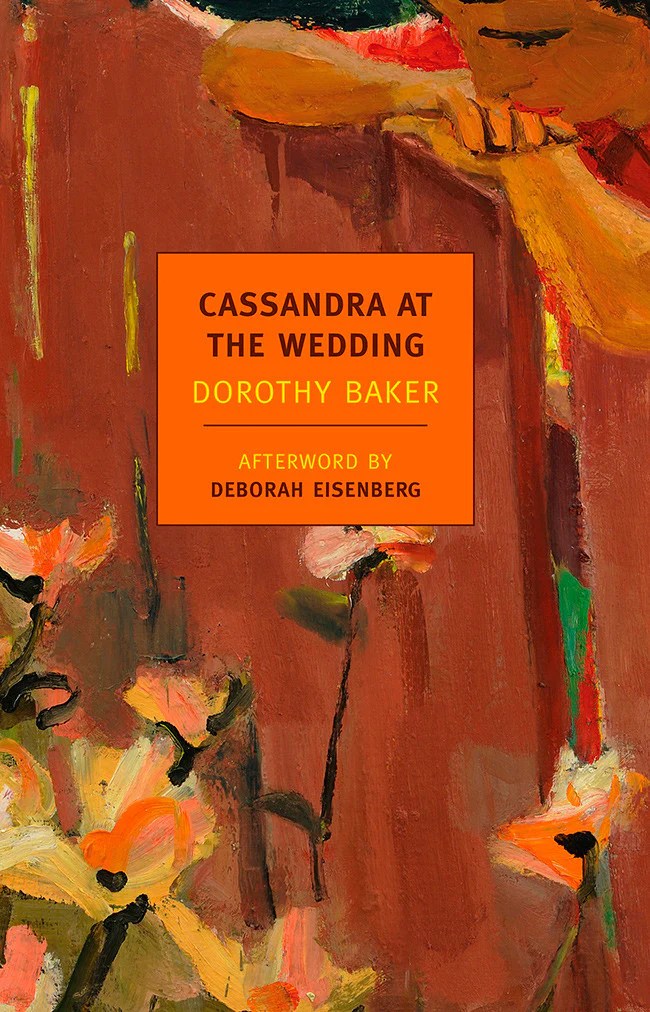
Early in Cassandra at the Wedding Cassandra Edwards tells us how “attractive” the Golden Gate Bridge looks to her. That sounds innocuous enough until she clarifies that its irresistible pull is the “appeal of a bright exit sign,” a way out of a life in which she feels rootless, dissatisfied, unhappy, angry. All that “cancels it out” is her therapist—so maybe it isn’t surprising that when she travels away from her home in Berkeley and her doctor’s support she becomes increasingly unstable. It doesn’t help that she’s traveling to attend the wedding of her identical twin sister, Judith, an event that Cassandra finds intolerable to contemplate, an unacceptable tear in the fabric of their relationship and her own identity.
What makes Cassandra at the Wedding so gripping and ultimately heartrending? Cassandra’s a pretty privileged person—a running thread in the novel is the fate of the Bösendorfer piano she and Judith co-own, and the family home where she and Judith converge for this fateful event is an elegant house with a pool and all modern conveniences—and her clear intention to derail Judith’s wedding seems petty and selfish, even mean. Her passive-aggressive refusal to get Judith’s fiancé’s name right is just one symptom of how this plays out; getting so drunk and upset that even Judith is reluctant to firmly and clearly tell her that she will not in fact call off the wedding shows us Cassandra knows only too well how to deploy her own vulnerability to get exactly what she wants.
 Cassandra, in other words, is an almost entirely unsympathetic protagonist and her manipulative mission is one we can hardly sympathize with, especially when the novel breaks from her first-person narration to Judith’s for an interval, a tactic which (among other things) makes quite sure we know that Judith’s love for John Finch is sincere, as is his for hers, and that Cassandra’s point of view is definitely not to be trusted. Unlikable characters are often the most interesting ones (I’m reading Adam Bede with my 19th-century fiction class at the moment, so the potential of virtuous ones to be wooden or static is much on my mind!), but the risk I felt Baker was taking is that Cassandra’s nastiness in combination with the basic set-up of “privileged people struggling with personal issues” could make the novel itself seem trivial.
And it was sometimes tempting to say to Cassandra “oh, just get over yourself!” What kept me going was Cassandra’s voice, which conveys so well the emotional mess she is in, as an aspiring writer inhibited from pursuing a writing career out of fear of comparisons to her mother, “author of two novels, and three plays, and quite a few screen plays, all quite well known,” dead from cancer but still a powerful presence in Cassandra’s life. Cassandra is, instead, pursuing a PhD “about writers, very current ones, women mostly and young,” work she only intermittently finds engrossing: it is, she thinks, a “gap-stopping degree.”
 Her depression (if that’s what it is—I always advice against armchair diagnoses of fictional characters, but it read like Borderline Personality Disorder to me) is also very much related to what we could consider a form of separation anxiety about the coming breach in her bond with her twin. Cassandra and Judith are already living apart, and now Judith is taking the even more decisive step of establishing not just a separate life but a new identity, one no longer defined primarily by being Cassandra’s twin sister but by being Dr. John Finch’s wife. Cassandra cannot bear the thought of being herself without Judith; she doesn’t even know who that person—that half a person, as she insists—would be or what she would be worth. Not much, seems to be Cassandra’s conclusion: underneath her desperation about Judith’s marriage is a poignant current of both self-doubt and self-hatred, and that is where the power of the novel lies, in the pain Cassandra is constantly expressing but not explicitly admitting. A sample, as Judith sets Cassandra straight about the “plan” to intercept John at the airport and tell him the wedding is off:
‘I know I never said I’d let you go get him,’ she said now. ‘You thought it up; and after all the trouble about the dress, I didn’t think it was a very good time to get you all stirred up again. It was almost morning.’
‘Stirred up,’ I said, ‘girl you do talk like granny.’
‘What do you want me to say—disturbed?’ she said.
I felt a knife go in and twist around. For a moment everything stopped. Then I turned over again and lay flat and heard the pounding behind my ears, and felt the whirling in my head and the bitterness welling up out of m own personal well of bitterness, and I let it well. I think I may even have felt a certain relief, because nothing worse could happen now. I’d had the mortal blow, I’d received the Judas kiss with that word disturbed. . . . I lay there and listened to the roar, and once in a while the sounds would come down to me from up there where the assassins were hobnobbing with the traitors and hatching their plots, up there in the seersucker shirt. Who cares, it’s over. But I kept hearing my name in all its forms: ‘Cass, listen to me,’ and ‘Look, Cassie,’ and ‘Hey, Cassandra Edwards, don’t make a big thing of this. Let’s just not get into any more of these, shall we? Let’s not. Can’t we work up a little togetherness around here, and just accept the fact that I’m going to marry a man named Jack Finch, and his name isn’t Walter Thorson, and I’m sure you’ll like him very much, and that he’ll adore you. That’s how it ought to be, and that’s why we came out here to get married—so that he’d know my family and they’d know him. Don’t you see?’
But how can you see if you’re dead, and I was good and dead.
The hyperbole, the melodrama, the outrage, all juxtaposed against Judith’s perfectly reasonable attempts to talk her sister around: it’s hard, actually, to know who to feel more sorry for, because while Judith has every right to live her own life, Cassandra’s suffering, however unreasonable, is so palpable. And suffering is rarely reasonable anyway: if it were, people could be talked out of it. The question in this case is how far Cassandra should be allowed to set the terms for Judith, or what Judith should be willing to sacrifice to save her sister, if indeed that’s what Cassandra needs from her.
 Cassandra does eventually take a drastic step to set her sister free. “We should have been one person all along,” she thinks, “not two, and this way the other one could live it out, possibly with some part of my spirit alive in her to the end of her days to make up for the part of her I might take with me today.” This is not a real or good solution, though: even Cassandra wonders what her decision might do to Judith. If the novel had allowed her to end her attempts at sabotage in this way, it would also have preempted the quest she is on from the first moment she tells us she is drawn to the bridge, the journey to confront and then accept herself, alone, one person. I didn’t think the flying visit from her therapist was a very plausible or convincing part of her extrication, but that she does ultimately attend Judith’s wedding seemed necessary to that process, and the novel’s ending successfully, I thought, walked the fine line between pat and thus unsatisfying optimism and a more provisional commitment to a way of being that is still uncertain but, at least in the moment, bearable:
I was wearing loafers and socks and on the way back I was walking faster and one of my socks kept crawling down behind my heel. I stopped and pulled it up two or three times and finally I slipped the shoe off and dropped the sock over the side and stood where I was and watched it go. Or tried to. It took immense concentration to stay with it. When I thought I’d lost it for good, the wind caught it far down and I saw it flash in the sunlight, once, and again, and maybe even a third time. But after that I don’t know. It was out of sight a long time before it could have hit the water.
You just have to keep going, Cassandra concludes, contemplating again her vocation as a writer: “Don’t lean. Stand up. Find a way.” If we are meant to read Cassandra at the Wedding as the result, it is more than a record of destructive self-absorption: it is a confession, an apology, perhaps even a redemption.
 Novel Readings
Sounds too frightening to read, Rohan, but valuable to know that books like this are there. Not sure it is for me, however. Just getting caught up with non-fiction WRITING (and lecturing) is quite enough, thank you… Patricia
LikeLike
I’m not sure I would call it “frightening” (it’s just family drama, after all!) but it is certainly very emotionally intense.
LikeLike