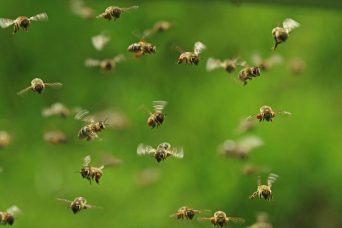
 I’ve always loved these lines from Tennyson’s The Princess:
The moan of doves in immemorial elms,
And murmuring of innumerable bees.
All those soft sounds: how gentle and enticing! But unfortunately they are on my mind right now because I’ve been feeling so overwhelmed with the start of term: it’s my head that seems full of buzzing bees, and that is not so pleasant.
The start of term is always chaotic, and really overall things are going fine, I think. Maybe it’s age that makes me more aware, in a worried sort of way, of just how many moving parts there are, of how many balls I have to keep in the air at all times just to keep myself and my students on track. I used to trust myself to do it all, but these days my executive function and memory just aren’t what they used to be. Announcements and assignments, lecture notes and handouts, attendance lists and spreadsheets, slides and quizzes and worksheets—oh my!
 Actually, thinking about it now, maybe there are more moving parts than there used to be. Once upon a time we didn’t use an LMS, for example, and while there’s no doubt that Brightspace (formerly Blackboard formerly Web CT formerly DIY websites) is a useful back-up system for in-person courses—a storage facility available to your students 24/7 so they can never not locate their syllabus!—it’s also the case that expectations have gone up considerably around our use of them (and students’ reliance on them). Now I post my PPT slides on Brightspace after class, for example, something that requires multiple additional steps, assuming I remember to do it in the first place. (I never used to use PowerPoint, either, and I blame it and Brightspace, which both require incessant mousing, for my now chronic shoulder pain.) I used to give quizzes and midterms in class; now, they are all taken in Brightspace—but that too means many more steps than devising the questions and making copies, setting up all the many features just right and entering the questions in the optimal way. When we were all online, I posted weekly announcements for my classes: it turns out students really appreciated these, so I’ve kept doing them, but they take me (no kidding) hours to compose, both to make sure they are optimally clear and useful and because heaven forbid there’s a mistake in one, like a wrong deadline, that gets fixed in their minds or calendars in spite of any subsequent efforts to correct it! Recently, too, in a departmental discussion around class size and workload, one of my colleagues pointed out ruefully that “there didn’t used to be email” and that is such a good point, especially as our class sizes have gone up even as we became not just teachers but customer service representatives! (And yet somehow, without an LMS and without Outlook and without PowerPoint, we managed to do our jobs. Imagine that. Did we do a worse job? Maybe in some respects—accessibility seems like a key point here—but I really do wonder how much all of this apparatus actually helps, rather than hinders, us in our core mission.)
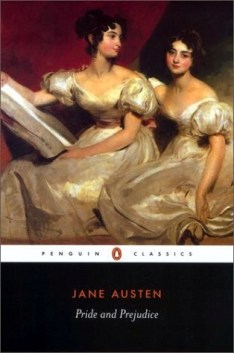 How are things going otherwise in my classes? So far 19th-Century Fiction seems great (I hope it’s not just me who thinks so!). It’s the Austen to Dickens version this term, and I took the risk of assigning Pride and Prejudice, which as regular readers will know I sometimes shy away from, not because I don’t love it but because it’s too popular! It is so delightful, though, and I figured that given <waves hand around> the state of everything, personally and generally, there couldn’t be such a thing as too much enthusiasm. Good call, is my current impression. There is so much positive energy in the room! Last year in Dickens to Hardy it sometimes seemed like such a struggle, despite there being so many keen students in the class; and it was so discouraging to watch attendance dwindle, especially during our time on Middlemarch, which I had been so looking forward to. I really hope we can sustain the current level of engagement when we move on to Jane Eyre next week. It can be self-fulfilling: if it’s fun to come to class, people keep coming. So that’s my goal!
 My other class this term is a section of intro, once again the prosaically-named “Literature: How It Works.” But this time it’s in person, because I was so disheartened by the end of last year’s online version that I couldn’t face doing it that way again. I spent a lot of time this summer thinking about how to revamp my specifications grading model to incorporate in-person components. I feel a bit guilty about the amount of paper I’m using up as a result, but I am hopeful that it will pay off in terms of attendance and engagement and in building skills and instilling confidence so that they realize they don’t need to look everything up online but can learn to do the work of literary analysis themselves and get more out of it in the process. We’ll see! I always start with poetry, and we’ve done some bangers already, including Seamus Heaney’s “Digging” and “The Grauballe Man”; “My Last Duchess”; “Aunt Jennifer’s Tigers”; and today, “Musée des Beaux Arts.” Judging from our class discussions so far, it does seem to me that not everyone (ahem) is actually doing the reading before class, something I hope the in-class exercises will encourage them to do more consistently. I wonder if the need to do that advance work seems less pressing when it’s “just one poem,” and so it gets shunted aside for “harder” homework. There are definitely hands going up when I pose questions, though, and it’s early yet: my job here is to make it seem necessary to come prepared but also safe to try out preliminary or uncertain ideas, since so much of the real teaching and learning happens in those exchanges.
It was a bit of a rough summer, so in some ways I welcome the demands and distractions of the term. As it all settles into routine, the buzzing will hopefully subside into a manageable murmur. I have some other things on the go as well, most immediately a review of David Bergen’s Away from the Dead for the Literary Review of Canada—it’s my first time writing for them, so I’d like to do a good job! I also spent a couple of enjoyable hours recently in interviews with some folks who are putting together a documentary on Wilkie Collins for the CBC show Ideas. I’m just one of several interviewees, so I don’t know how much of me you’ll actually hear when it airs, which will be sometime early in 2024, in honor of his bicentenary. I don’t seem to be reading much (except for work, of course) but when I am, it’s either Loretta Chase’s Carsington series for relaxation (Mr. Impossible is still my favorite!) or Claudia Piñeiro’s A Little Luck, which seems likely to be every bit as good as Betty Boo. Maybe this weekend I can settle down enough to finish it, and then write it up properly here, the way a real book blogger should!
 Novel Readings
The other day I arrived in class and logged into a) the classroom computer, b) my Office 365 account, c) the LMS. All the same login credentials, mind you, but they have to entered 3 times. AND my name is long, AND my password must be long! I thought a bit sadly about how I used to roll in with a few sheets of acetate to slap on the overhead projector. If I totalled all the minutes I spent logging in and waiting for stuff to boot up and load. . .
I certainly empathize with the bees and how juggling feels harder now.
LikeLiked by 1 person
Yes! And now there’s two-factor authentication, which means so many more little hiccups (is my personal phone on and ready to hand, for instance?). I mostly try to teach 19thC fiction in a low-tech way day to day, just me and the book (and some notes) and the whiteboard. Maybe next year I will try to do that in intro and just see what happens.
LikeLike
You mentioned teaching My Last Duchess and I wondered if you knew that Maggie O’Farrell’s latest novel The Marriage Portrait is based on this? It’s on my To Read list.
LikeLike
I do know that – in fact, I reviewed the novel for the TLS (and was interviewed about it on their podcast): https://www.the-tls.co.uk/articles/the-marriage-portrait-maggie-ofarrell-book-review-rohan-maitzen/
LikeLike