My recent reading has included one book that is suspicious of story but clever (perhaps too clever) about plot and (for my taste anyway) shallowly dismissive about the possibility of meaning; another that is very conventionally plotted and pretty compelling reading but didn’t yield much deeper meaning; and then one more that I think really effectively combines plot, story, and meaning.
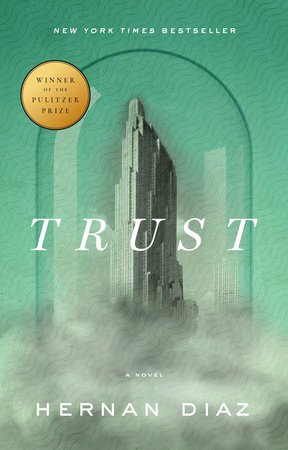 If you’re a friend of mine on social media, it won’t surprise you that Hernan Diaz’s Trust is the first one. It is an inarguably ingenious novel, but I thought (and the other members of my book club agreed) that the payoff for its ingenuity in the second half wasn’t enough to make up for the extraordinary, if self-conscious, dullness of the first half. Even a novel that can only really light up on a second reading can (and, arguably, should) generate some excitement the first time through. For me, a case in point would be Atonement, which is a much more layered and complex novel on a reread but which is also exceptionally well written and engrossing to begin with—that’s one of the reasons its big ‘twist’ is so important. If you want to write a novel that is implicitly or explicitly about the power of fiction(s), shouldn’t it actually be powerful fiction? But Trust not only drags on (and on and on) but eventually fizzles out. I assume that it does so to prove its point that there isn’t really anything solid at the heart of the stories we tell—that authenticity and identity are both also fictions, the way money and narrative both are (this is one of the novel’s central conceits). OK, fine, but that’s not only an unsurprising (dare I say unoriginal?) idea but a kind of lazy one. What if narrative is precisely the way we explore and discover and create meaning? Meaning doesn’t have to be absolute to matter, either, and human stories of the kind Trust plays with do matter, even if they are bound together in some ways by artifice. The novel’s embrace of vacuity as a premise and theme left me shrugging, and (something we talked about quite a lot at our book club meeting) it also produced a novel in which even the most painful human experiences were fairly boring to read about, and that’s not just disappointing, it’s also disturbing. Plenty of critics found a lot to admire in Trust but it just wasn’t for me.
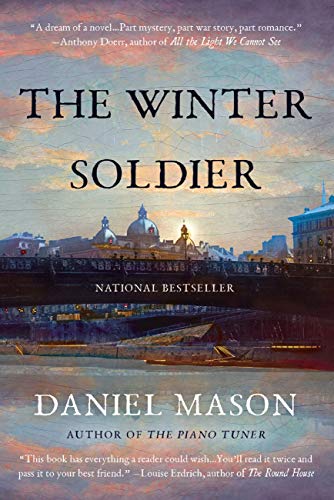 I picked up Daniel Mason’s The Winter Soldier because I’m writing up his latest novel, North Woods, for the TLS and it’s good enough that I wanted to read more by him. The Winter Soldier is quite unlike North Woods, mostly in ways that favor the newer novel—which suggests Mason is getting better at his craft! The Winter Soldier (2018) is a good old-fashioned historical novel. It is packed with concrete details that make the time and place of its action vivid in the way I want historical fiction to be vivid. It takes place mostly in a remote field hospital in the Carpathian mountains during WWI; its protagonist, Lucius Krzelewski, is a medical student rapidly converted to a doctor to serve the desperate needs of the Austro-Hungarian army. His time at the hospital is full of harrowing incidents; through them runs his growing interest in an illness that eludes physical diagnosis and treatment—what today we would call PTSD. There are chaotic battle scenes and idyllic interludes; there’s a love story as well. It’s good! It really immerses you in its world, and (unlike Trust!) makes you care about its characters. I ended it not really sure it was about anything more than that. Novels don’t need to be, of course, though the best ones are. Still, I liked it enough that I will probably also look up Mason’s other novels, starting with The Piano Tuner. North Woods is a lot smarter and more subtle, though. (I am not sure it’s entirely successful: in my review, I will say more about that, when I figure out how to!)
 And then there’s Claudia Piñeiro’s Betty Boo, which I found a really satisfying combination of smart plotting, thoughtful storytelling, and ideas that matter. In some ways it is less ambitious than the other two novels: it is structured more or less conventionally as a crime novel, and there aren’t really any narrative tricks to it, unless you count the sections that are ostensibly written by the protagonist, Nurit Iscar, about its central murder case. Iscar is a crime novelist who has had a professional setback (a crushing review of her foray into romantic fiction) and is currently getting by as a ghost writer. A contact at a major newspaper asks her to write some articles about a murder from a less journalistic and more contemplative perspective; in aid of this mission, she moves into the gated community where the victim lived and died. She ends up collaborating with the reporters on the crime beat as they investigate the death and discover that it is a part of a larger and more sinister operation—about which, of course, I will not give you any details here! Betty Boo is an unusual book: it doesn’t read quite like a “genre” mystery, as it is at least as interested in Nurit’s life and especially her relationships, with her close women friends and her lovers, as it is in its crime story. Also, Betty Boo is about crime, reporting, and fiction as themes, though its attention to these issues is integrated into the storytelling so that it never really feels metafictional—unlike Trust, which is all gimmick and so no substance, Betty Boo seems committed to the value and possibility of substance, even as Piñeiro provokes us to think about the obstacles we face in achieving it, in writing or in life, especially now that the news as a vehicle for both information and storytelling has become so degraded. I appreciated how original Betty Boo felt, and how genuinely interesting it was: I haven’t read another writer who does quite what Piñeiro does, in it or, for that matter, in Elena Knows. Of the three novels I read recently, this is the one I’m most likely to recommend to others, and I’m definitely going to read more of Piñeiro’s fiction, probably starting with A Little Luck, when I can get my hands on it.
 Novel Readings
Your comment about Trust being all gimmick and no (or very little) substance confirms my suspicions about it. I’ve seen a variety of responses, some wildly enthusiastic, others much more muted, and I can’t say it particularly appeals. Claudia Piñeiro, on the other hand, is a much more interesting proposition. I thought Elena Knows was excellent – not an easy read, but a remarkably compelling, satisfying and thought-provoking one. I really like the way Piñeiro uses elements of crime fiction to explore pressing social issues, so I’m glad to see how much you liked Betty Boo. A Little Luck sounds brilliant, too – I’ve seen nothing but praise for it so far!
LikeLike
I thought Elena Knows was such an interesting play on conventions, and this one is even more “genre but not genre.” I’ve been wondering about assigning EK in my seminar on Women & Detective Fiction, where we are as interested in what our readings have to say about women and crime as we are in them as examples of genre fiction (if that’s what they are). It’s so clear by the end of EK that one of the crimes is (to put it reductively) patriarchy.
LikeLike
So many people I know loved Trust that I sometimes thought maybe I was just not in the right mood when I read it. I found the first part (the novel) so boring I thought sure the rest of the plot would depend on it being a failure. The fact that it turned out to be successful was so unbelievable to me that it colored the rest of my read. And the end was a male writer telling the readers something women have always known.
LikeLike
That’s such a good point about the ending. I’ve been thinking that if I’d approached the first part with “what is he trying to do here?” instead of taking it more or less straight, I would have (maybe!) enjoyed it more, but the idea that it was a best-selling novel in its own day? I agree, it seems so unlikely that it threw me off too. Folks at my book club proposed that its popularity rested solely on its being timely gossip, which does seem plausible.
LikeLike
You are spot on with “Trust.” Since “Sing Unburied Sing” didn’t win–didn’t even make the finals–in 2018 I have been deeply suspicious of the Pulitzer judging panels and process. “Trust,” like “Less,” is a self-indulgent minor work at best. And, while I didn’t love “Demon Copperhead” because it hewed too closely to Dickens’s plot, I thought as I was reading it that it would be the winner. Kingsolver shouldn’t have to share her moment of glory with such a piece of experimental fiction that fails its experiment.
LikeLike
It does seem odd that the prize was split: a rarity, as far as I can tell looking back over the awards. There was a split Booker recently too. Inevitably such a decision feels like a committee compromise.
LikeLike