 I have read a fair amount of poetry in my life, for pleasure and for work. One of my very oldest books is an illustrated edition of Robert Louis Stevenson’s A Child’s Garden of Verses, and I went through a phase as a tween where I thought reading Poe’s “The Raven” or Alfred Noyes’s “The Highwayman” aloud was the height of literary engagement; around the same time, I was given an anthology of Romantic poetry, which (read obsessively but selectively) confirmed my youthful predilection for angst and pathos. Mostly I read fiction, though, so it remains surprising to me that it was a poem—Robert Graves’s “The Cool Web,” specifically—that turned me into an English major (thank you again, Don Stephens!).
My poetic horizons broadened considerably during my student years, mostly in predictable ways: the English Honours program at UBC required entire courses in Chaucer, Shakespeare, and Milton in those days, for one thing, and I actually chose a course on ‘Poetry in the Age of Dryden and Pope’ as an elective—and really enjoyed it, thank you very much! (In fact, I often reflect on how much I gained by the now old-fashioned idea that my curriculum should not be primarily determined by what I already knew I was interested in.) At Cornell too, where I did my graduate studies, historical breadth requirements meant a fair amount of attention to poetry across time.
 Since I became an English professor myself, my research and teaching has primarily focused on fiction, but I actually consider poetry the highest form of literary art, and I always look forward to the chance to work through some examples with my students, something I rarely get to do except in first-year courses or when I teach our ‘theory and methods’ course on close reading. Once upon a time we had a full-year Victorian Literature course, which meant plenty of poetry and even (rarer still) some of the period’s great “sage” writing, and today sometimes I get to teach our survey course on British Literature from 1800 to the present: hooray, more opportunities for poetry! I also regularly assign as much of Aurora Leigh as I dare in my seminar on the Victorian ‘woman question.’ (If you’re curious about how I approach these courses, the index to my series of posts on “This Week In My Classes” will lead you to all kinds of reflections on them.)
And yet in spite of this long experience—or because of it, in a way, as it has been so miscellaneous and in some respects haphazard, driven by immediate requirements, constrained by the contents of anthologies or the imperatives of course design—I consider myself both amateurish and ignorant about poetry, at least compared to those who really work with and on it, as teachers and scholars, or as poets themselves. I’m particularly stupid about most very contemporary poetry: when I do dip into it, I am often baffled or alienated or bored, reactions which I genuinely believe are as much my fault (maybe more) as the poets’. I am professionally committed, after all, to the idea that reading well is something we have to learn to do!
 When I teach poetry, something I often remark is that even the most skeptical among us tacitly acknowledges its power and value on special occasions—weddings, for example, and funerals. There is something about poetry that we need, not just at those times but especially at those times. I knew this already in theory but only really understood its truth when Owen died. Lines of poetry that I had read many times before became new to me, in terrible but also beautiful ways; I reread them over and over, and also sought out (and was offered) more. Sometimes the words brought comfort, but more often they offered confirmation: yes, this, this is how I feel, this is what I would say myself, if I could. I have found some passages of prose that bring the same relief, but it is still poetry I turn to when the grief is hardest to bear. I copy passages into my journal and save screen shots, an ongoing commonplace book of sorrow. I don’t necessarily think that this is the best way, the best reason, to read poetry. It can feel solipsistic; I wouldn’t want it to be the only way I (or anyone) read poetry. I wouldn’t want these to be the only poems I read.
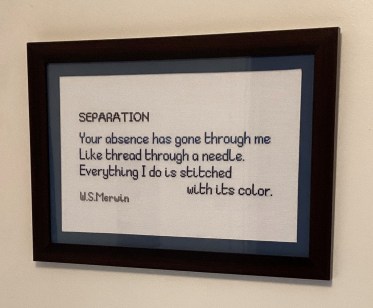 I would like to read more poetry, and to read more different kinds of poetry better. You’d think this would be easy, and of course the steps themselves are simple enough, but the feeling of not “getting” it (which I have, cumulatively, spent many hours trying to train my students out of) does get in the way of my good intentions. Lately, therefore, I’ve come up with a little game I call “Poetry Serendipity”: every time I go up into the stacks of the university library, I take different routes on my way to and from whatever section I am specifically visiting and, as I wander, I scan the shelves for names I recognize or (more random and risky, but also more fun) for those tell-tale slim volumes that you just know must be poetry collections. Sometimes I have a few names in mind, so that if I notice I’m in the (say) contemporary American section around names starting with M or P, I can look around for (say) W. S. Merwin, or Marge Piercy. I sign out a few books, bring them home, and browse them without purpose or pressure. If I like something, I pause and reread; if I don’t connect, I close the book and move on without shame or regret—sometimes from very famous poets! I haven’t had many big successes, but pretty often I find at least one poem I like enough to copy out. Along the way I think I am learning something about myself as a poetry reader. I like form, or the feeling of it; I like clarity, sometimes (though not always) simplicity; I like concrete details; I like ideas but not elusive abstractions; I like moments in time, poignant or reflective; I like calm, and melancholy, not exultation; I do not like religion (with rare exceptions). Yet somehow I also like many poems that meet none of these specifications.
Here are a couple of poems I have copied out, from among the ones that aren’t (for a change) about grief, or not overtly. Maybe you already know them, or maybe for you too they will feel like lucky finds, a bit of poetic serendipity.
The Bookstall
Just looking at them
I grow greedy, as if they were
freshly baked loaves
waiting on their shelves
to be broken open—that one
and that—and I make my choice
in a mood of exalted luck,
browsing among them
like a cow in sweetest pasture.
For life is continuous
as long as they wait
to be read—these inked paths
opening into the future, page
after page, every book
its own receding horizon.
And I hold them, one in each hand,
a curious ballast weighting me
here to the earth.
— Linda Pastan
Otherwise
I got out of bed
on two strong legs.
It might have been
otherwise. I ate
cereal, sweet
milk, ripe, flawless
peach. It might
have been otherwise.
I took the dog uphill
to the birch wood.
All morning I did
the work I love.
At noon I lay down
with my mate. It might
have been otherwise.
We ate dinner together
at a table with silver
candlesticks. It might
have been otherwise.
I slept in a bed
in a room with paintings
on the walls, and
planned another day
just like this day.
But one day, I know,
it will be otherwise.
— Jane Kenyon
At a Bach Concert
Coming by evening through the wintry city
We said that art is out of love with life.
Here we approach a love that is not pity.
This antique discipline, tenderly severe,
Renews belief in love yet masters feeling,
Asking of us a grace in what we bear.
Form is the ultimate gift that love can offer—
The vital union of necessity
With all that we desire, all that we suffer.
A too-compassionate art is half an art.
Only such proud restraining purity
Restores the else-betrayed, too-human heart.
— Adrienne Rich
One of my luckiest finds so far has been Elizabeth Jennings. She turns out not to be particularly obscure, but I had never come across her before. After I went through the first of her collections that I’d brought home, I went back for more. Here’s one of hers that I like.
Answers
I kept my answers small and kept them near;
Big questions bruised my mind but still I let
Small answers be a bulwark to my fear.
The huge abstractions I kept from the light;
Small things I handled and caressed and loved.
I let the stars assume the whole of night.
But the big answers clamoured to be moved
Into my life. Their great audacity
Shouted to be acknowledged and believed.
Even when all small answers build up to
Protection of my spirit, still I hear
Big answers striving for their overthrow
And all the great conclusions coming near.
— Elizabeth Jennings
I own only a handful of poetry books (not counting the many anthologies and readers and textbooks I have accumulated for work): the collected poems of Philip Larkin, of Elizabeth Bishop, of Mary Oliver; Daniel Mendelsohn’s translations of Cavafy; Sylvia Plath’s Ariel; some Daphne Marlatt. Of these, Larkin is my favorite (and “Aubade” my favorite of his poems)—my tastes and interests lean pretty conventional, I guess, which is fine with me. I wonder if it counts as “winning” my game to find someone else whose poetry I want to buy, not borrow. In the meantime, I’ll keep browsing.
Do you have any favorite poets, preferably lesser-known, that you think I should keep an eye out for as I wander the stacks?
 Novel Readings
I am not aware of Elizabeth Jennings. I will look up more of her poetry. Thank you for the introduction.
LikeLiked by 2 people
I love your idea for poetry serendipity!
My favorite poets, in addition to Larkin, are W.H. Auden and Wallace Stevens, along with Howard Nemerov, Edward Field, Dorianne Laux, Stanley Plumly, Billy Collins, James Wright, Mary Oliver, Naomi Shihab Nye, and Stephen Dobyns.
If you’re ever interested in reading Postcard Poems, I can send you a copy.
LikeLike
Auden and Stevens are good suggestions: of course I know the most anthologized ones, but I’ve never ranged more widely across their oeuvres. I know one poem by Naomi Shihab Nye (“Kindness”) and really like it, so that’s definitely another name I should pursue.
LikeLike
Also, I would be honored to get a copy of Postcard Poems: it would be so kind of you to send me one. I can DM you a mailing address on Twitter.
LikeLike
Stevie Smith!
William Carlos Williams (the film Paterson, 2016, with Adam Driver – is excellent on poetry as an everyday occupation!).
LikeLiked by 1 person
Elizabeth Bishop’s “One Art” is one of my favourite poems. Teaching poetry is the highlight of my teaching year.
LikeLiked by 1 person
It always makes me sad that students typically are very wary of it. I spend a lot of time trying to demystify the process of reading it.
LikeLike
I hope my students, when they encounter poetry in post-sec studies, approach it with pleasure. I tend to concentrate on narrative poetry in the early grades to get them used to it. Doesn’t work for all, but it does for some.
LikeLike
Oops, hit the send button prematurely. I meant to add that my favourite poets, quite conventional here too, are Robert Frost and Emily Dickinson. I do love Cavafy, but no translation has ever been able to capture the thrill of him in Greek.
LikeLike
The thing about “conventional” taste is that pretty often, the best-known writers are well known for good reasons. I resent the attitude you sometimes see in discussions on Twitter (and elsewhere) by which anything familiar is just cliched. It’s a kind of “hipster” credentialism.
LikeLike
Well, no one is greater than Dickinson or more difficult. I call my Dickinson unit “Beyond the Thing with Feathers”; and Frost, “Beyond the Road Not Taken”. I remember once trying to teach “Crazy Jane Talks with the Bishop”…LOL, it didn’t go well. Plath’s “Daddy” and “Lady Lazarus” were huge hits, but the school counsellor nixed them from my curriculum.
LikeLike
P. S. “Hipster credentialism” is now my go-to!!
LikeLike
On the one hand, I have many favorites; on the other, I like your method, which I also use sometimes. I think my latest success with it was W. J. Herbert’s “Dear Specimen” (2021), which links illness and scientific museum specimens in interesting ways. I guess, then, that is my recommendation.
LikeLike
That’s definitely a new name to me: thank you! I have many favorites too, mostly older (predictably, many from the 19th century); the challenge for me is to read past Tennyson and Hopkins and Browning. I know a smattering of 20thC poetry quite well but it tends towards the obvious, because it’s mostly what I find in anthologies.
LikeLike
There’s so much that resonates with me here. I’m bookmarking it (plus the recommendations in the comments) to come back to. As Carolyn said, thank you for acquainting me with Elizabeth Jennings.
Here are a few poets, books, and individual poems that might strike a chord with you:
Natasha Trethewey
Donald Hall, Without — a book about the death of his partner Jane Kenyon—since you like her “Otherwise”
May Sarton, esp. “Dutch Interior” and “A Glass of Water”
Wisława Szymborska
the anthology A Book of Luminous Things, ed. Milosz
LikeLike
Thank you for these names! Sarton is someone whose poetry I have tried before, because I love some of her memoirs so much, but without much success. I don’t think I know either of the two you’ve named, though.
LikeLike
So much of your experience with poetry resonates with me—right down to love of “The Cool Web” as the mark of a future English major, ha! I think that getting on the Poetry Foundation’s poem a day email list is my form of serendipity. I don’t read them every day, but I’ve certainly encountered a lot of new-to-me poets that way. (My friend had an Elizabeth Jennings poem, I think “Friendship,” at her wedding, but I think that’s all the Jennings I ever read).
When I go to the library I’m often looking for books from awards lists, which has been a pretty good discovery method, but I like your lucky dip style. I also look at whatever is new to see if it catches my fancy. This has meant I mostly read contemporary poetry “for fun”—maybe older poets remind me too much of work, but I certainly love them, so perhaps I should go back. Hardly unknown, but I really like Sharon Olds, Ada Limon, and, like Hope, Natasha Trethewey. My most recent library checkouts were Peter Cole’s “Draw Me After,” which I liked a lot, and Adam Zagajewski’s “True Life” (him I discovered from a daily poem, the wonderful “Try to Praise the Mutilated World”).
LikeLike
A. E. Stallings
LikeLike