 I don’t want to leave the impression that frustration with the rigidity of academic practices is all I took away from my Louisville conference experience. There was definitely value for me in the work I put into my own paper, as well as in hearing and discussing the papers my co-panelists presented. So I thought I’d follow up my previous post with a sketch of the questions I went to Louisville to talk about.
My paper was called “Book Blogging and the Crisis of Critical Authority.” During the discussion after our papers, all of the panelists agreed that things have died down since the days when you could hardly turn around without seeing yet another “bloggers ruin everything” article. A few diehards still take every opportunity to decry the temerity of feckless amateurs who think they can just go online, say whatever they want, and call themselves “critics” (I’m looking at you, William Giraldi), but by and large (as Dan’s paper convincingly argued) the success of many serious web magazines has proven that online criticism can be as good as if not better than its old media competition, and book blogs in all their idiosyncratic variety are now a familiar, if not always respected, feature of the critical landscape.
Daniel Mendelsohn’s conspicuously temperate “Critic’s Manifesto” was one sign of the changing times; in it he acknowledged (as so many of his professional colleagues would not) the existence of “serious longform review-essays by deeply committed lit bloggers.” Mendelsohn did still conclude that “everyone is not a critic”; he cites “expertise and authority” as crucial qualifications (“knowledge … was clearly the crucial foundation of the judgment to come”) along with a more ineffable quality that he sums up as “taste” (“whatever it was in the critic’s temperament or intellect or personality that the work in question worked on“). Though he concedes that the requisite knowledge does not depend on formal credentials such as Ph.D.s, he does ultimately describe the critic’s job as being “to educate and edify” — so, it’s still a top-down or hierarchical model.
 Mendelsohn’s article was one of the sources I cited in my paper, in which I explored some questions about what we mean by “critical authority.” As he notes, once you move outside the academy degrees are neither a necessary nor a sufficient measure of the relevant expertise. But it’s not easy to pin down what does count, how authority is established, especially in a field of inquiry where there are no sure or absolute standards of judgment. Literary critics know that their authority is unstable because the history of criticism teaches us how judgments change over time, while simple experience shows us how much they differ among individuals. We can call variant assessments “gaffes” or “errors in individual taste,” as Mendelsohn does in his recent New York Times review of A. O. Scott’s Better Living Through Criticism, but he can’t actually prove that “early and wince-inducing takedowns of John Keats’s poetry, [or] of “Moby-Dick” are flat-out wrong any more than I could convince my Modernist colleagues that George Eliot is objectively a better novelist than James Joyce. Still, the rhetoric of criticism as well as its traditional methods of delivery typically seek at least the appearance of offering definitive judgments. As Sebastian Domsch argues in his interesting essay about ways the internet transforms critical genres, criticism has typically attempted to be and sound “monologic,” as if “everything that needed to be said has been said and there are no more follow-up questions possible.”
One reason blogging aroused such hostility, I proposed, was that it exposed the artifice of this model, and indeed of any idea of literary criticism as a series of edicts issued from on high, leaving critics themselves exposed, not as frauds, but as less authoritative than they pretended to be. As Mendelsohn says in his review of Scott, “the advent of the Internet” has “rais[ed] still further questions about authority, expertise and professionalism”; I argued that it has done so by breaking down monologic forms and exposing the inherently dialogic nature of both critical judgments and critical authority. Domsch defines “critical authority” as “the level of acceptance that is conceded by a reader to an aesthetic value judgment”: I think he is right to emphasize that this kind of authority is not inherent in the speaker but conferred by context and audience. In my paper I drew on Wayne Booth’s notion of “coduction” to make the case for the importance of dialogue in developing critical judgments, and I pointed to blogging as a form that establishes “follow-up questions” as both a natural and an inevitable part of criticism.
 If critical authority is not something you simply have but something you have to earn and maintain by your own participation in a dialogue — if it is best understood not so much as a top-down assertion of superiority (“the critic’s job,” Mendelsohn proposes in his recent review, “is to be more educated, articulate, stylish, and tasteful … than her readers have the time or inclination to be”) but as a process of establishing yourself as someone whose input into an ongoing conversation is sought and valued — that helps explain why “expertise” is such a tricky thing to define for a critic. Mendelsohn’s original formal training is as a classicist — despite his wide-ranging erudition and critical prestige, he would almost certainly not qualify for an academic position in any other field — but obviously he has written with considerable insight on a wide range of subjects, from Stendhal to Mad Men. That so many of us read Mendelsohn’s criticism with interest and attention no matter what he writes about is a sign that we have come to trust him, not as the last word on these subjects, but as someone who will have something interesting (“meaningful,” to use one of his key terms) to say about them. If we disagree with him, we are not challenging his authority but continuing the conversation — and in fact one thing I’ve been thinking a lot about is how little disagreement really matters to this kind of critical authority. If what we go to criticism for is a good conversation, then engaged disagreement can be seen as a sign of authority — a sign that you care enough about the critic’s perspective to tussle with it, if you like. I can think of a number of critics in venues from personal blogs to the New Yorker whose views I would not defer to, but which I want to know because they provoke me to keep thinking about my own readings — which (however definitive the rhetoric I too adopt in my more formal reviewing) I always understand to be provisional, statements of how something looked to me in that moment, knowing what I knew then, caring about what I cared about then.
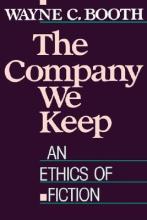 I’m not saying we can’t or shouldn’t defend our critical assessments, but awash as we are and always have been in such a variety of them, it would be naively arrogant at best and solipsistic at worst to imagine ourselves as “getting it right,” no matter who we are or where we publish. Blogging very often reflects that open-endedness in its tone, and its form is based on just the process Booth describes as “coduction”:
‘Of the works of this general kind that I have experienced, comparing my experience with other more or less qualified observers, this one seems to me among the better (or weaker) ones, or the best (or worst). Here are my reasons.’ Every such statement implicitly calls for continuing conversation: ‘How does my coduction compare with yours?’
The comment box makes that implicit call explicit. This doesn’t mean “erudition, taste and authority” (the qualities Mendelsohn repeatedly invokes) don’t matter — though the extent to which they matter will depend on what you want from criticism. Domsch argues, for instance, that Amazon reviewing ultimately returns us to the most monologic form of criticism: people seek out, or are steered to (by algorithms, ‘like’ buttons and so on) the reviewer whose views and tastes are closest to their own, and once they find their “virtual” critical self, their critical proxy, as it were, they have found their perfect authority, a guarantor of their own well-established tastes. But Amazon is fundamentally about shopping. If you read criticism for some reason other than deciding which book to buy next, you are likely to look for and concede authority to different qualities. In my paper I noted that I don’t want to be told about books — I want to talk about books. So sympathetic as I am with most of what Mendelsohn says, I resist his insistence on the critic’s superiority as a necessary or structural part of the relationship.
The result of accepting, rather than resisting, the challenge blogging poses to old-fashioned critical forms is, I argued, not a catastrophically relativistic criticism of the kind Peter Stothard dreaded but a pluralistic criticism, such as that described by Carl Wilson in Let’s Talk About Love:
a more pluralistic criticism might put less stock in defending its choices and more in depicting its enjoyment, with all its messiness and private soul tremors — to show what it is like for me to like it, and invite you to compare. This kind of exchange takes place sometimes on the internet, and it would be fascinating to have more dialogic criticism: here is my story, what is yours?
I’d be very interested to know what you think about this argument, particularly about my proposal to redefine “critical authority” in a more reciprocal and context-dependent way than the anti-bloggers always do. What makes a critic “authoritative” to you? Or is “authority” not something you think or care about? If it isn’t, how would you explain what makes a critic someone you want to listen to or engage with? Are there critics you pay attention to because their taste (I might prefer the term “sensibility” myself) reflects yours, or because they push you to less familiar points of view? Does disagreeing with a critic make you doubt them, or does it depend on the critic, or the context? More generally, what do you want from criticism, and how do you think that affects where you read it and who you listen to?
The first picture here is one I took of the Big Four Bridge across the Ohio River from Louisville to the Indiana side. It was a really nice walk across and back!
 I’m back from Louisville, where
  Even taking these good things into account, though, I left Louisville feeling more than ever that, as a profession, we need to rethink how we do things. One of the main incentives for me to participate in this panel was that I have recently been given emphatic notice that I haven’t been going to the number of conferences expected of someone in my position. A significant number of academics apparently consider frequent conference-going a key measure of scholarly productivity and knowledge ‘dissemination.’ Frankly, I thought this was bollocks when it first came up as a criticism of my record, and my experience in Louisville only confirmed me in that view. Here’s why: Under pressure to show I am doing the “right” things professionally, I traveled a long distance at great expense (a significant amount borne by me personally, as the funding available did not cover nearly the full cost) to present a 20 minute paper to an audience of 8 people. All around me, hundreds of other academics were there doing the same, sometimes to even smaller audiences (the smallest I saw was 3 people plus the panelists, the largest, excluding keynotes, was about 16 — for a panel on Joyce — and one of the keynotes itself had an audience of maybe 15). Though there’s no doubt that some of the attendees were genuinely engaged with the papers they heard, most of them will take little concrete away besides a vague sense of the argument. One questioner at a panel I attended prefaced his remarks (as usual, questions were usually of the discursive rather than inquisitive variety) by saying that he’d heard a paper at another conference by someone whose name he couldn’t remember making an argument he dimly recalled had been somewhat similar to the one he’d just heard: though I’m sure there are some exceptions, that impressionistic result seems to me pretty typical, at least of a conference as diffuse as this one.
 The small audiences and inchoate overall experience is in part a function of the kind of conference this was: papers were collected under a very large umbrella, and (I suspect) accepted somewhat indiscriminately, perhaps with the admirable goal of being inclusive. But when there are 10 or more concurrent sessions in every time slot, there’s little chance of robust numbers at any given panel, and even less chance of a sizable cohort of conference-goers having much of a common experience and thus much deep, shared conversation. My experience of
  Once upon a time going to conferences really was our best option for letting a wider audience know what we are working on, for getting feedback on work in progress, and for networking with colleagues in our field. But while I think it is possible for a conference experience to be genuinely valuable, particularly if the conference has a narrower focus and a different format (a friend of mine speaks very highly, for instance, of the
  I think I personally would have found the Louisville conference more intellectually stimulating if I were a modern literature scholar myself: I had a harder time even than usual latching on to the papers’ arguments because they were typically quite specialized contributions to scholarly inquiries I know little about. I went mostly to Woolf panels because at least there I knew the primary sources a bit! (I was interested to note that there were no papers, much less panels, on Winifred Holtby or Vera Brittain at all; there was one paper on Sayers, but I saw no sign of Rebecca West or Rosamond Lehmann or Mollie Panter-Downes or Elizabeth Taylor or Olivia Manning or any of those I think of as the ‘Virago’ set. Eliot, Pound, Woolf, Joyce, a bit of Lawrence and Forster — this was a pretty canonical outing. You 20thC people can tell me if that’s typical or just Louisville.)
 It’s an image that is specific to Lily’s situation and history, but it’s also the familiar refrain of women seeing the myth of their influence, and the perfection of their weakness, exposed as lies that serve everyone but them. It’s not just Becky shamelessly marketing herself, but Amelia, trying to scrape together enough money to keep her son at home, and Gwendolen presenting herself to Klesmer in the vain belief that she can be a great singer just by wishing it so, and Isabel imagining she has not just the freedom but the wisdom to choose her future.
 Lily’s life does end on a “tragic yet sweet” note: tragic because she is hopeless and, she believes, loveless; sweet because she spares herself (or is spared — Wharton carefully avoids the specificity of suicide) the further — perhaps even worse — compromises she sees in her future, and also because at least in death she is loved for herself, not just for the market value of her beauty. I don’t think Wharton means to leave us in despair, despite Lily’s catastrophic decline: Selden’s belated arrival is one sign that something better is at least imaginable. As he thinks, kneeling by her death bed, “at least … if the moment had been fated to pass from them before they could seize it, he saw now that, for both, it had been saved whole out of the ruin of their lives.” That such a moment is even possible is a slim but real victory for optimism. That its promise is unfulfilled leaves us with the dissatisfaction that we also feel finishing Daniel Deronda and The Portrait of a Lady. Surely something better should be possible for these remarkable women: what a waste their worlds have made of them!
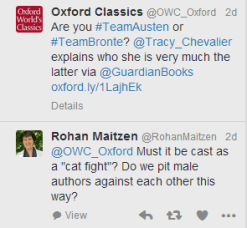 I got a bit snippy with the tweeters from Oxford World’s Classics a couple of days ago. Poor things: they were just doing their job, spreading some news about great books and trying to get people to click through and read it. How could they know that I was already feeling grumpy, for reasons quite beyond their control, and that this particular gimmick pushes my buttons on a good day?
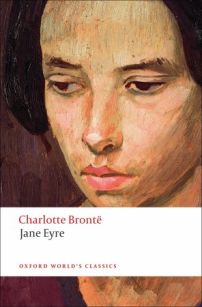 But (and you knew it was coming, right?) if for some absurd reason I absolutely had to choose, not which novelist is in any absolute sense “the greatest” but whose team to play on, it would be Brontë all the way — and I say that having only just enjoyed Pride and Prejudice entirely and absolutely for about the 50th time. We’ve just started working our way through Jane Eyre in the 19th-century fiction class and what a thrill it is. I know it’s a cliche to associate the Brontës with the moors, but it does feel as if a fresh, turbulent breeze is rushing through, stirring things up and bringing with it a longing for wide open spaces. The freedom and intensity of Jane’s voice, the urgency of her feelings, and of her demands — for love, for justice, for liberty — it’s exhilarating! I brought some excerpts from contemporary reviews to class today to demonstrate the shock and outrage with which some 19th-century critics received the novel: it’s striking how much the very qualities that enraged and terrified them are the same ones that make so many of us want to cheer Jane on. By the end we know that we should not have allied ourselves so readily with Jane’s violent rebellion, and we may even be equivocal about the conclusion to her story, but I think it’s impossible to read the novel and not be wholly caught up in her fight to define and then live on her own terms.
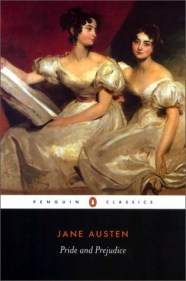 I started rereading Emma recently and had to put it aside. I appreciate that it is aesthetically and morally complex and infinitely nuanced, but I felt smothered by it: I found it claustrophobic. Brontë’s criticism of Austen is well known: she told G. H. Lewes that in Pride and Prejudice she found only “an accurate daguerrotyped portrait of a commonplace face; a carefully fenced, highly cultivated garden, with neat borders and delicate flowers; but no glance of a bright vivid physiognomy, no open country, no fresh air, no blue hill, no bonny beck. I should hardly like to live with her ladies and gentlemen,” she went on, “in their elegant but confined houses.” I think she underestimated the novel — a lot of people do, still, who see just the delightful characters moving on the surface and not the currents of social and historical change carrying them along. I’m also sure that my trouble with Emma is about me, not Austen. But I understand Brontë’s reaction, and it is just the one you would expect, too, from the author of such an entirely different book, one that opposes itself in every way to both literal and mental confinement. I think that’s why Jane Eyre refreshes my soul: it rushes with us out into the hills. Jane is so defiant, so passionate, so forthright: she speaks up so fearlessly, for herself and for the right! I wish I could always do the same: I admire her principles and envy her courage. So much as I would miss Elizabeth Bennet if for some reason I had to give her up, Jane’s the one I really couldn’t do without.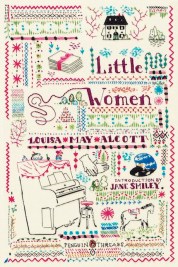
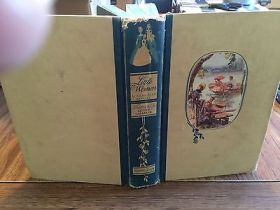 I used to read about them in my mother’s old, cherished copy: I discover, peering around online, that it was the “Illustrated Junior Library” edition from Grosset and Dunlap, with an original copyright date of 1947. The cover alone is immediately evocative of my childhood! I loved the novel and reread it often; I had been feeling mournful that I didn’t have a nice copy of my own, so I put the Penguin Threads edition on my Christmas wishlist this year and was thrilled to get it. It’s very satisfactory: not only is the cover delightful to an embroidery buff like me, but the whole volume is tactile in all the right ways, from the raised graphics on the artwork to the heavy, deckle edged pages. It feels the way a classic should.
 Like a lot of other early – to mid- 20th-century women’s fiction I’ve read (Elizabeth Taylor’s
  I ended up thinking that its lack of direction and energy was its governing idea. The narrator is stifled by her family life and by the social constraints on her behavior as well as her options: she would like to have a vocation, but she can’t really imagine what it might be. The visit that changes everything by showing her how other people live actually changes very little, at least about how she can live: its effects arise only through the new connections she makes, most of which turn out to be far less consequential than she expects. Even when they do lead to something significant (like a marriage proposal), the promised transformation ultimately has no appeal. The one big change that finally occurs at the novel’s end is so artificial, so unanticipated, that it doesn’t seem to solve or promise anything either, except perhaps that it is the beginning of the real bildungsroman, the real story of her life, which we don’t get because our novel is the story of the stuttering, inchoherent, mostly pathetic existence that preceded it. (Is it also factitious? There’s an odd moment when she frankly remarks her difficulty in figuring out how to end the autobiographical novel she’s writing / we’re reading.)
 That she is well-suited to be a writer is often asserted by people she meets, mostly because she is so observant. I suppose The Beautiful Visit does give us some evidence of that: mostly silent herself, the narrator watches those around her with a sharp, if often somewhat puzzled, eye. Her lack of experience limits her insights into others as well as herself, but what she sees, she describes. That her account is so episodic suggests her own lack of direction. Other people find her more interesting than I did: when the young man she met on the initial visit reappears and declares his passionate love for her, I wondered if he had mistaken her for someone else because she seemed such a shadow of an actual person. Is that the necessary quality of a writer, to be self-effacing enough that they elude our attention even as they claim it?
 Mantel makes the Cazalet Chronicles sound well worth reading. I’m not sure how convinced I am, however, by her broader argument that Howard is relatively unknown “because she’s a woman” writing what were perceived of as “woman’s books.” “Good books by women,” Mantel rightly notes, “fell out of print and vanished into obscurity: not just because, as in the case of male writers, fashion might turn, but because they had never been properly valued in the first place.” But I’d have to read more of Howard’s novels to see if I think they are as good as Mantel does. “Her virtues are immaculate construction,” she asserts, “impeccable observation, persuasive but inexorable technique.” I didn’t discern these qualities in The Beautiful Visit: nothing about it seems to justify falling into critical rhapsodies. I’m quite prepared to believe I am missing something about it, though — that I could learn to read it better. I’m looking forward to our discussion on the weekend.
 Thanks to Dalhousie benefactor
  In 19th-Century Fiction, we focused today on Chapter 53, “
 I got to do an extra class this morning, making a guest appearance in a colleague’s first-year seminar. I say “got to” because although it was extra work, it was of a particularly pleasing kind, as she asked me in to speak on the role of “Dover Beach” in Ian McEwan’s Saturday. I taught the novel myself an astonishing (to me) nearly 10 years ago, so I had some notes to draw on but, oddly, none specifically on the scene with “Dover Beach,” so that left me some work to do! I am
 Novel Readings