This Week In My Classes: Being Beginners

woman-writing-1934My previous post on struggling to appreciate Persepolis (like the one not long before it on reading Maus badly) exemplifies one difference between the writing I do here and most of the writing I do elsewhere (especially but not exclusively writing for academic publications). Here I’m allowed — or perhaps I should say, here I’m not afraid — to be openly imperfect: hesitant, confused, even flat-out wrong. Here, it’s OK for me to be new to something and struggling with it … and to say so.

I can imagine someone reading those posts (and the other ones like them) and wondering what’s the point. Why bother writing about something I know I don’t fully understand? Why not do the research first and then write, from a position of informed confidence? Why not earn some authority before opining? Why opine at all, really, when with the right preparation I could pronounce instead?

Some of the license I enjoy here stems from the format and ethos of blogging. Though some blog posts are highly polished and, on their own terms, complete, the set-up of a blog is always potentially conversational, and good conversations flow from provisional statements, not definitive declarations. When we’re not quite certain, not really experts, not authoritative, we leave room for other people to join the discussion, whether by sharing their own confusion or, as with most of the comments on my Persepolis post, by trying to help us reach a better understanding.

That reciprocity is something I cherish about blogging. But I think there’s also intrinsic value in writing occasionally from weakness rather than strength. The truth is, after all, that we all start out as beginners in everything we do, and that’s not something we should forget, especially if we’re teachers. Doing things, reading things, that are new to me and thus puzzling for me gives me a healthy lesson in humility. It’s also a useful reminder for me about the process of learning, and it’s an opportunity to model that process, which is one that inevitably includes at least some confusion, frustration, and wrong turns.
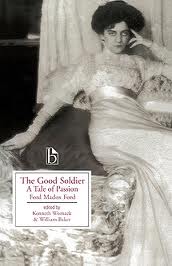
fordTime, context, and need typically determine how far we go in learning about something new: if there is no obligation, we might set limits based on our current personal preferences, and not get much beyond that initial stumbling phase. That certainly happens for me with my reading: if my curiosity is strong enough, I might persist past an initial bad experience, but sometimes I will just let something go, knowing that my understanding remains superficial. When there’s a need, though — for scholarship or teaching especially — I put in the effort. For example, I still wouldn’t pick Hammett or Chandler to read for fun, but I knew I couldn’t responsibly teach classes on detective fiction without them. So I have done some research and a lot of rereading, and though I still don’t necessarily love The Maltese Falcon or The Big Sleep, I get them. (And as a result, I like them much better than I used to, which is often the case.) If for some reason The Good Soldier or Persepolis became an obligation for me, I’d try again, and try harder, and, at the very least, fail better.

My point is that there is a rhythm, a pattern, to learning, and it helps to be self-conscious about it, and not to render it invisible, as if understanding isn’t something we’ve always had to work for, to earn. What does this have to do with my classes? Well, for one thing, thinking about what it’s like for me to be a beginner gives me, I hope, some insight and sympathy into what it is like for my students. I’ve talked before here about my efforts to demystify the process of literary analysis and to encourage students to think about the process of their work as much as the product. It should reassure them to know that confusion and frustration are normal parts of learning. My students are not likely to read these posts about my own struggles, but my work here helps me think of how to talk to them about and guide them through their own. One good thing about taking a class for credit is that it provides a strong incentive to get further than that initial stumbling phase: not to throw your hands up and say “not for me” (or “not now,” which is where I am with graphic novels) — and the result is that you will learn to do and learn about things you might otherwise turn away from. That pressure to stick with something unfamiliar and thus difficult is at once one of the best and one of the hardest things about being a student.
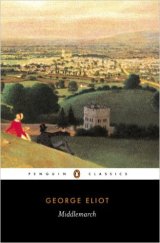
penguinmiddlemarchMy first-year students are beginners in some obvious ways. All term I have been trying to work with them in a way that recognizes that for most of them, not just the readings but the kind of writing they’re being asked for is more or less unfamiliar, and I’ve tried hard to provide steps and supports and suggestions that will help them get better at it all. This careful scaffolding comes with the territory for introductory classes. What I hadn’t quite anticipated, or thought as much about, is that in some ways my graduate students are also beginners. For instance, most of them have read very little, if any, George Eliot before. I’m finding this situation trickier to address pedagogically, because the strategies I would usually use to lead undergraduate students towards greater expertise seem out of place (not just more lecturing but also things like worksheets, exercises, or tests). Even for readers who are already quite sophisticated, four George Eliot novels in a relatively short time is a lot to wrap your head around, and the specialized academic articles we’re reading alongside the novels are not that helpful for just getting oriented. I feel rather as if I threw them right in the deep end, and though they are staying afloat, that is almost as much as I ought to expect from them. (I’m not sure how to finish that thought using the same metaphor – they won’t be doing any fancy diving? they’re not about to swim laps?) This is a criticism of me and my preparations for the class, not of my students. When (if) I teach another graduate seminar, I may structure it somewhat differently — though at this point I’m not really sure how. This time around, all I can do is be as explicit and helpful as possible. I will be their flotation device! (I can’t help it: “We all of us … get our thoughts entangled in metaphors, and act fatally on the strength of them.”)
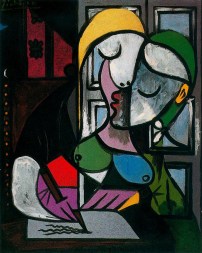
Painting: Woman Writing (Picasso, 1934)

Reading Persepolis: Comically Inept?

persepolisMe, not Persepolis, of course. Because Persepolis is highly acclaimed (from the cover blurbs: “brilliant and unusual,” “superb,” “a mighty achievement,” “a dazzlingly singular achievement”) and widely considered an outstanding example of its kind. So the truth must be that if I read Maus badly, I read Persepolis very badly — despite having dutifully read Scott McCloud’s Understanding Comics in the meantime.

I enjoyed Understanding Comics. I always like the feeling of starting off down a path that’s new to me while being guided by someone smart and, in this case, also fun. I think I got a lot out of it, too — not just some basic vocabulary for talking about the art and craft of comics (terms like “closure,” “gutters,” and “motion lines,” for instance) but a better, if obviously still superficial and preliminary, appreciation of comics as part of the broader landscape of both pictorial and textual art. I was intrigued and largely convinced by the argument that comics are a form that requires a high degree of audience participation to make meaning, and by the theory that “by de-emphasizing the appearance of the physical world in favor of the idea of form, the cartoon places itself in the world of concepts” — in other words, something that might seem from a different perspective to be a flaw in comics (their more or less iconographic rather than realistic style of representation) is better understood as a feature of the form (not unlike the formulaic plot structure of the classic mystery). I was interested in the histories McCloud provided of various comic-like forms, and in the connections he made between developments in other theories and practices of art and things comics do and don’t do. I was both engaged and amused by the ecstatic tone of the book’s final chapter, which rises to a crescendo of enthusiasm about how one day “the truth [about comics] will shine through!” It’s a long way from reading my first book about comics to claiming any expertise, but by the time I finished Understanding Comics I thought I would at least read my next graphic novel with more appreciation.

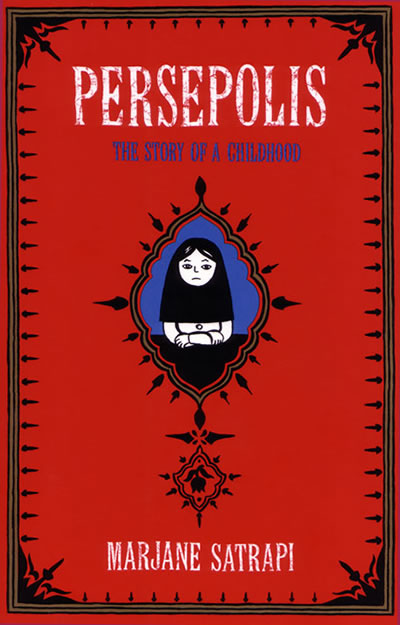
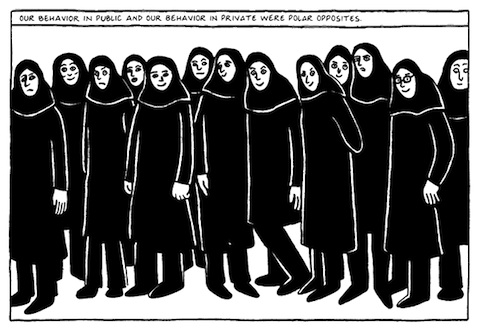
04-persepolisBut I didn’t! If anything, I found Persepolis less satisfying to read than Maus. From start to finish I felt as if I were reading a child’s picture book about Iran: an illustrated oversimplification, rather than a sophisticated verbal-visual synthesis, which is what the euphoric conclusion of Understanding Comics holds up as the form’s highest potential. Satrapi’s decision to tell the story strictly from her childish point of view is one obvious reason for that: the book does effectively convey the frustration and confusion she felt, not just at events themselves but at people’s often puzzling and contradictory responses to them. I really missed the kind of framing perspective we get in Maus from both Art and his father, though; compared to Marjane the character, Marjane Satrapi the author certainly knows much more about, or understands much differently, the world of her childhood, but I struggled to find evidence of that in the book. Maybe it’s in the drawings — but if it is, I wasn’t able to perceive it. The art was often dramatic and sometimes beautiful, or disturbing, but it also seemed incongruously cartoonish to me, and it distanced me from the emotion and action of the story as a result. McCloud proposes that more generic drawings allow us to identify with characters rather than being preoccupied with their specificity, their difference from us, but since in this case the characters are highly specific, the degree to which they looked similar was frustrating and seemed to flatten out the narrative. I could see at times that the effect was appropriate: stamping out individuality in favor of conformity was clearly a goal of the Islamic regime, for instance, and being unable to tell which veiled girl in the group was Marjane played into that. Overall, though, I couldn’t shake off the desire to have a more rich and complex written text; for me, even the most complex of the pictures were not sufficient compensation for what I felt was missing.

understanding-comicsI think what I may be running into here is a limitation created by my own love of words. Though I can tell even from one reading of Understanding Comics that there is a grammar to the art work and a language and style (or rather, many languages and styles) to the combination of words and images in comics, I am by both training and inclination a different kind of reader, a long-time devoted reader of a different kind of texts. Right now it seems unlikely I’ll ever become an avid reader of comics, partly because so far I haven’t enjoyed them that much and partly because there is so much else I want to read (so many novels that aren’t ‘graphic’) that I can’t really see putting in a concerted effort to get better at reading them. If I did end up choosing to teach an example of the form, I’d have to put my personal preferences aside, of course, and do the work. I’ve done that often enough with other texts I have felt obligated to teach that I know I’m often led by obligation to appreciation and then to genuine liking. I’m done with comics for now, though, as I have to write up some notes on Middlemarch for tomorrow’s seminar … no shortage of words there! And on no occasion have I ever wished the novel had pictures, either.

This Week In My Classes: Everything Else!

BigMagicFinalWhen it’s this quiet around here, that can only mean one thing: I am very busy elsewhere! The main reason I haven’t written up any new reading is that I’ve been working on a review for the next issue of Open Letters. Despite my best efforts, I’m still quite a slow and painstaking writer when I know it’s for a “formal” purpose (most of the time, I write with much greater freedom here, but there haven’t been quite the spin-off benefits in the rest of my writing life that I’m always hoping for). Sort of ironically, given that, the book I’ve been writing about is Elizabeth Gilbert’s Big Magic: Creative Living Beyond Fear, which I picked up to read (not, initially, to review) precisely because I was feeling stymied about my writing and thought maybe she’d have some helpful tips. All I’ll say about the book for now is that it did indeed motivate me to do some writing!

I sent my draft of that review off to my co-editors for their input a couple of days ago and will come back to revisions once they are done with it. I’ve been writing for Open Letters for six years now (my very first piece went up in the October 2009 issue) and everyone there is now a friend as well as a colleague, but I still get butterflies when I post my work for their edits. If you’ve contributed to OLM you may sometimes have wondered what the process is like for the insiders: believe me, we are just as attentive and rigorous with each other’s work! And in a way it’s a more intense process for us, because we condense and redact editorial comments a lot of the time before sending them back to authors, whereas we see the edits on our own work quite unfiltered. To show what I mean, here’s a screen clipping of a typical* segment of one of my drafts (the first version of this review) festooned with suggestions (I won’t decode which font is which editor):

editingsample

(If you want to see the details, click on the image and it gets bigger). Even a piece that doesn’t provoke a lot of objections or corrections can generate a lot of debate about its argument or examples: it’s thrilling, really, to have so many smart people ready and willing to pay close attention to my writing. And while it can be intimidating, it’s done in such a supportive spirit that it’s somehow never discouraging. I’ve certainly never experienced anything like it in academic publishing.

Anyway, because I was using so much of my extra-curricular time writing the review, I haven’t done much other interesting reading, so I don’t have anything to write up for the blog. I have been slowly working through Adam Johnson’s Fortune Smiles, but as I’m going to be reviewing it for OLM for the next next issue, I won’t be blogging about it in any detail. (I can say, though, that it seems to me as extraordinary in its own way as The Orphan Master’s Son, which is one of the most memorable novels I’ve read in a long time.)

The other reason it has been quiet here is that I have been pretty busy on campus too — not so much with teaching, since my load this term is not heavy, but with administrative and advising work. I’ve already sent out a lot of reference letters and there are more requests coming in pretty steadily. Writing the letters themselves is often kind of uplifting, as you are cheering students on as they move into new, exciting phases of their lives. The paperwork is a real pain in the a–, though, even though these days much of it is virtual. No two places have the same forms or the same specific requirements, and often when there are forms they pose interesting technical challenges (yesterday, for instance, I ended up retyping several paragraphs into a fillable PDF because for whatever reason I could not get it to allow me to paste in the text of my letter, even though that is something I have done without difficulty on similar forms). As far as I know I have never screwed up anyone’s application by missing a deadline or sending the wrong materials to the wrong place or whatever, but it’s stressful worrying that I might lose track of something important.

Committee work, too, has been a bit hectic. One reason is that our department is steadily losing resources: we have five wonderful senior people now phasing into retirement (and more to come soon, it seems likely), which has lots of implications for administrative assignments as well as teaching capacity, and this fall at one point we also had four people on sick leave plus another on a personal leave — and that’s not even counting sabbaticals. We also have no truly “junior” people left in our tenure-track ranks as it has been so long since we made a permanent hire. It seems like many of our recent meetings have focused on reshuffling the people we still have in order to keep everything running, and it’s just barely working. Welcome to the downsized humanities. I’ll never forget the dean telling our Faculty a couple of years ago that we were all going to do “less with less and do it better.” The “less with less” part has certainly come true, but better? Well, we’re certainly doing our best, and every day I’m reminded how committed everyone is — to our students, first of all, but also to the university, in both its real and its ideal incarnation.

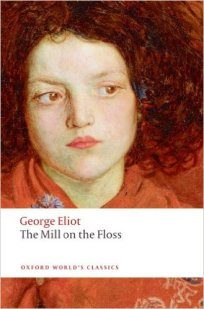
All is not gloom and doom, however! I thoroughly enjoyed the class my TA ran on “Araby” on Monday (as always, when I get to move back to the other side of the podium, I was reminded just how much I loved being an English student), and yesterday we had what I thought was quite a good session on Katherine Mansfield’s “The Garden Party.” In my graduate seminar, we struggled with the second half of The Mill on the Floss — not with actually reading it, of course, but with figuring it out. As I eventually said to them, one thing about the ending is it as good as tells us directly “you need to interpret this!” It’s not a novel that’s overtly metafictional in a cool postmodern way (not as much as Middlemarch is, anyway), but it constantly teases us about how fiction works and what its conventions are, as if to make sure we think about how The Mill on the Floss confronts them. We start Middlemarch on Monday; we’re taking it slowly, with just the first two books assigned, so I hope that allows them to linger over the reading and think about form as well as plot.

TLS_Cover_October__1186210hOne other piece of good news, which I kept quiet about until now because I was worried that (for who knows what reason) it might not actually come to fruition: in the summer I got the opportunity to review a book for the TLS (the TLS!), and after much waiting, my review has finally appeared in the current issue. I try not to be an “old media” snob, but there’s something about the TLS and its history that makes it pretty thrilling to see my name in its table of contents.

*OK, maybe not 100% typical – it looks like the new piece is coming through relatively unscathed, for instance! (Maybe I’m getting better at this?) But typical of sections that show fear. Never show fear in the shark tank – it’s like a faint trail of blood and they’ll always pick up on it!

This Week In My Classes: Strangeness and Subtlety

millonflossBecause of the Thanksgiving holiday on Monday, my graduate seminar didn’t meet this week. If only Eliot had written her novels in a different order, we could have used that extra time for reading through Middlemarch — always the book for which I like to allow the most weeks because it demands and rewards such luxurious patience. But we are only on The Mill on the Floss, so instead we just delayed our discussion of the second half. Not that The Mill on the Floss doesn’t also demand and reward patient reading! In fact, rereading it has been one of the best parts of the past couple of weeks for me. It still absorbs me, especially as we rush towards the final catastrophe in Books VI and VII. I hope the students feel the same way.
My Introduction to Prose and Fiction class, however, has two meetings this week. We have wrapped up our work on essays and are in the middle, now, of our short fiction unit. We read “The Yellow Wallpaper” for Wednesday’s class, and I was reminded all over again what a strange, creepy, brilliant story it is. Though obviously one key thing I wanted us to discuss (which we did) was Gilman’s critique — through her narrator’s sad, horrifying, weirdly comic disintegration (“I got so angry I bit off a little piece [of the bed] at one corner – but it hurt my teeth,” she says, with such disquieting reasonableness!) — of a whole destructive patriarchal system, I also tried to keep some emphasis on literary details, including symbolism (an easy one, in this case), personification, and imagery:

It is dull enough to confuse the eye in following, pronounced enough to constantly irritate and provoke study, and when you follow the lame uncertain curves for a little distance they suddenly commit suicide — plunge off at outrageous angles, destroy themselves in unheard-of contradictions.

The colour is repellent, almost revolting: a smouldering unclean yellow, strangely faded by the slow-turning sunlight. It is a dull yet lurid orange in some places, a sickly sulphur tint in others.

All of these vivid details contribute, of course, to our sense of her character and situation: it’s not hard to pick up on the wallpaper, and then the woman she “sees” behind the pattern, as a projection of her entrapment and despair. That’s one reason that the story’s a classic, and that it’s so fun as well as useful to teach: there are subtle details, but as a whole it’s almost as flamboyantly expressive as the wallpaper.

bviewshortfictionToday in our smaller tutorial my group will be reading a story that is equally artful but far more subtle: Kazuo Ishiguro’s “A Family Supper.” Here, I think, we will have to work much harder to move past our initial impressions of what the story is about, of what details in it are significant and how they add up. Ishiguro is a master of understatement but also of moods and shadows. Despite its innocuous-seeming title, “A Family Supper” has an atmosphere of menace from the opening account of the poisonous fugu fish, and the title itself starts to seem less and less innocent as we learn first of the death of the narrator’s mother (at another seemingly-innocuous supper) and then of a father who killed himself and his whole family to escape the dishonour of his failed business. There isn’t much overt action in the story, and the ending especially feels like an anti-climax. With Ishiguro, though, the conflicts tend to shimmer around the characters, to be represented as much by what they don’t say or do as by what they actually say or do.
I’ve been following Dorian’s wonderful series of posts about his short fiction class, and it has got me thinking about the role of leading questions in our teaching — often he comments on what he’s hoping or expecting students to come up with in response to his prompts, for instance. This is not the same as trying to steer them towards one “correct” answer, of course, and the process he describes is intensely familiar to me. There’s no point asking completely open-ended questions that, as far as you know, will get you nowhere in particular in terms of understanding the story in front of you, so we ask leading questions to help our students discover for themselves what we already know is there. The process also models for them the right (meaning most productive) kinds of questions to ask. But at the same time, you want to allow for different readings, for original observations, for the idiosyncrasy of genuine individual engagement. One reason I like to mix in stories I don’t already know well, like “A Family Supper,” is that it is easier for me to back off, to be open-mindedly curious and see where our discussion takes us. I have some ideas about the story’s central themes and how its specific details (the fugu fish, for instance) fit into them — but it’s still somewhat strange to me, and its subtlety means working harder to make something of it. I hope it isn’t too elusive for the students to take an interest in it. (Updated post-tutorial: I think we had quite a good discussion, particularly about the family dynamic in the story and the way both cultural and generational expectations and differences affect it. Some students said they found it frustrating that there’s so little action, or that the conflict feels so unresolved, but I suspect that’s one reason we ended up with so much to say about it — unlike a more plot-driven story, “A Family Supper” forces us to look for meaning in other places.)

Next week it’s “Araby” and then Mansfield’s “The Garden Party,” so back again to established classics. One of my TAs has volunteered to teach the session on “Araby,” which means I get to return to one of my favorite roles in the classroom — being a student again!

Reading Maus Badly

mausIIn the comments to my last post, Bill said he hoped that my choice for a comic book or graphic novel for a course on “pulp fiction” would not be “some terribly respectable ‘graphic novel’ along the lines of MausFun Home, or Persepolis” — not that there’s anything wrong with these on their own terms, obviously — quite the opposite! — but that they wouldn’t really represent “the genuine pulp article.” In response, I mentioned that I have just recently read Maus ... which reminded me that I never wrote anything about it here.

Actually, it wasn’t that recent: I read it at the end of the summer, so several weeks ago now. Usually I blog about books more or less as soon as I finish with them: the time lag here is a sign of trouble. And the trouble was, I didn’t know what to say about Maus. Not that I always know exactly what I’m going to say about a book when I sit down to blog about it — but I do usually have some sense of direction, some sense of how to engage with it. I finished Maus, however, with the nagging sense that I’d read it wrong. You see, I read it like a novel: an illustrated novel, because obviously there are pictures, but still, like a novel, with my primary attention on the words.

You see my problem, I’m sure. Maus is neither a novel nor an illustrated novel: it is a graphic novel, which is another term (a sometimes contested one) for a comic book, which is, in turn, helpfully defined at the Internet Public Library as “sequential visual art, usually with text.” But I don’t know how to read “sequential visual art”: I don’t know what to notice, what to track across the sequence, how to interpret what I’m seeing. I looked at all the pictures in Maus, of course, but I didn’t scrutinize them: to me, they seemed secondary — they were only drawings of the story.

I’m not saying I didn’t notice that the Jews in the book were mice, the Nazis cats, and the Poles pigs — or that I didn’t think as I went along about the general style of Spiegelman’s drawings, which reminded me of  folk art with their rough-hewn quality, or of naïve art, with a deceptive simplicity that somehow enhances the horror of the telling by its childlike air. How can something so cute be so terrible? That’s as far as I could go, though: otherwise, I just read on to find out what happened to the people whose fates and relationships unfolded across the novel with such pain and urgency. (Of course, the pictures rapidly stopped meaning cats and mice to me, no matter what the drawings showed).

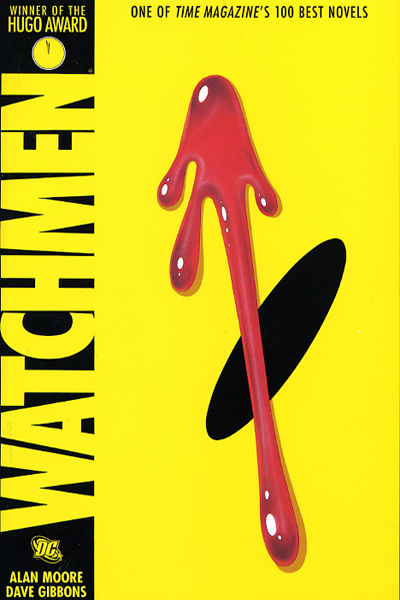
watchmenMaus isn’t the first graphic novel I’ve read. Several years ago a thoughtful student gave me a copy of Watchmen, and I worked my way through it with even less success than I had with Maus. It’s not that I wasn’t interested in it, but in that case, I couldn’t even hang on to the characters or story. (In retrospect, to be fair, that might at least partly be because I read most of it on my one and only trip to Australia, including on long trans-Pacific flights while under the calming influence of Ativan.) Then too, I was aware that I wasn’t paying close enough attention to things besides the words on the page, which is, after all, what I’ve spent years focusing on pretty exclusively.

There are definitely things I understood about Maus, including the ingenuity of recasting its population as animals in such a potent metaphorical way. Lawrence Weschler puts it well in his essay “The Son’s Tale”:

There have been hundreds of Holocaust memoirs — horribly, we’ve become inured to the horror. People being gassed in showers and shoveled into ovens — it’s a story we’ve already heard. But mice? The Mickey Mice of our childhood reveries? Having the story thus retold, with animals as principals, freshly recaptures its terrible immediacy, its palpable urgency.*

And of course Spiegelman himself, quoted in the same essay, is eloquent about his reasoning:

Almost as soon as [the idea] hit me, I began to recognize the obvious historical antecedents — how Nazis had spoken of Jews as ‘vermin,’ for example, and plotted their ‘extermination.’ And before that back to Kafka, whose story ‘Joseph the Singer, or the Mouse Folk’ was one of my favorites from back when I was a teenager and has always struck me as a dark parable and prophecy about the situation of the Jews and Jewishness.

He goes on to explain that he also wanted to subvert the metaphor: “I wanted it to become problematic, to have it confound and implicate the reader.” In a way, though, what both writers are dealing in here is something familiarly textual. Once you get how the metaphor works, you can “unpack” it in the same way you would if nobody ever drew a picture.

mauscoverIn general I’m not that well educated about the visual arts, not trained to notice and appreciate them in any expert, or even well-informed, way. Once we watched a Great Courses series on the history of Western art, and that helped a bit. What is the comic book equivalent? Is there a primer of some kind on what to see when you’re looking at graphic novels? Or is it just a question of slowing down and really looking, not taking the lines on the page for granted, the same way I’m always telling my students not to take the words on the page for granted?

Or, and of course this is a real possibility, am I overthinking the whole thing? I was caught up in Maus: I read it with rapt attention, with interest, and occasionally with tears, after all. By some measure, that has to count as a good reading.

*As a side note, I am very grateful for the recommendation of Weschler’s essay, both because it is fascinating and because the same collection (Vermeer in Bosnia) includes Weschler’s  ‘Balkan Triptych,’ which I hadn’t read before either and which is stunning.

Update: Well, this is certainly timely!

This Week In My Classes: Looking Ahead Already!

dalhousieWe’ve barely settled into a routine in this term’s classes but the call already went out for us to propose offerings for next year. This request seems to get earlier all the time, and often it’s an unwelcome distraction in the hubbub of the fall term. It’s also frustrating to have to make these decisions before you’re quite sure how things are going this time: the success (or not) of a particular course might be a reason either to try it again soon or to give it a rest for a while. This year I was glad to get the request, though, because it came just as I was thinking that — good as I think the readings are for my section of Intro to Literature, and confident as I am that the basic principles and sequences I follow make pedagogical sense — I am feeling a bit tired of the course and would like to try something different.

I do rotate through a fairly consistent set of classes most years, but I try to keep them fresh, which I do mostly by mixing up the reading lists. I’m passionate enough about the classes in Victorian literature that it’s hard to imagine ever tiring of them in any deep way, and the mystery class usually keeps me pretty engaged and entertained precisely because so much of what we cover is outside my usual territory. Intro classes can feel like more of a chore, though, partly because the ones I teach have such a generic mandate (literally generic, meaning, they are meant to introduce the major literary genres). That leaves a lot of latitude, of course, for building in thematic approaches or finding other ways to provide unity and momentum across the term. I think I haven’t done too badly with that over the years: we always read a lot of splendid short works and some of the combinations of longer texts I’ve assigned have been quite exciting to teach together. That includes this year’s pairing of Woolf’s A Room of One’s Own and Carol Shields’s Unless: the first time I assigned them in juxtaposition it was actually kind of a random decision, but they turned out to play off each other quite brilliantly and I’m looking forward to working through them again.

Still: every intro class I’ve taught has been some variation on the same basic model, and when the call for proposals appeared in my inbox I was in the mood to seek out something genuinely new. As a result, I put myself down for a section of another of our intro-level courses, one I’ve never taught before: English 1050, Pulp Fiction. Here’s the basic course description from the university’s Calendar:

This course provides an entry point to the discussion of literature through ‘pulp’ genres such as romance, mystery/crime, the Western, sci-fi/fantasy, horror, sports literature, and comic books.

The first thing that might occur to you, looking at this, is that “pulp” is being used in a fairly imprecise way: the course sounds more like a general introduction to “genre fiction,” or to “popular” (rather than canonical) fiction. (I suspect that the course title was chosen partly as a marketing ploy.) Then, the list of possible genres covered is itself a bit oddly various. But we usually keep Calendar copy deliberately open-ended: specific enough to mark out some distinctive parameters for a class but vague or flexible enough that different people could take the job on and do it in a way that suits their interests and judgment.

ladyaudleyI don’t know yet how I’ll approach the “pulp fiction” class, much less which books I will assign. I do know, though, that I’m already interested in thinking about these questions, so that’s exciting. Looking at book lists from a couple of my colleagues who have taught the class before, they don’t actually strike me as very “pulpy,” at least not in the longer texts, which have included works by Austen, Charlotte Bronte, and Shakespeare. (Not that there’s anything wrong with that! Indeed, I can see how any of these writers might be used to provoke really exciting discussions about canonicity, literary prestige, historical shifts in taste and popularity, and so on.) I do have some relevant experience from teaching the mystery fiction class (a hard-boiled novel might make a good choice for this one), and over the last few years (thanks to Twitter and blogging friends) I have accumulated some helpful ideas about romance fiction, both in and out of the classroom (at the moment I’m tempted to assign Lord of Scoundrels). The Victorian period is also full of possibilities, including some I know well (Lady Audley’s Secret, for example) and some I know a bit about but haven’t actually read yet (such as H. Rider Haggard’s She or King Solomon’s Mines). I know basically nothing, so far, about Westerns (unless Cormac McCarthy counts, and though he is many things, I’m not sure “pulpy” is one of them), and have only a spotty sense of what might be a useful sci-fi or fantasy title for these purposes. Happily, I have until next fall to work out the reading list and until January 2017 to fix all the details — so you can expect to hear more about it here. If you have ideas for either primary or secondary sources to help me figure it all out, do let me know! I’d be especially interested to know how you would define “pulp fiction” as a category: it won’t be possible to make good choices for specific readings until I settle on a satisfactory working definition of the term, or at any rate choose the definition that my course will be organized around.*

It looks like I will also be teaching our survey of British Literature Since 1800, which I’ve done a couple of times before and very much enjoyed (but haven’t taught since 2010), plus two Victorian classes – The 19th-Century Novel from Dickens to Hardy and an upper-level seminar on the ‘Woman Question’ (which I haven’t taught since 2011). So, my 2016-17 courses will be a good mix of levels and material, and will involve plenty of class prep that won’t seem at all routine.

But for now, it’s back to the realities of my 2015-16 classes … though not quite yet, since it’s a long weekend. Happy Canadian Thanksgiving!

*Quick update: After posting this I read James M. Cain’s The Postman Always Rings Twice, which was one of the first titles I thought of as I brainstormed possible readings. It certainly is lurid and suspenseful — and it’s short and reads briskly, too. That combination keeps it on the list of possibilities, as for a first-year course (and one that’s also supposed to spend class time on writing skills) I can’t get too ambitious with the reading list.

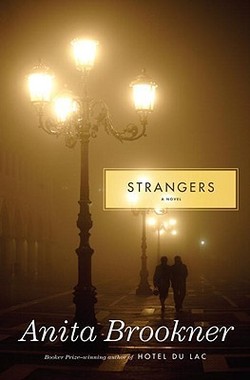
“Endurance”: Anita Brookner, Strangers

strangersThat was one of the dubious endowments of ageing, a conviction that one’s desires had not been met, that there was in fact no reward, and that the way ahead was simply one of endurance.

Anita Brookner’s Strangers is a quietly ruthless dissection of the discomforts and disquietude of growing old alone. Its protagonist, Paul Sturgis, is a nice man in his early seventies — “too nice,” he remembers an old girlfriend telling him dismissively, breaking up with him. Retired, solitary, undemanding, he lives a life, not exactly of quiet desperation, but of unrelieved introspection and almost no pleasure. He has money and a flat of his own, but he finds no fulfillment in his solitary walks, his visits to the library, his reading, or the one family connection he still has when the novel begins — his late cousin’s wife, to whom he makes ritual Sunday visits with no great rewards on either side, until her unattended death completes his isolation and gives him a painful glimpse of his own likely future.

Paul’s life feels insubstantial to him:

It seemed to him a terrible thing to live without witnesses, as if he had failed to make good the inevitable deficiencies of both past and present, had never created a family of his own, so that he was haunted by a feeling of invisibility, as if he were a mere spectator of his own, his only life, with no one to identify him, let alone with him, in the barren circumstances of the here and now.

What is there, what can he do, that will infuse meaning into his day-to-day existence? Once, the routine of work kept such questions at bay, and there was occasional travel, and friends, including girlfriends. None of this has lasted, though, or had any lasting effect. Paul thinks the answer might lie  in connections with other people, and in another novel, that would be the answer, and the relationships that develop across the second half of the novel would restore him, and thus us, to happiness and hope.

“But not so,” as Hardy says — and in fact there is something faintly Hardy-esque about the unremitting bleakness of Strangers, though Paul’s suffering never rises to the morally grandiose level of Jude’s. Paul’s solitude is impinged on, first by the willful and energetic divorcée Vicky Gardner and then by his old girlfriend Sarah, herself now also aged and alone. Both prove unsatisfactory companions, though, and their contradictory needs and demands stir Paul to selfishness rather than sympathy, to a restless if inchoate ambition to effect some kind of change on his own behalf.  Must the scant time that remains to him be spent in the encroaching dullness of his flat, the dreary time-killing of his unmotivated outings? The novels he once enjoyed “usually finished on a note of success, of exoneration, which was not for him”:

In the absence of comfort he was forced to contemplate his own failure, failure not in worldly terms but in the reality of his circumscribed life. He knew, rather more clearly than he had ever known before, that he had succeeded only at mundane tasks, that he had failed to deliver a reputation that others would acknowledge. . . . his life of reading, of walking, was invisible to others: his friendships, so agreeable in past days, had dwindled, almost disappeared. Memories were of no use to him; indeed, even memory was beginning to be eroded by the absence of confirmation. As to love, that was gone for good. Whatever he managed to contrive for himself would not, could not, be construed as success.

Strangers meticulously documents Paul’s confrontation with these realities, and then his growing wish that somehow, old and set in his ways as he is, he can “make it new.” But how? He lacks talent, ambition, drive; he has no sense of mission to lift even his wildest dreams above the quotidian. Brookner offers Paul no epiphany, though at the very end she does grant him a reprieve, as he finally acts to set his “fantasy” of change in motion:

This was the obverse of all fears, the assurance that life was still a possession to be treasured and that its possession was unalienably his.

The lonely end he anticipates cannot be staved off altogether, but it can at least be approached from a different direction. This is not quite the “note of success,” the “exoneration,” of the novels Paul has repudiated, but Brookner had brought me so low, along with Paul, that I rejoiced with him at the promise of something at least a little better than just endurance.

George Eliot and “Fine Old Christmas”

snowfall

I don’t usually think about George Eliot and Christmas together, and when I do, it’s usually by way of Silas Marner, which is a lovely secular version of the Christmas story (among other things). Rereading The Mill on the Floss for my class this week, though, I was struck by this little passage, which somehow had never really stood out to me before:

Fine old Christmas, with the snowy hair and ruddy face, had done his duty that year in the noblest fashion, and had set off his rich gifts of warmth and color with all the heightening contrast of frost and snow.

Snow lay on the croft and river-bank in undulations softer than the limbs of infancy; it lay with the neatliest finished border on every sloping roof, making the dark-red gables stand out with a new depth of color; it weighed heavily on the laurels and fir-trees, till it fell from them with a shuddering sound; it clothed the rough turnip-field with whiteness, and made the sheep look like dark blotches; the gates were all blocked up with the sloping drifts, and here and there a disregarded four-footed beast stood as if petrified “in unrecumbent sadness”; there was no gleam, no shadow, for the heavens, too, were one still, pale cloud; no sound or motion in anything but the dark river that flowed and moaned like an unresting sorrow. But old Christmas smiled as he laid this cruel-seeming spell on the outdoor world, for he meant to light up home with new brightness, to deepen all the richness of indoor color, and give a keener edge of delight to the warm fragrance of food; he meant to prepare a sweet imprisonment that would strengthen the primitive fellowship of kindred, and make the sunshine of familiar human faces as welcome as the hidden day-star. His kindness fell but hardly on the homeless — fell but hardly on the homes where the hearth was not very warm, and where the food had little fragrance; where the human faces had had no sunshine in them, but rather the leaden, blank-eyed gaze of unexpectant want. But the fine old season meant well; and if he has not learned the secret how to bless men impartially, it is because his father Time, with ever-unrelenting unrelenting purpose, still hides that secret in his own mighty, slow-beating heart.

The immediate context is Tom’s return from Mr. Stelling’s school for the holidays, and the emphasis on coziness and fellowship helps bring out both his happiness at being at home again and the novel’s larger emphasis on home and family as the roots of memory and thus morality. The penultimate sentence here does something rather different, though, doesn’t it? It introduces (on a small scale) a Dickens-like critique of exclusion from these blessings, a quick but painful sketch of the unhappiness the season exacerbates for those unable to rejoice in its warmth and bounty. I find the personification of Christmas, and then ‘his’ characterization as the son of ‘father Time,’ strategically interesting. The “fine old season” could just as easily be winter, especially given the evocative descriptions of the snow, but we can’t do anything about winter, (sadly!): its sorrows are indeed “unresting.” Christmas, however, is what people have made of the season: it is the consolation we’ve come up with for its cold and privation. It is, in other words, a man-made, not a natural (or a supernatural), phenomenon. Eliot’s personification reminds us of that, and hints that we could perhaps do something about “unexpectant want.” The “rich gifts” of Christmas, after all, really come from us.

I’ve been trying to think of other explicit Christmas scenes in Eliot’s novels and am coming up blank. Anyone?

Open Letters for October!

stacks-300x200

The October issue of Open Letters Monthly is up, and the editors are enjoying the brief interval fondly (or sometimes grudgingly — I’m looking at you, Steve Donoghue!) known as the “Basking Period,” in which we sit back and admire the results of our hard work — and, of course, the hard work of our excellent contributors.

One of this month’s highlights is our Bestseller Feature, in which we take a hard look at the NYT fiction bestsellers. As you might expect, things don’t often go that well for the poor bestsellers (Greg Waldmann’s takedown of James Patterson’s Alert is both harsh and hilarious, for instance), but there are some nice surprises too: check it out to read, among others, Steve Donoghue on Debbie Macomber, Sam Sacks on Kristin Hannah, John Cotter on Jonathan Kellerman, me on Paula Hawkins, and Rebecca Hussey on Jennifer Weiner.

Rebecca also contributed a smart, thoughtful review of Vivian Gornick’s The Odd Woman and the City that made me even more interested in reading the book for myself (how I hadn’t even heard of Gornick until so recently is a puzzle to me). We’ve got a lovely essay-slash-review from Kerry Clare, as well, on Anne-Marie Macdonald’s Adult Onset; a fascinating piece from Victoria Olsen on the dancer Jane Avril; a review from Steve Donoghue of a new book on “The Rise and Fall of the House of Caesar” — plus other reviews, new poetry, and links back to our previous bestseller features from 2008 and 2009.

As always, I feel proud and happy to help bring so much good writing together for readers. I really think we offer a good experience for writers, too: our editing is attentive and rigorous and focused on bringing out the best in every contribution. The editors do it all on top of our “day jobs” and with essentially no budget: I suppose there’s a way in which that is not necessarily to be celebrated, but the results certainly are.