“Something Worth Reading”: Richard Flanagan, The Narrow Road to the Deep North

flanagan

His tone, he felt, was at once too obvious and too personal; somehow it brought to his mind the questions he had failed to resolve all his life. His head was full of so many things, and somehow he had failed to realise any of them on the page. So many things, so many names, so many dead, and yet one name he could not write. He had sketched at the beginning of his foreword a description of Guy Hendricks and something of an outline of the events of the day he died, including the story of Darky Gardiner.

But of that day’s most important detail he had written nothing. He looked at his foreword … with the simple, if guilty, hope that in the abyss that lay between his dreams and his failure there might be something worth reading in which the truth could be felt.

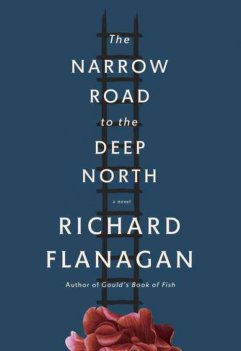
How far do the hopes of Dorrigo Evans, the protagonist (perhaps the hero) of The Narrow Road to the Deep North, reflect Richard Flanagan’s for his novel? The Narrow Road to the Deep North is an ambitious book, almost palpably so, in its subject as well as in its form and style: it tries to give a meaningful shape to experiences that hardly bear thinking about, and perhaps  to discover in them something like truth, even something like beauty—not in the violence itself (not like, for instance, Cormac McCarthy) but in what it reveals. Flanagan throws every literary tool he’s got at this problem: romance, heroism, brutality, camaraderie among the characters, metaphor, symbolism, allusion in the language. The novel is often grim but sometimes lyrical; dramatic, but also introspective. What can Dorrigo—what can we—learn from this story of “the Line” and the POWs who built it at such horrendous cost? Is that quest for meaning itself an effort as pointless, in its own way, as the construction of the Death Railway?

Flanagan never entirely resolves that question. Dorrigo himself has some revelations during his time on the Line that he believes (in the moment, at least) stand as “the truth of a terrifying world”:

It was as if man existed only to transmit violence to ensure its domain is eternal. For the world did not change, this violence had always existed and would never be eradicated, men would die under the boot and fists and horror of other men until the end of time, and all human history was a history of violence.

It’s no wonder this feels true to him as he watches “three hundred men watching three men destroying a man whom they knew.” That beating—one among many but also unique among them—is a defining moment for Dorrigo and also, in some ways for the novel, which keeps bringing us back to it, as if violence is the only reality that matters. Yet after the war Dorrigo feels his entire existence is “bogus”; the falseness of it arises from the pretense that there is life outside of horror and crime:

He thought of how the world organises its affairs so that civilisation every day commits crimes for which any invidual would be imprisoned for life. And how people accept this either by ignoring it and calling it current affairs or politics or wars, or by making a space that has nothing to do with civilisation and calling that space their private life. And the more in that private life they break with civilisation, the more that private life becomes a secret life, the freer they feel. But it is not so. You are never free of the world; to share life is to share guilt.

 Is this hard-won insight, knowledge freed from sentiment? Or is Dorrigo’s condemnation of private life as artifice a war wound, a scar on his perception? When he reaches the end of his life we’re told that he already “no longer lived,” as if in giving up hope and love he has cut himself off, not from civilisation, but from humanity.

flanagan2The Narrow Road to the Deep North does gesture towards the value of the private life that Dorrigo has lost faith in. But of all its many parts, the novel’s romance seemed to me the weakest: the story of star-crossed lovers doomed to separation because of a petty deception felt forced, too overt a gesture of the novelist himself, as if he thought we needed that kind of idyllic star to follow through his otherwise unrelentingly dismal narrative. I’m not sure the love story works this way in any case: there’s a suggestion at the very end of the novel that the beauty of love is a “small miracle” worth cherishing even “in the midst of the overwhelming darkness,” but is this the real truth of the novel, or is it an illusion that is beautiful but unsustainable? It isn’t love that sustains Dorrigo in the camp but his own characteristic determination to “charge the windmill”: not to turn back or be daunted by the next hard task, or the next, or the next. What good are dreams of love when you are literally wading through shit? Or, what is the point of wading through shit, unless you believe in love?

This inconclusiveness is the source of some of my reservations about The Narrow Road to the Deep North. Another problem for me is the representation of the Japanese officers and guards, who seem for at least the first two-thirds of the novel to be little more than caricatures, embodiments of every negative stereotype imaginable: they callously starve, beat, and dehumanize the POWs, with occasional time-outs from the action to meditate on their service to the emperor. Whereas Dorrigo’s fixation on Tennyson’s “Ulysses” is set up as a symptom of his yearning humanity, the reverence of the Japanese officers for Issa and Basho is deployed ironically, at their expense, to highlight their failures of humanity along with their self-deception:

They recited to each other more of their favourite haiku, and they were deeply moved not so much by the poetry as by their sensitivity to the poetry; not so much by the genius of the poem as by their wisdom in understanding the poem; not in knowing the poem but in knowing the poem demonstrated the higher side of themselves and of the Japanese spirit—that Japanese spirit that was soon to daily travel along their railway all the way to Burma, the Japanese spirit that from Burma would find its way to India, the Japanese spirit that would from there conquer the world.

In this way, thought Nakamura, the Japanese spirit is now itself the railway, and the railway the Japanese spirit, our narrow road to the deep north, helping to take the beauty and wisdom of Basho to the larger world.

That their implacable cruelty makes perfect sense to them only demonizes them here. But later in the novel Flanagan starts providing back stories, contexts that elaborate on (though they don’t necessarily justify) their indifference to the suffering around them. Why, I wonder, didn’t  Flanagan structure the book differently so that we knew who these men were before we saw them at their worst—or, doing their worst? It seems like a missed opportunity. The Narrow Road to the Deep North could have started from both sides and then brought together the full range of people we come to know so that their time together in the camp stood as a fateful convergence, a clash of opposing ideas about authority, valor, heroism, self, and survival. The cruelty of the camp, it is belatedly suggested, is in many ways an extension of a culture in which  (at least for these men) violence is inconsequential and expected. And, as Nakamura points out to Dorrigo, the Japanese by no means have a monopoly on coercion: “Your British Empire . . . You think it did not need non-freedom, Colonel? It was built sleeper by sleeper of non-freedom, bridge by bridge of non-freedom.” In a novel that also includes the bombing of Hiroshima, what means justify what ends? How do we stand in judgment: is victory the only measure that ultimately counts? Flanagan’s novel raises these questions, but its treatment of them seems indecisive, or unfocused, as if Flanagan could summon up marvelous parts but not quite orchestrate the whole.

And I did think that, in parts, The Narrow Road to the Deep North was pretty marvelous. I was certainly engrossed from the beginning—which is not, of course, a definitive measure of merit, but it’s also inarguable as a starting point. I was particularly gripped by the saga of the men on the Line, who were not idealized but individualized as the absolutes of their characters were bit by bit exposed by the extremity of their ordeal. Dorrigo himself, too, seemed to me a powerful creation, strong without false heroics, thoughtful but only reaching for, not achieving, wisdom. I’m not convinced the book is the “masterpiece” it’s called on the cover of my edition: if it were in a Tournament of Books match against The Orphan Master’s Son, which has some similar elements and aspirations, Johnson’s novel would win handily; so too, though for different reasons, would In Sunlight and In Shadow, which is closer to it in style and tone. I can’t disagree with those who have pointed out weak spots in Flanagan’s prose, but overall I didn’t find it affected or manipulative. It struck me, again, as ambitious, and that’s not a bad thing — “a man’s reach must exceed his grasp” etc., and one result of that reaching higher is writing that I sometimes found really evocative and even beautiful:

Around him, behind him, beyond him were people, moving every which way. Wild flying particles in the light, lost long ago, as he knew everything now was lost, in the steel and the stone, in the sea and the sun and the heat rising and falling in the cloudless blue sky, lost in the ochre cranes and the thundering expressway.

Ecstatic blurbish hyperbole or hysterical hatchet jobs aside—and don’t most books actually deserve something in between?—I think The Narrow Road to the Deep North is at a minimum “something worth reading.” That’s not everything—but it’s quite a lot.

Jenny Offill, Dept. of Speculation

offillMany of the fragments that make up Dept. of Speculation read like perfect, self-contained microfictions:

When we first saw the apartment, we were excited that it had a yard but disappointed that the yard was filled by a large jungle gym that we didn’t need. Later, when we signed the lease, we were happy about the jungle gym because I’d learned that I was pregnant and we could imagine its uses. but by the time we moved in, we had found out that the baby’s heart had stopped and now it just made us sad to look out the window at it.

They were in the coffee shop that day he asked her. When were you the happiest? Something she should have seen then, something about the look on his face, the way the air changed in that moment.

The Yoga People always travel in pairs, their mats under their arms, their hair severely shorn in that new mother way. But what if someone sucker punched them and took their mats away? How long until they’d knuckle under?

The fragments are beaded together by a thin, almost transparent thread of narrative: they meet, they marry, they have a child, things get tough, he has an affair, they work through it.

This story in itself is commonplace, predictable, even trite — one way or another, it has been told over and over. Each time we revisit it, the interest has to arise from how it is told this time, about these people. For instance, they and their marriage, their child, their affairs, could be made rich with interest and significance, taking us deep into an experience we have not understood in this way, in this place. Contexts could be explained, characters attentively developed, personal stories woven into complex histories. The single thread could become part of an elaborate tapestry.

Or there’s Jenny Offill’s strategy, which is to tell us less, rather than more, to leave the thread exposed, unsupported, and hope that the colors and textures of the pieces strung along it will be enough for her readers. Suggestion or implication, not explanation; parts, not wholes; moments, not meaning. No explication, no context, no names. What happens, in between one paragraph, or one chapter, and the next? Figure it out — and you will, but that’s not the point, that’s the plot, and instead what matters is the writing. What there is of it.

I don’t make the mistake of thinking that because Dept. of Speculation has so few words it is facile or lazy.  We all know the old line about apologizing for a long letter because of not having time to write a shorter one: brevity means thinking hard about what to omit. A novel like this puts a lot more strain on each individual word than a novel like, say, He Knew He Was Right (also the story of a marriage). The elegance of the excerpts that make up Dept. of Speculation testifies to Offill’s care over them. They are touching and funny, painful and precise. They often have the resonant quality of poetry:

Fall comes early here. And it is unnerving to see so many stars. At night, the wife lies awake worrying about bears and chimney fires. About the army of spiders that live within. The husband wants goats. The daughter cries for Brooklyn.

But my own word “excerpt” gives away my frequent impatience with Dept. of Speculation, my resistance to its tricks. It is also a mistake, after all, to assume that because something is elliptical, it is profound. And it’s hard work to write the whole novel, at least as hard as it is to polish up its most beautiful or memorable shards and lay them out just so. A novel that sustained the kind of shimmering intensity of the best bits of Dept. of Speculation would be spectacular — and it would be one organic thing, instead of a collection of self-conscious impressions, a construction that’s always calling my attention back to its own artfulness. Look at me, going here and then there, alluding, gesturing, refusing to fill in the blanks — but did you notice (yes, I did) that it shifts from first-person plural to third person and then back again, as the relationship falters and then repairs?

It’s very good on the sleep-deprived hysteria of early motherhood, though. And bedbugs.

“Some Pattern That I Could Not Unravel”: Rose Macaulay, The Towers of Trebizond

towers1

Then, between sleeping and waking, there rose before me a vision of Trebizond: not Trebizond as I had seen it, but the Trebizond of the world’s dreams, of my own dreams, shining towers and domes shimmering on a far horizon, yet close at hand, luminously enspelled in the most fantastic unreality, yet the only reality, a walled and gated city, magic and mystical, standing beyond my reach yet I had to be inside, an alien wanderer yet at home, held in the magical enchantment; and at its heart, at the secret heart of the city and the legend and the glory in which I was caught and held, there was some pattern that I could not unravel, some hard core that I could not make my own, and, seeing the pattern and the hard core enshrined within the walls, I turned back from the city and stood outside it, expelled in mortal grief.

The Towers of Trebizond interested and entertained me so much that it seems hardly fair to describe it as a disastrous hodgepodge of a novel — and yet, despite the apparently widely held view that it is some kind of a masterpiece — despite Jan Morris’s confidence that it is a “permanent work of art” or Joanna Trollope’s identifying it as the “book of her life,” to give just two examples of prominent people raving about it — I just can’t get past how strange, uneven, and miscellaneous it is. I notice, too, that these enthusiasts don’t really try to explain why all the parts of the novel fit together, how they add up convincingly to one impressive thing. Maybe unity, for them, is not a particular virtue. I wouldn’t necessarily have identified it as a requirement for literary greatness myself: I don’t demand that every element of a novel be strictly and obviously essential to one fundamental idea or purpose. I don’t, for instance, object to the rather baroque excesses of many of Dickens’s novels, which often digress or effloresce in extraneous ways. But including things you (arguably) didn’t have to isn’t the same as throwing together things that don’t belong together, at least not according to any principle I could discern. Hence my title, which in context is not meant as a criticism but as an embrace of mystery. Much as I loved that transcendent passage and the many others like it in the novel, I could not make The Towers of Trebizond “my own.”

And yet … I can’t entirely disagree with the critic who called it “a little treasure,” or the one who noted that it is both remarkably erudite and very funny. I would have loved the book if it were all in one vein or the other: either a spiritual quest or a farce; either philosophical depth, or social satire. I could have loved the novel with all of these disparate qualities — because Macaulay does them all so well — but I didn’t think she assembled them  into a coherent whole. The deranged camel provides much whimsical hilarity — but why is it the vehicle for Aunt Dot’s and then Laurie’s journey – not so much literally (though it’s a reasonable question, too, why they should ride a camel at all) as symbolically?* Aunt Dot’s ultimately fruitless mission to convert the women of Turkey to Anglicanism (and thus, she believes, liberate them from patriarchal injustice) is both entertaining and thought-provoking: “we emancipated Turkish women … must do this from within,” explains a one-time ally, who by the end of the novel has converted back to Islam;

we must speak to them as Moslems, we must tell them that our religion and theirs allows these things that they think they may not do, and this way we shall wake them to ambition and to progress, and make their men ashamed to keep them down.

But what does this rebuke to missionary zeal (both religious and feminist) have to do with the overabundance of literary types all keen to write their “Turkey books,” or with Laurie the narrator’s adulterous affair? What does the ape Laurie adopts and teaches to drive and play chess have to do with anything at all? Why is the travel writing so lyrical when the plot is so farcical? What’s with all the spies — real, imagined, pretend? Why are the religious ruminations sometimes so profound and sometimes so painstakingly literal — several pages on the 39 Articles? really?

towers2I exaggerate my interpretive confusion slightly — but only slightly. If pressed, I would say that the novel’s central concern is the nature of religious faith: a great many of the novel’s other concerns, including gender roles, cultural and national identities, and problems of morality, spiral outward from that, and the travelogue covers geographical territory with historical layers that further highlight the contingency but also the continuity of belief in its many forms.  Going abroad always reveals the arbitrariness of values and behaviors that we take for granted, so what counts as “strange” or “exotic” is a good index of our own oddities, and the same, here, is often suggested or even stated about religion: “Other clergyman are so odd,” Aunt Dot says, “compared with ours,” which prompts Laurie to think,

I could see that she was remembering the whole strange world of clergymen; mullahs, Buddhists, Orthodox, Copts, Romans, Old Catholics, Anglicans, Lutherans, Presbyterians, Rabbis, and of course they are all odd, for they uphold strange creeds and rites, and that is what they are for, but Aunt Dot may have been right to think Anglicans the least odd, or perhaps it is only that they are the ones we are most used to.

Laurie is an agnostic, but she (probably she, though I was glad to find another reader who thought there was some ambiguity there) is most drawn to Anglicanism (following Macaulay herself, apparently, who returned to the church around the time the novel was written). Laurie’s reasons are not so much theological as pragmatic and emotional, however: she likes that its prayers are “dignified and beautiful and in fine English and not abject or sentimentally pious, or hearty and pally and common, or in Latin,” and that as a faith it has proven amenable to “new light and development” rather than doctrinal rigidity and resistance to change. It’s only the (unforeseen, inexplicable) catastrophe at the novel’s conclusion that makes her really yearn to be inside as a believer, rather than outside as a spectator: if the spiritual journey she is (possibly) on is really just one for comfort, not for truth, that seems an anticlimax, but that’s really no more puzzling than anything else in this literary olla podrida.

There are lots of wonderfully quotable bits from the novel, from the unforgettable first sentence (“‘Take my camel, dear,’ said my aunt Dot, as she climbed down from this animal on her return from High Mass”) to the many evocative descriptions of the Levantine landscape, in which classical, Biblical, and historical references make it resonate with meaning. Here’s a little bit that captures that quality but also hints at the bathos into which (until the very end) even the novel’s loveliest moments seem inevitably to collapse:

Now we were among the rhododendrons and the azaleas which had supplied the maddening honey to the Ten Thousand, and the May breezes blew about, sweet with the tangs of lemon trees and fig trees and aromatic shrubs; and pomegranates and cucumbers and tobacco plants and gourds and all the fruits you would expect flourished in the woods we went through, and I thought the Garden of Eden had possibly been situated here. When we stopped for lunch in a wood, I asked Father Chantry-Pigg about this but he said no, that garden had been in Mesopotamia.


* “The importance of the camel in The Towers of Trebizond is difficult to define,” says Wikipedia helpfully. But unlike most reviews I looked at, at least they tried!

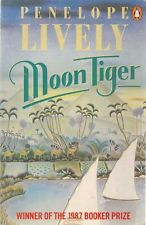
“History is True”: Penelope Lively, Moon Tiger

moontiger

“When the times are out of joint it is brought uncomfortably home to you that history is true and that unfortunately you are a part of it. One has this tendency to think oneself immune.”

I have often mentioned Moon Tiger as one of my favorite novels, but I haven’t read it through for at least 10 years, maybe more. The last time I’m sure I read it is when I assigned it in a seminar on “Women and Historical Writing,” in one of my first years teaching at Dalhousie. I was fresh from my dissertation research on gender, genre, and historiography, and Moon Tiger, which is preoccupied with who writes history and how, and with what authority, played right into my hands. Its protagonist, Claudia Hampton, is a historian, but a popular one, not a professional one: her career has been defined by a kind of belligerent celebration of her outsider status as she is dismissed by academic historians who see her as unserious. Yet she herself derides her lover, Jasper, for the historical epics he produces for television, which Claudia thinks “diminished the past, turned history into entertainment”: “I held forth about the difference between history as reasoned analysis and history as spectacle.”

Moon Tiger itself experiments with different approaches to history. In particular, it prods us to consider the insoluble problem that history is at once personal and general, that the particular which matters so much, so intensely, to each of us in the moment is always part of something much larger in which it can easily be lost. How can history, as a narrative, accommodate both these levels of attention? The novel’s vacillation between first-person and third-person narration is a formal gesture towards the desired balance. But even the third-person narration focuses mostly on Claudia, whose personality dominates the novel just as she has always commanded every room she enters: “always,” thinks her sort-of adopted son Laszlo, “Claudia has seemed brighter cleverer more entertaining than other people, . . . always when you leave Claudia you go flat a little.” It’s through Claudia that we are directed out into the world of impersonal history: we are shown its events through her eyes and through her ideas about it, as if to remind us that objectivity is always already compromised, that nothing means anything until it is seen, considered, narrated — all of which requires a point of view, a story.

moontigerSo Moon Tiger is Claudia’s story, but it is also a historical story. In particular, it is the story of her years as a correspondent in Egypt during the Second World War, when she had the experiences which still, at the end of her life, are “its core, its centre.” The section about the war in the desert, and the heartfelt love story of Claudia — the usually impervious, arrogant, brilliant Claudia — and Tom Southern (“oh God, thinks Claudia, may it have a happy ending”), comprise the novel’s stunning centerpiece, but embedded as it is in Claudia’s wide-ranging reflections on history and mortality, and in her memories of her family, it doesn’t define Moon Tiger as either a war novel or a romance. Instead, it provides the most fully realized example in the novel of the ways we are all, as Tom says to her, part of history, not exempt from it. We can’t always tell what that truth means: it’s cataclysms like war that break open our illusion of immunity, revealing that most of us are not writing history but living it — that we are not really the authors of our own lives.

As she lies in her hospital bed waiting for death, Claudia dreams of writing another book, this time “a history of the world.” It’s an absurd project, of course: no book could be so comprehensive. But as she reflects, there’s a way in which she herself already embodies just such a history:

My body . . . remembers Java Man and Australopithicus and the first mammals and strange creatures that flapped and crawled and swam. Its ancestries account, perhaps, for my passion for climbing trees when I was ten and my predilection for floating in warm seas. It has memories I share but cannot apprehend. It links me to the earthworm, to the lobster, to dogs and horses and lemurs and gibbons and the chimpanzee; there, but for the grace of God, went I. Being the raging agnostic that I am, of course, I consider that God had nothing to do with it.

Claudia is fascinated by fossils, those physical traces of the past in the present, reminders of the enormous changes but also continuities of the earth. On her deathbed, she feels at once the totality and the singularity of it all, the simultaneity of the big stories (“Rommel was pushed out of Africa … we won the war”) and the personal experiences. Against the overarching narrative of the war she has Tom’s diaries, “louder now than the narrative I know”:

This dispassionate sequence explains — or purports to explain — why the war happened and how it evolved and what its effects have been. Your experience — raw and untreated — does not seem to contribute to any of that. It is on a different plane. I cannot analyse and dissect it, draw conclusions, construct arguments. You tell me about gazelles and dead men, guns and stars, a boy who is afraid; it is all clearer to me than any chronicle of events but I cannot make sense of it, perhaps because there is none to be made. . . . All I can think, when I hear your voice, is that the past is true, which both appalls and uplifts me. I need it. . . . And I can only explain this need by extravagance: my history and the world’s. Because unless I am a part of everything I am nothing.

1987 Penelope Lively Moon TigerEverything, nothing; a history of the world, a history of one woman — there’s something vertiginous in the novel’s movements between these extremes, but holding the ideas and the experiences together is always Claudia, because that, after all, is our own way of being in the world and in history:

In the beginning there was myself; my own body set the frontiers, physical and emotional, there was simply me and not-me; the egotism of infancy has grandeur. And when I became a child there was Claudia, who was the centre of all things, and there was what pertained to Claudia, out at which I looked, the world of others, observed by not apprehended, a Berkeleyan landscape which existed only at my whim — when it ceased to interest me it no longer existed. And eventually, or so I am claiming, I grew up and saw myself in the awful context of time and place: everything and nothing.

Like Oleander, JacarandaMoon Tiger is wonderfully evocative about setting — especially about Egypt, where Lively grew up. They also share an interest in the difference between seeing and apprehending, in the uncertainty but also the inescapability of memory, and in the fragmentation of our identities, particularly as we age:

if I am to be cast as the matriarch, she thinks, I may as well do the thing properly. And somewhere beyond or within, another Claudia looks on with amusement. And regret. And disbelief. Is this true? This strident bossy old woman; these blotched veined hands opening a napkin; and these companions — who are they?

These are strains I have noticed in her other novels, too, especially Cleopatra’s SisterWhere Moon Tiger differs, or perhaps just excels, is in the poignancy which bathes the whole. If that makes the novel sound saccharine, it shouldn’t: “poignant,” after all, means not just sad but sharp, piercing, painful. Above all Moon Tiger is about loss, which is always the end of every story. How can so much presence leave the present and become the past? “How can a man be sitting in a tank with you one day,” asks Tom, “and nowhere at all the next? How?” It’s not war, or not only war, that presses that unanswerable question on us all, but death is not the end of history: “The world moves on. And beside the bed the radio gives the time signal and a voice starts to read the six o’clock news.”

This Week in My Sabbatical: Out of Sync

thedanceToday is the last day of classes in Dal’s winter term. Usually, that would mean I am feeling elated, relieved, deflated — and a bit panicked at the looming prospect of grading final papers and exams. But because I’m on sabbatical, it’s just another day, which brings on its own feelings, including some disorientation. The thing about academic life is that it has such strong rhythms, such intense recurring cycles of highs and lows, from the optimistic frazzle of the first day of classes through the mid-term slump and slog to the year-end celebration. Everyone goes through these phases, teachers and students alike, and the result is a strong, if occasionally fraught, camaraderie as we go up and down together.

I’m not sorry, of course, to be out of that rhythm for a while, though as my sabbatical goes along one of its beneficent effects is that I’m thinking positively about teaching again (which was not so much the case late last December) and I’m almost (almost) ready to enter wholeheartedly back into conversations about graduate student funding, curriculum reform, class scheduling, and all the other topics that draw us together even as they drive us apart (academics are nothing if not fractious!). It’s nice not to be on that erratic hamster wheel and to pace myself according to my own priorities, and also to follow my own energy as it rises and falls instead of forcing myself to meet a steady stream of external demands. When you’ve been “in school” one way or another as long as I have, though, it is odd to have time passing in this steadier, more self-reflective way, especially when you are working on campus and everyone around you is caught up in the familiar pattern.

WP_20150409_002My own sabbatical rhythm — which has never quite settled into a regular beat thanks to the nightmarish winter we’ve had — has been more disrupted than usual this week, first by the Easter weekend and then yet another snowstorm Tuesday morning, and then by the beginning of a long-anticipated kitchen make-over. We are finally saying goodbye to our aging laminate cupboards and vintage 80’s appliances, which were failing bit by bit and thus ultimately forced our hand: there comes a point where it seems like throwing good money after bad to keep them running. We aren’t doing anything structural — just taking the old stuff out and replacing it with new stuff — but even so there’s a lot of domestic disruption (something they rather downplay in those TV shows where a top-to-bottom renovation appears to happen in 60 minutes less commercials). To my surprise, the thing I find most frustrating is not having a proper sink. Even filling a kettle becomes a logistical challenge in a shallow bathroom sink, and you know how important my morning tea is to me!

I did manage a Meeting With Your Writing session on Thursday, and I’m puttering away at my George Eliot stuff. I think I have reached some tentative conclusions about the book vs. essay question, but I’m still turning things around in my head. While it’s true I don’t have to decide now, I think I will work better if I have a better understanding of my goals (short term and long term), so it’s useful brooding provided I can keep the neuroses under control. I haven’t gotten much concentrated reading done since I finished The Good Terrorist (which we discussed energetically at my book club meeting last night): inspired by Oleander, JacarandaI have begun rereading Moon Tiger, and I’m dipping into Ellis Peters‘s One Corpse Too Many in the interstices of the day. I also read, or really skimmed, Nora Roberts’s The Next Always. I kind of liked the ones I read from her Bride Quartet, because I liked the insider look at the different expertise each heroine had. But they were like literary jello: smooth, sweet, but nothing at all to sink your teeth into! The Next Always is about the same except it has a ghost and a stalker plot that seemed like a cheap way to provide the crisis and resolution required to come to the HEA.

And that’s where I am as this week in my sabbatical wraps up! Work on the kitchen continues next week and then there’s a lull before the final stages can be done; now that the planning and packing and reorganizing is done and the project is actually underway, it should be easier (in between specific events) to get back into a writing rhythm. I hope so! One thing about witnessing the end-of-term rush is that it reminds me that this time to work on my own terms is both precious and fleeting.

Comrades or Hooligans? Doris Lessing, The Good Terrorist

good-terrorist

There was nothing there about their exploit! Not a word. They were furious. At last Faye found a little paragraph in the Guardian that said some hooligans had blown up the corner of a street in West Rowan Road, Bilstead.

“Hooligans,” said Jocelin, cold and deadly and punishing, her eyes glinting. And she did not say — and there was no need, for it was in all their minds — We’ll show them.

Like the subtitle Hardy chose for Tess of the d’Urbervilles, the title of this book promises challenges to readers’ moral assumptions: if Tess is a “pure woman,” then female purity must not be defined by sexual innocence; if Alice is a “good terrorist,” then there must be a way to reconcile goodness with terrorism — either terrorism itself is sometimes a good thing, or being a terrorist doesn’t necessarily make you a bad person, even if you commit an evil act. Unless, of course, the title is ironic, or descriptive of competence, not virtue, as it is applied, in fact, to one of Alice’s co-conspirators, who “was studying handbooks on how to be a good terrorist.”

I spent most of my time reading The Good Terrorist trying to orient myself in these possibilities. Is the novel at any level about the necessity, the justice, the virtue of terrorism? It certainly does not paint an encouraging picture of modern England: “The relentlessness of it,” Alice thinks, “the fucking shitty awfulness of it.” But though we see plenty of ways in which the “system” is failing, it’s hard to take the “comrades” seriously, with their ideological vagaries, their bumbling incompetence, and their high-flown rhetoric, indistinguishable from parody:

All over the country were these people — networks, to use Comrade Andrew’s word. . . . Unsuspected by the petits bourgeois who were in the thrall of the mental superstructure of fascist-imperialistic Britain, the poor slaves of propaganda, were these watchers, the observers, the people who held all the strings in their hands.

It’s also impossible to take Alice as she would like to be taken: as a revolutionary. Her commitment to the cause is hard to distinguish from her feelings for Jasper, who is not exactly her boyfriend, certainly not her lover, but whom she idolizes and yearns for, whose approval she craves but who actually seems to depend almost entirely on her for money and all domestic arrangements. Her revolutionary zeal is also constantly challenged by her nostalgia for the home and family of her childhood (though one of the novel’s more interesting developments is her realization that maybe things never really were the way she remembered them). How good a terrorist can someone be who steals her mother’s brocade drapes to make her “squat” more cozy, who runs home hoping to make off with the really big soup pot, who can’t bear it when her mother comes down in the world (thanks in large part to her, Alice’s, interference) and ends up in a sad little flat with no one to talk to about books?

So is The Good Terrorist a satire about people who imagine themselves to be both good and terrorists but are really just playing at revolution, for whom épater le bourgeois is more the goal than real political transformation? Is the novel told at Alice’s expense, to expose her as what her mother calls her, a spoiled child? Alice loves to shock her parents, to steal from them and throw rocks at their middle-class suburban windows, but she also runs to them for money (and soup pots) and expects them to stand as references when she applies for permits and loans. She loves to demonstrate and run from the police, but more often she stays behind, transforming the “squat” into as close an approximation as she can of a respectable home. It’s necessary camouflage, she argues to her comrades: keeping up appearances keeps the inspectors and the cops at bay. She’s right, but it’s not easy to tell which goal is, ultimately, the pretense for her.

The house itself is tempting to read symbolically, but of what? Does it stand for England, with its solid foundation but shameful state of disrepair, its squandered capacity to welcome and shelter, its rotting beams at the top that need replacing by stalwart workers? Or is it more specific to the revolution, with its shared spaces regressing into private territories, its pretense of civility barely concealing its buried sewage, its susceptibility to external attack as well as internal rot? Or maybe it’s just the site on which the novel’s conflict between the desire to build up and the forces that tear down is rendered most literally — with a deliberate ambiguity about which side the comrades are on.

I did get mildly interested, by the end, in what kind of terrorist Alice would turn out to be. (I would say that she’s not in fact a “good” one in either sense of the word.) But I didn’t find her a very consistent or believable character: she fluctuates too wildly between cool self-control when dealing with bureaucrats and wild emotional ups and downs in other contexts. I couldn’t piece together, either, a coherent idea about how she ended up where she is when the book begins — not in terms of plot and events, but in terms of motivation. That was one of many things I ultimately found dissatisfying about The Good Terrorist. It seems like a book that could have done something much deeper and more interesting about modern values and political violence. Instead of probing, though, it skipped along the surface, describing in painstaking detail and what sometimes felt like real time what is happening, but not why, not itself entering into the problems its characters are, however superficially or solipsistically, going on (and on) about — and trying, however wrongheadedly and ineffectually, to do something about. I didn’t enjoy Lessing’s writing style, either, which is more an absence of style combined with a failure of selectivity: I really couldn’t see why the book had to include quite what, or quite as much, as it did.

theterroristsThe book I found myself comparing it with is Sjöwall and Wahlöö’s The Terrorists. To my mind, the advantage is all with Sjöwall and Wahlöö. They tell a much tighter story that does a much better job at making us think about what it means to be a “terrorist,” or who we label “terrorists.” Rather than being a book about (wannabe) socialists, it’s a book that is, itself, socialist in its reading of society and especially its analysis of the operations of state power, class, and gender. In Rebecka Lind Sjöwall and Wahlöö also offer us someone who really deserves the label “good terrorist,” and in doing so they draw us effectively into the moral paradoxes that label provokes. If we sympathize with her — if we concede that her act of political violence is understandable in the circumstances, though not necessarily excusable — we have come a lot closer to revolution than is entirely comfortable. Lessing clearly did not have that kind of political goal for her novel,* but what exactly The Good Terrorist offers us instead has not only eluded me but also doesn’t much interest me.


*I don’t believe authors are necessarily authoritative on what their books do or are about, but after mulling over The Good Terrorist for a while on my own I poked around online a bit and came across Lessing’s Paris Review interview, in which she says she thinks it’s “quite a funny book” and that she wanted to “write a story about a group who drifted into bombing, who were incompetent and amateur.” The humor was pretty much lost on me. Would I have read the novel differently if I’d known it was supposed to be funny? Shouldn’t I have been able to tell it was funny?