The Butterfly Effect: Penelope Lively, How It All Began

I’m a long-time fan of Penelope Lively’s Booker-winning 1987 novel Moon Tiger.  In my first year teaching at Dalhousie, it was one of the novels I assigned in a seminar on women and historical writing (IIRC, I also assigned Daphne Marlatt’s Ana Historic — these details date me as much as the seminar!). I’ve read a number of Lively’s novels since then (including Cleopatra’s Sister) but none has made the kind of impression on me that Moon Tiger did. I wonder if that’s at least partly because she seems to return frequently to similar themes. In my post on Cleopatra’s Sister, for instance, I note that like Moon Tiger, it explores the ways “moments are collected into histories, which give retrospective meaning because, in hindsight, we can see the steps that made a difference, that turned things in one direction or another” — as well as in “the paradoxical relationship of unimportant individuals to the larger narratives of history.”
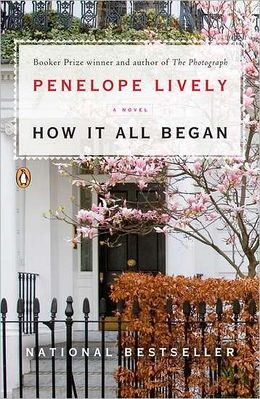
livelyI could say very much the same things about How It All Began, which begins with a random event — here, the street mugging of retired English teacher Charlotte Rainsford — and then traces out the effects of this one moment in the lives of an array of interconnected characters. There’s a logic, or at least an intelligibility, to the way things unfold, but that is not the same as their being destined or fated, though at times the characters are tempted to interpret their experiences this way. Lively sets up the novel with a quotation about the “Butterfly Effect” from James Gleick’s Chaos, so we know that she is deliberately playing with the possibilities of this idea. The mugger (an unsavory butterfly!) couldn’t possibly have foreseen the personal and professional consequences of his own thoughtless action: “beyond him, unknown and of no interest, he had left Charlotte on her crutches, the embattled Daltons, Henry in his humiliation, Marion, Rose, Anton . . . ”

It’s Lively’s gift, though, to make each of these people of genuine interest to us. There are no cataclysms, no dramatic show-downs, no epiphanies in How It All Began, but by the end of the novel very little is quite the same in anyone’s life, all because of the sequence of disruptions begun with the mugging. Charlotte’s injury causes Rose to stay away from work for a while, so her employer, historian Sir Henry Peters, calls on his daughter Marion, thus precipitating a last-minute text message to Marion’s married lover Jeremy, which is intercepted by Jeremy’s wife Stella — and thus “the Daltons’ marriage broke up because Charlotte Rainsford was mugged.” Marion, unaccustomed to tending to Sir Henry’s business, forgets his notes when they head to an event at the University of Manchester; as a result, his speech is a disaster, which leads Henry into various machinations designed to revivify his moribund career and recover some wished-for celebrity. In Manchester, Marion meets a man she hopes will help turn around her struggling interior design business; though her involvement with him doesn’t lead to financial prosperity (little does, in this age of recession and belt-tightening), it turns out nonetheless to be a fortuitous encounter.

Charlotte, in the meantime, who has moved into Rose’s home for her convalescence, misses having a purposeful way to pass the time. So she arranges to tutor one of the students from her adult literacy class, Anton, “a soft-spoken man, central European of some kind.” Rose, married to the underwhelming Gerry, offers to take Anton shopping for clothes for his mother back home. Rose and Anton begin meeting regularly to walk and talk, and their friendship and, eventually, their deeper feelings bring them to a difficult decision:

You live twenty years in a London suburb. Husband, children, house, cat — go to the supermarket. Then — something happens. A person happens, that’s all. Him.

You do not mess up everything that has been important to you for most of your life because you are in love with an Eastern European immigrant you have known for ten weeks. You do not do that to Gerry. To Lucy and James [their children].

Do you?

During their reading lessons, Charlotte has an idea: for the dreary literacy primers, she substitutes children’s books so that Anton will be drawn on by story. It works: he learns faster because, as he realizes, “I must know what will happen.” “Powerful things, stories,” says Charlotte. How It All Began is about that power as much as it is about chaos theory: Charlotte reflects often on her own reading, and Lively too is self-conscious (perhaps a little too self-conscious, too overt) about the appeal of what she’s doing for us. “So that was the story,” she sums it up near the end:

These have been the stories: of Charlotte, of Rose and Gerry, of Anton, of Jeremy and Stella, of Marion, of Henry, Mark, all of them. The stories so capriciously triggered because something happened to Charlotte in the street one day. But of course this is not the end of the story, the stories. An ending is an artificial device . . . but time does not end, and stories march in step with time. Equally, chaos theory does not assume an ending; the ripple effect goes on, and on. These stories do not end, but they spin away from one another, each on its own course.

Still, she is no more able to omit at least a sketch of all their endings than Eliot is with her panoply of characters in the Finale to Middlemarch. For all its interest in chaos theory, it’s not a formally experimental novel, just an artful, intelligent, sometimes quietly touching look at pretty ordinary people. Lively is particularly sharp (here as, again, in Moon Tiger) about aging. “Old age is not for wimps,” thinks Charlotte;

Ah, old age. The twilight years — that delicate phrase. Twilight my foot — roaring dawn of a new life, more like, the one you didn’t know about. We all avert our eyes, and then — wham! you’re in there too, wondering how the hell this can have happened, and maybe it is an early circle of hell and here come the gleeful devils with their pitchforks, stabbing and prodding.

Sir Henry’s pomposity and preening egotism make his lapses of memory more comical, but he too earns a certain pathos as he declines from self-important bluster to “reading and rereading in a desultory way, and eventually ceased to do even that.”

Though there’s nothing strikingly memorable or original about How It All Began, what it does, it does very nicely: it seems true, both to its characters and to what we know or feel about the tragicomedy and uncertainty of our lives.

My First Romance? L. M. Montgomery, The Blue Castle

bluecastle1

Once upon a time I had never read a “romance novel” — or so the story went. There’s a way in which that was absolutely true: I had never read anything marketed or labeled explicitly as a “romance novel” (a Harlequin, say). As with all literary labels, though, “romance” isn’t really that precise:all around the territory of the card-carrying Harlequin-style “romance novel” there’s a vast borderland populated by everything from chick-lit to Victorian marriage-plot novels, all of which have at least some key elements in common with romances, even if it’s only a structural similarity. I had certainly read a lot of books from that more nebulous territory before I ventured into the heartland, but (partly because I didn’t know, or think, much about what made something a “romance novel” instead of some other kind of novel, and partly because I hadn’t read any self-identified “romance novels”) I hadn’t recognized any of them as romances.

I just reread Lucy Maud Montgomery’s The Blue Castle, which is why I’ve been thinking about how (and, a bit, why) we make these distinctions. I haven’t read The Blue Castle in over 30 years; though it was a favorite of mine long ago, our family collection of L. M. Montgomery didn’t move east with me, and the only ones I’ve restocked are the first two in the Anne series. I happened across The Blue Castle at the Women for Music book sale last weekend and grabbed it right up. And as I reread it, what I kept thinking is how similar it is to so many of the romances I’ve read in the last couple of years, particularly Mary Balogh’s: I can totally imagine the entire plot transplanted to one of her Regency settings. In fact, aren’t there one or two that are very similar? But asked about my recollections of it, I would never have said it was a romance: though I remembered the falling-in-love plot, it’s the heroine’s journey of self-discovery that has stayed with me all these years. (Of course the two things frequently go together, as they do here and in many of the romances I’ve read.)

The funny thing was that this time, though the whole of The Blue Castle was intensely familiar to me, and I thoroughly enjoyed revisiting all of its familiar scenes (it’s almost eerie, isn’t it, how you can reread something you used to know well and not even know how much you remember about it, but then at each moment find yourself thinking “oh yes, this is what happens”?), it also struck me as familiar in a different way: as exemplary of a particular formula. “Formulaic,” of course, is the derogatory term other people (who me? never! OK, sometimes…) use for genre fiction. Being formulaic is perhaps the defining quality of “genre fiction,” the way that we know it isn’t “literary fiction.” (Getting past the use of “formulaic” as a judgment is actually one of the key things I work on in my mystery fiction class. First of all, another word for “formula” is “convention,” and all literary works rely to some degree on conventions. And second, once there’s a formula, you can mess with it in interesting ways, and that’s its own kind of challenge, especially because readers get very savvy about formulas — which makes them hard to surprise and impress.) The Blue Castle read like a romance this time — which is not a criticism, but just a recognition that my reading has always been more promiscuous than I thought — or that labels are less useful. It also looked like a romance this time: look at that cover! The one I grew up with is below — quite a contrast.

bluecastle2The Blue Castle is a great example of a book written for the tortoise market, which is probably why I loved it when I was around 13 and moping about being undesirable the same way as Valancy does through the first half of the book. (Count me among those who have no nostalgia for their teen years.) Much older and somewhat less self-critical now, I still enjoyed her Cinderella-style transformation into someone joyful and confident in her own beauty and sure of her own values — and yet what I liked best about it is that unlike Cinderella, Valancy is the agent of her own transformation. I also liked the lyrical nature writing in the novel, which is linked in the plot to the books of Valancy’s favorite author and [spoiler redacted!], so that the descriptions, which are usually filtered through Valancy’s emotions, draw all the elements of the novel together. I’ve never been to the Muskoka region of Ontario, but Montgomery made me wistful for it in a dreamy kind of way, as a place I’ve never seen and yet somehow know intimately:

The stars smouldered in the horizon mists through the old oriel. The haunting, persistent croon of the pine-trees filled the air. The little waves began to make soft, sobbing splashes on the rocks below them in the rising winds . . .

October — with a gorgeous pageant of colour around Mistawis into which Valancy plunged her soul. Never had she imagined anything so splendid. A great tinted peace. Blue, wind-winnowed skies. Sunlight sleeping in the glads of that fairyland. Long dreamy purple days paddling idly in their canoe along shores and up the rivers of crimson and gold. A sleep, red hunter’s moon. Enchanted tempests that stripped the leaves from the trees and heaped them along the shores. flying shadows of clouds. What had all the smug. opulent lands out front to compare with this?

Catching Up and Looking Ahead

Flowers

Friday afternoon I filed the last of my final grades for 2012-13. Compared to the arduous work to be done at the end of last term, wrapping up this term hasn’t been as difficult, but it also hasn’t been quite as interesting.

My last post dwelt on the perplexities of ‘coercive pedagogy.’ Marking exams last week I saw both good and bad results. Mostly, students’ performance is quite consistent with their work throughout the rest of the term; a couple of them clearly put in a lot of time studying and made a better showing than usual — and while in some ways this is a good thing, still, the very last three hours of time on a course is not the optimal time to rise to the occasion if learning, rather than scoring, is the real goal. So next year I’m going to focus on raising expectations for class time. I’ll re-institute reading quizzes in the 19th-century fiction class, and I’m going to take Yonina’s idea and introduce ‘calling cards’ of some kind in my section of Intro. One of my students told me this year that I made class worthwhile even for students who weren’t keeping up with the reading. While she meant this (I think) as a compliment, and while it reflects the effort I put into making sure our class time is informative and stimulating, I think it also gives me a hint about the problem: if students know that I’ll keep things going, then I become not the ‘value-added’ that I should be but the whole package. I think that’s fine sometimes. I’m not anti-lecture: lectures are an efficient way to get some kinds of work done, and they can be more than information delivery (when I do more formal lecturing, for instance, I often structure my comments in order to model something like building an argument from close reading). But if I’m too ready to answer my own questions in class, too willing to fill in when it should be their turn, I’m enabling their passivity as well as potentially preempting discussion that might emerge if I held back more, or made more deliberate efforts to bring in students’ voices. It has to work both ways (they have to be ready and willing to talk) — so I’ll work the problem from both sides. It’s not that these are new goals for me, to be clear. It’s just that this year more than other years my usual strategies seem not to have worked that well. (Individual classes have their own mysterious chemistry, also, so it may be that I’m overreacting to two groups that just happened to be on the quiet side.)

I’ll do a bit more housekeeping when I get back into my office tomorrow:  recycling and filing and shelving books and so on. I’ll even bring in a collection of supplies and do some literal cleaning! And then it will be time for the next phase to begin. April and May are key times for administrative work — I’ve had a number of meetings already and have more booked for next week. It’s also an important time for our M.A. students, who have to present the first stages of their thesis work at our colloquium in a couple of weeks. I’m supervising one M.A. student this summer. I’m on two Ph.D. committees too, one as a reader and the other as supervisor. Both seem likely to require quite a bit of work over the summer — in fact, one of my big tasks over the last two or three weeks has been reading through an entire draft of one thesis that might be going forward to defense before too long.

Then there are my own summer projects. It might look from the absence of book posts on this blog as if I haven’t been doing much reading, but that’s actually not true. It’s just that I’ve been reading (and rereading) in preparation for pieces to run elsewhere and I don’t want to steal my own thunder! I’m working on a review of Kate Aktinson’s Life After Life for the May issue of Open Letters Monthly, just a bit behind the big flurry of press attention it has already gotten (including reviews in major papers by not one but two of my OLM colleagues) but not so late, I hope, that nobody’s interested. As soon as that’s a wrap, I need to get serious about reviewing Deirdre David’s new biography of Olivia Manning, also for OLM.  And I’ve started a big project of rereading all 40+ novels by Dick Francis for an essay I’ve proposed for the Los Angeles Review of Books. This may be the only literary piece I’ve worked on so far for which I need to enter my notes in a spreadsheet. There’s just no other way I can think of for me to keep good track of the details across so many books. Now that my days won’t be (entirely) taken up with teaching and administrative work, and my nights also will be freed up from reading for class, I should also be able to return to reading more of the books that currently sit in tempting piles around my desk and nightstand and coffee tables, and writing posts about them too.

I have some longer-term summer plans as well. At the top of the list is completing a ‘beta’ version of the ‘Middlemarch for Book Clubs’ site that I began building last year. I think it’s in decent shape but it’s still skeletal. Once I’ve filled in preliminary versions of most of the pages I’ll make it public and solicit feedback. It’s just a one-person show at this point, but if it seems to people like a good thing, I may eventually make a pitch for some funding and support for it. And the final, most ambitious but at this point most amorphous plan is to think about where I’m going with the various George Eliot essays I’ve written over the past few years: do they, could they, add up to something larger, perhaps some kind of cross-over book project? If Rebecca Mead can do it, so can I, right? (Well, OK, wrong, since she’s a known quantity in the larger literary world — “A connected author, regularly featured at the New Yorker Festival, who is a natural for promotion,” as the site says. But a writer’s reach must exceed her grasp etc.) As part of that effort I will probably also get started on essays about the books I haven’t written anything about yet, probably starting with Adam Bede, but the most important work will be conceptual: what kind of book could it be? what do I specifically have to offer?

And on that note, suddenly I feel very busy — but in a good way! I’m hoping that having a rich list of projects I’m really interested in will help me avoid the summer slump I often fall into. I’m also going to experiment with working in different locations, to see if that makes a difference. My home office is in our basement, and long hours spent below ground at any time but especially when it’s finally pretty outside get disheartening. My office on campus, on the other hand, has a nice big window that unfortunately faces west, and as my floor is not air-conditioned, the room is basically uninhabitable in the afternoons once the temperatures rise. I may try working there in the mornings and then moving into the library in the afternoon. Even though I usually like it quiet when I’m writing, I’ve also wondered if, paradoxically, I might find it energizing to work in busier locations — a coffee shop, for instance — where the noise might blur because it would be impersonal, unrelated to me, and so (maybe) not psychologically distracting the way that, say, household commotion distracts me when I’m working at home.

This Week In My Classes: Coercive Pedagogy

keepcalmstudyMonday was my last day of class meetings, and now I’ve moved into the exams-and-essays phase of the term. I have mixed feelings about both final exams and final essays, but for different reasons. Final essays can be triumphant culminations of a term’s work, the products of significant reflection and practice.  But they can also be perfunctory hoop-jumping or last-minute rush jobs, and because they are final, there’s no hope that you can turn them into learning opportunities. I still comment pretty thoroughly on them, but I bet we all have that disheartening file of uncollected papers stashed away in our offices: for some students, the recorded grade (which we often see as the least important part of our evaluations) is all that matters. (One of my favorite things about electronic submissions is that I can email them the marked papers, which at least puts the ball back in their courts — and doesn’t increase my clutter.) I often rethink how I approach or build up to a final essay assignment, but I never rethink including a final essay, or essay option, in my courses: organizing ideas about literature into well-supported analysis is just too fundamental to my goals for the courses, and indeed to my ideas about the discipline of literary studies.

I do often rethink holding final exams, however. Again the results for individual students can be triumphant or passable or disastrous, but though they can produce flashes (occasionally even pages!) of brilliance, and though I try to make them meaningful reflections of the course objectives, I don’t really believe in the exam as a form that’s intrinsically worthwhile. Yet especially in recent years I hold exams in every class except 4th-year seminars. Why? Because knowing that there will be a final exam turns out to be highly motivating for a lot of students in ways that benefit them, and the course, over the rest of the term. It encourages attendance, note-taking, and (most important) doing the readings, which means it reinforces the things students need to do to be actively rather than passively present (and by actively present I don’t necessarily mean participating vocally in discussion, but just being ready and able to follow and mentally engage with what’s going on). Even for students who are highly motivated intrinsically, there are a lot of competing demands on their time and effort, and it’s rational (if sometimes regrettable) that they make choices about how to invest them based on the immediate consequences of not doing so. If mine is the only class in which the consequences are not conspicuous and quantifiable, then it may lose out in the inevitable triage. Exams, then, are one of my strategies for literalizing and enforcing my expectation that they do the work for my class too. And it does help: one sure way to focus the attention in the room is to point out that whatever we are doing — whether it’s sorting out some details of literary history or analyzing a passage from a novel — is the kind of thing that they will also be expected to do on the exam.

But final exams seem pretty far away for most of the term, and students can count on having time to catch up on notes or readings after classes end. So like most teachers, I require students to do a lot of other things that have both pedagogical and coercive aspects — depending on the class, these might include reading quizzes, in-class writing starts, online discussion threads, question sets, or reading responses, for example. The primary purpose of these smaller assignments (as opposed to the weightier ones like essays or seminar presentations, which have loftier aims) is simply to encourage students to keep up with the reading — so, they are pedagogical tools because in an English class, the readings are the main focus of all of our class time, but they are coercive because, oddly enough, students often don’t seem motivated to do the reading if there aren’t marks immediately tied to it.

I kind of hate the whole circular logic of that, though. If I tie marks to doing the reading, I am tacitly agreeing that you should be rewarded for doing what I actually believe you should just do because after all, if you don’t, what’s the point? Aren’t you in class in the first place because you want to learn about the books on the reading list — not just to read them but to grapple with them, question them, argue about them, make sense of them, see how they work? If you decide you’re fine with just showing up and letting everyone else have the fun of actually knowing what we’re talking about, isn’t that your problem, anyway, not mine? But then I go around the question again and think how often we all need to be prodded into doing things that, afterwards, we realize the benefit of. And I think how much better the class meeting is when a critical mass of students can contribute in an informed way. And I remember the arms race we’re all in: if their chem prof, or their stats prof, or their Spanish prof outbids me in the quest for their time and attention, then nobody wins! We’ve all seen attendance drop off in our intro classes around midterm time, right? And how many of us have had students tell us blithely that they missed class for a chem lab or a math midterm, or something else they felt they couldn’t fudge? I want to at least be in the game.

letter_paper_and_pen_vector_275746In my 19th-century novels class this term I tried what I hoped would be a more flexible and intrinsically valuable approach than the reading quiz: I required students to keep an online reading journal, using the journals tool in Blackboard. (I don’t like Blackboard in general, but this particular feature seemed unusually streamlined and user-friendly, so I took a chance on it.) The requirements were simple: three posts per novel minimum (no more than one per day for credit), at least 150 words and in full sentences. This way I figured they could keep track of their reading at their own pace, get regular small-scale practice writing (with the chance of regular quick feedback from me), and end up with a useful record of ideas and observations. After the first round, though, I realized that I had not been coercive enough: easily 75% of students did all three of their journals on the last three possible days, and often their posts suggested that they were way behind on the reading. What I hadn’t done, you see, is explicitly tie credit for the journals to the portions of the novels assigned for each class meeting, or insist that they stagger their work so that they were writing and thinking throughout our time on each novel. Silly  me: I thought they would just be doing that anyway, and that self-interest and forethought would motivate them to do a journal here, a journal there — rather than piling them all on at the end. But apparently all that many of them wanted (and therefore got) out of the exercise was the credit for having done it. There were certainly some students who approached the whole exercise in exactly the spirit I hoped for, and kudos to them. My strong suspicion (and in some cases, my past experience) is that these are the students who don’t need coercion anyway: they’re just into it, and more power to them. But they are a minority.

So my question heading into the next iteration of this course is just how much more coercive I should be: is it really up to me to micromanage when students write and what they write on in order to make them get the wider benefits from the exercise if I possibly can? It’s exhausting, after a while, providing all the incentives and policing all the rules. But it is also exhausting asking provocative questions about Tess of the d’Urbervilles and getting mostly blank stares in response (and shocked gasps when I “reveal” how the novel ends!). Must I make it worth their while in some tangible way to show up ready for that conversation? I’d really rather just expect them to and not be disappointed. I’m thinking, though, that next time I try this I won’t make it three posts per novel but one, or maybe two, posts per week, and I’ll tighten the requirements for getting full credit so that their posts must reflect specific knowledge of the reading installments assigned for that week. At the very least that will distribute their work (and thus mine) better across the term.

Do you fret about how to get your students to do the reading for your classes? A colleague of mine recently expressed concern and frustration that often her students are showing up without even bringing their course packs to class — not having the text in hand even if you’ve read it (and I think she believes they are also not doing the readings) is also a real problem for class discussion. But are we just perpetuating the wrong idea about why to do things (to get a gold star!) if we give marks for something as fundamental as that? Or (to go around the circle once more) are we pragmatically using whatever tools work to make sure everyone gets the most value out of the course experience? And is it their problem if they aren’t doing the reading, or ours — or both?

“Because she’s a woman”: Carol Shields, Unless

unlessI’ve just wrapped up a couple of weeks of reading and discussing Carol Shields’s Unless with the students in my Intro class. I assigned it a bit on impulse: I wanted a reasonably contemporary Canadian novel on the syllabus, and I was also looking for a novel to pair with Woolf’s A Room of One’s Own — something that I thought could be in an interesting conversation with it, the way I thought Wiesel’s Night and McCarthy’s The Road would be thought-provking read side by side (which they were). When I started preparing Unless attentively for class, I was amazed at how many connections I found to Woolf, from questions about literary significance and merit (“This is an important book, the critic assumes, because it deals with war. This is an insignificant book because it deals with the feelings of women in a drawing-room”) to a riff in Unless on the importance of female friendships in fiction (“Chloe liked Olivia”). From a purely pedagogical standpoint, I felt I had struck gold!

As this post from 2007 shows, my previous reactions to Unless have been mixed, but (as is often the case) I found myself appreciating the novel more the more I worked at figuring out what (and how) it meant. (One specific change is that reading it today, I am less “distanced” by the features that struck me then as overly didactic or diagrammatic.) I also read other material about it, and about Shields, including this Salon review, this review in the Guardian, this review in Quill & Quire, and, best of all, this thoughtful and spirited blog post from Kerry Clare about Unless as a contender in Canada Reads in 2011. The coductive process of comparing my reading to other people’s always challenges and enriches my own first responses.

Unless

A recent talk with a good friend sent me back to my bookshelf to revisit Carol Shields’s Unless, which I remembered having found not wholly convincing. My reaction on this re-reading was the same, though the novelistic intelligence evident throughout engaged me more fully this time. My problem here is the opposite of my complaint about ‘chick lit’ (absence of ideas): Shields’s novel is too conspicuously driven by an idea, specifically an idea about the way women are rendered trivial, condemned (as the narrator Reta says in one of her interspersed letters) to a “solitary state of non-belonging.” The novel does not have a feminist sub-text: it is, both artfully and overtly, a feminist novel. Reta confronts her “smarmy” New York editor about her next novel featuring her characters Roman and Alicia–bound, on her initial conception, for marriage, but now redirected by her epiphanic realization that Alicia must be granted her singleness:

“I am talking about Roman being the moral centre of this book, and Alicia, for all her charms, is not capable of that role, surely you can see that. She writes fashion articles. She talks to her cat. She does yoga. She makes rice casseroles.”

“It’s because she’s a woman.”

“That’s not an issue at all. Surely you–”

“But it is the issue.”

“. . . A reader, the serious reader that I have in mind, would never accept her as the decisive fulcrum of a serious work of art that acts as a critique of our society while, at the same time, unrolling itself like a carpet of inevitability, narrativistically speaking.”

“Because she’s a woman.”

“Not at all, not at all.”

“Because she’s a woman.”

The reflexivity of this moment is palpable: can we take Reta herself–who calms herself through housekeeping, who cooks lasagna, who mothers her children–seriously as a moral fulcrum? Can her story offer a social critique that reaches beyond the personal? Or, perhaps, should we want it to, as the novel, even as it chafes against cliches about women novelists being “miniaturists of feeling” (from another of Reta’s letters), refuses to reach out and claim its larger issues in larger ways? Doesn’t Shields, in avoiding bolder confrontation with the global and ideological issues that lurk around the edges of her plot (admittedly, as they typically lurk around the edges of our lives), allow her novel to settle into something like comfortable domestic realism? The woman in a burka who sets herself alight and thus precipitates Norah’s (and, in turn, Reta’s) crisis: surely in a post-9/11 novel to choose such an incident to stand for women’s desperation is no accident, but no more is made of her than that, a symbol–and an occasion for Norah’s and Reta’s meditations on goodness, rather a reductive and objectifying gesture, and one that conflates Reta’s rather abstruse complaints (women writers and thinkers are undervalued in the history of literature and philosophy!) with the truly devastating limitations on personal freedom, individualism, and well-being we can imagine might motivate a woman to actual self-immolation.

And yet at the same time as I felt Shields allowed some of the (potential) substance of the novel to become insubstantial, I felt irritated at the novel’s didacticism on its main theme, and inclined to quarrel with its insistence that despite apparent gains, women continue to exist on the margins of power and discourse. “Not so,” I kept wanting to interject, and especially when the tone and art of the novel seemed to suffer from Shields’s polemical intent. “I need to speak further about this problem of women,” Reta begins one chapter, “how they are dismissed and excluded from the most primary of entitlements.” Is my resistance to these persistent iterations the result of a generational difference? Wishful thinking, or ignorance? Whatever its cause, it distanced me from the novel.

And yet (again), there are moments and expressions in the novel that sparked poignant recognition in me, that made me reach for my notebook to jot them down for later reference. (“This is why I read novels,” Reta reflects: “so I can escape my own unrelenting monologue.”) And Norah’s story, though ostensibly the occasion for Reta’s narrative rather than a “fulcrum” in its own right, strikes me as a creative and appropriate working out of George Eliot’s line about the “roar on the other side of silence” that Shields takes as her epigraph. If the novel irritated and frustrated me at times, I think it was because I wanted a different kind of book, one that gave me these people and their stories in more Eliot-like depth, with more picture and less diagram. But I’m aware, too, because the novel is also about novels and what we want from them and how we theorize and criticize them, that Shields is resisting that kind of book and offering this one instead, and I respect and appreciate her invitation to her readers to think as well as to feel.

(Original post July 9, 2007)

Diana Athill, Stet: On Angela Thirkell, Virginia Woolf, and the Embarrassment of Caste

StetThis month’s reading for the Slaves of Golconda group was Diana Athill’s briskly evocative memoir Stet, about her decades-long career in publishing. Other folks have been putting up their smart and detailed posts, and you should hop on over and read them if you haven’t visited already. Partly because I’m tired and busy, and partly because I can’t think of anything substantial to add to their observations, for my contribution I’m just going to quote a passage I particularly enjoyed. It comes almost at the very end, in Athill’s Postscript to the memoir, and it stood out for me because it touches on a number of issues about publishing and taste and literary merit and canonicity that have been coming up a lot in my classes this year — particularly the Somerville Novelists seminar (and as you’ll see, chronologically her remarks are spot on for that one) but also, more recently, in my intro class, where we’ve been talking about feminism and the role of taste-makers and gatekeepers in establishing and policing the literary hierarchy. The ‘crisis in publishing’ and the ‘death of reading’ are also, of course, endlessly reiterated themes in the literary world. I found Athill’s frankness and lack of pretension refreshing, her pragmatism admirable, and her examples thought-provoking.

Having seen Andre Deutsch Limited fade out, why am I not sadder than I am?

I suppose it is because, although I have often shaken my head over symptoms of change in British publishing such as lower standards of copy-preparation and proof-reading, I cannot feel that they are crucial. It is, of course, true that reading is going the same way as eating, the greatest demand being for the quick and easy, and for the simple, instantly recognizable flavours such as sugar and vinegar, or their mental equivalents; but that is not the terminal tragedy which it sometimes seems to the disgruntled old. It is not, after all, a new development: quick and easy has always been what the majority wants. The difference between my early days in publishing and the present is not that this common desire has come into being, but that it is now catered for more lavishly than it used to be. And that is probably because the grip on our trade of a particular caste has begun to relax.

Of that caste I am a member: one of the mostly London-dwelling, university, university-educated, upper-middle-class English people who took over publishing towards the end of the nineteenth century from the booksellers who used to run it. Most of us loved books and genuinely tried to understand the differences between good and bad writing; but I suspect that if we were examined from a god’s-eye viewpoint it would be seen that quite often our ‘good’ was good only according to the notions of the caste. Straining for that god’s-eye view, I sometimes think that not a few of the books I once took pleasure in publishing were pretty futile, and that the same was true of other houses. Two quintessentially ‘caste’ writers, one from the less pretentious end of the scale, the other from its highest reaches, were Angela Thirkell and Virginia Woolf. Thirkell is embarrassing — I always knew that, but would have published her, given the chance, because she was so obviously a seller. And Woolf, whom I revered in my youth, now seems almost more embarrassing because the claims made for her were so high. Not only did she belong to the caste, but she was unable to see beyond its boundaries — and that self-consciously ‘beautiful’ writing, all those adjectives — oh dear! Caste standards — it ought not to need saying — have no right to be considered sacrosanct.

Keeping that in mind is a useful specific against melancholy; and even better is the fact that there are plenty of people about who are making a stand against too much quick-and-easy. The speed with which the corners of supermarkets devoted to organic produce are growing into long shelves is remarkable; and there are still publishers — not many, but some — who are more single-mindedly determined to support serious writing than we ever were.

She’s right about organic produce (around here, anyway), and though I bet a lot of us would like to have it out with her about Woolf, and maybe also Thirkell, there seems a lot right too in her wry admission that there is no incontrovertible standard, and that  it’s all too easy to mystify one’s own preferences.