Both of my class readings for today focus on conflicts–real, assumed, or perceived–between the demands of the head and the demands of the heart.
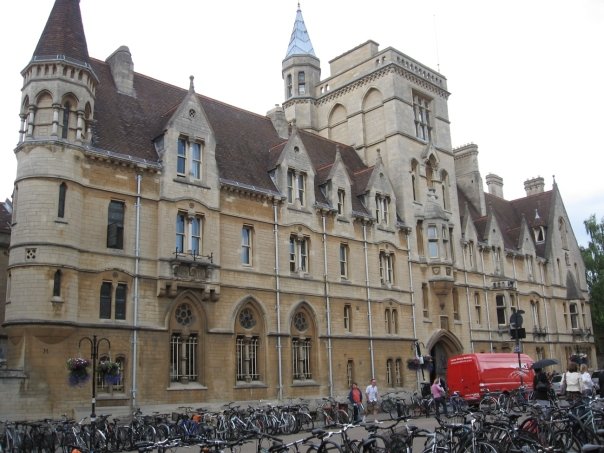
In Women and Detective Fiction, it was our first session on Dorothy Sayers’s Gaudy Night. The novel opens as Harriet Vane revisits Oxford for her college’s Gaudy celebrations. She is pleased to be leaving behind her, as she thinks, the emotional disruptions of her life in London, including her troubled past as a murder suspect and her current relationship with Lord Peter Wimsey. Oxford, to her, represents at this point an oasis of order and clarity:
To be true to one’s calling, whatever follies on might commit in one’s emotional life, that was the way to spiritual peace. How could one feel fettered, being the freeman of so great a city, or humiliated, where all enjoyed equal citizenship? . . . In the glamour of one Gaudy night, one could realize that one was a citizen of no mean city. It might be an old and an old-fashioned city, with inconvenient buildings and narrow streets where the passers-by squabbled foolishly about the right of way; but her foundations were set upon the holy hills and her spires touched heaven.
This “exalted mood” does not altogether survive the ensuing encounters with old classmates or former teachers, but even as clues emerge that beneath its beautiful surface Oxford conceals its share of ugly truths and dark secrets, Harriet continues to be compelled by the ideal of a place in which the highest value is placed on “integrity of the mind.” Writing about Gaudy Night, Sayers recalls having been asked by her own Oxford college to give a toast at the Gaudy dinner:
I had to ask myself exactly what it was for which one had to thank a university education, and came to the conclusion that it was, before everything, that habit of intellectual integrity which is at once the foundation and the result of scholarship.
Much of the novel explores the implications of this commitment, and whether the intellectual life can, or should, be isolated from the life of the heart. For Sayers, the technical challenge was to integrate her interest in this problem, and in the characters she had invented who were living out its implications, with her chosen fictional form:
The new and exciting thing was to bring the love-problem into line with the detective-problem, so that the same key should unlock both at once. I had Harriet, feeling herself for the first time one equal ground with Peter, seeing the attraction of the intellectual life a means of freeing herself from the emotional obsession he had produced in her, and yet seeing (as she supposed) that the celibate intellectual life rendered one liable to insanity in its ugliest form. I had Peter, seeing the truth from the start and perfectly conscious that he had only to leave her under her misapprehension [about the causes of that insanity] to establish his emotional ascendancy over her. . . . Peter’s honesty of mind had to tell him that if Harriet accepted him under any sort of misapprehension, or through any insincerity on his part, they would be plunged into a situation even more false and intolerable than that from which they started. She must come to him as a free agent, if she came at all . . .
Sayers explains in the same essay that her creation of Harriet as a strong, deep, and independent woman necessitated her reinvention of Peter: she had to rewrite him from a caricature to a human being so that a relationship between the two was conceivable. More than that, though, and I think this is at the heart of why so many women writers and critics cherish this novel, she would not compromise Harriet’s autonomy in the interests of romance, so she devotes this entire novel to the struggle of both Peter and Harriet to find the necessary balance or equipoise in their relationship that they can achieve both love and respect, can satisfy both head and heart.
In British Literature Since 1800 we are spending this afternoon’s class on Elizabeth Barrett Browning’s Aurora Leigh. I am fortunate to have as a colleague one of the leading experts on EBB, Marjorie Stone, who recently co-edited the definitive annotated edition of EBB’s poetry for Pickering and Chatto. Marjorie has kindly agreed to do a guest lecture. I’m always very excited when someone else lectures in my class. I thoroughly enjoy lecturing myself, but I love feeling like a student again–that experience, after all, was what sent me down this path in the first place! It’s wonderful to hear someone speak with passion and wisdom about a subject really dear to their heart. We are reading just the excerpts in the Norton Anthology: the bits from Book I on Aurora’s education, from Book II in which she faces off against her conventional cousin Romney, and then from Book V in which she (meaning both Aurora and EBB) redefines the epic form for the modern age, and for the woman poet:
Never flinch,
But still, unscrupulously epic, catch
Upon the burning lava of a song,
The full-veined, heaving, double-breasted Age:
That, when the next shall come, the men of that
May touch the impress with reverent hand, and say
‘Behold,–behold the paps we all have sucked!
This bosom seems to beat still, or at least
It sets ours beating: this is living art,
Which thus presents, and thus records true life.
It’s an exciting moment, but one that Aurora has earned (or so she thinks) by choosing her head over her heart, rejecting Romney’s proposal that she give up her poetic ambitions to become his helpmate in social reform: “If your sex is weak for art,” he says,
(And I, who said so, did but honour you
By using truth in courtship), it is strong
For life and duty.
Romney’s assumptions about women reflect Victorian commonplaces about the division of the world into separate spheres of natural aptitude and interest. His assumptions about poetry are also representative, in this case of the Utilitarian prejudice against such frivolous pastimes (“men, and still less women, happily, / Scarce need be poets”). Aurora’s rebuttal is one of many great passages in the verse-novel that reject such polarizing binaries, not just between men and women or poetry and useful work, but between the real and the actual, the spiritual and the material, the individual and the social:
I hold you will not compass your poor ends
Of barley-feeding and material ease,
Without a poet’s individualism
To work your universal. It takes a soul
To move a body: it takes a high-souled man,
To move the masses, even to a cleaner stye:
It takes the ideal, to blow a hair’s-breadth off
The dust of the actual.
Just as Romney must learn to value the heart (or poetry, or the soul, or the spiritual), Aurora must let go of her own absolutism and make manifest the value of poetry as a force for social good, as well as reconciling her head and her heart by accepting the value of love. By the end of Aurora Leigh, they have achieved a rare equality of both passion and commitment, which they celebrate in some wonderfully erotic, ecstatic poetry that (sadly) is not included in the Norton excerpts:
But oh, the night! oh, bitter-sweet! oh sweet!
O dark, O moon and stars, O ecstasy
Of darkness! O great mystery of love,
In which absorbed, loss, anguish, treason’s self
Enlarges rapture, – as a pebble dropt
In some full wine-cup over-brims the wine!
While we too sate together, leaned that night
So close my very garments crept and thrilled
With strange electric life, and both my cheeks
Grew red, then pale, with touches from my hair
In which his breath was. . . .
Sure, it’s perhaps a bit excessive, but isn’t rapture precisely excessive? And even Jane Eyre doesn’t bring her physical response to Rochester to such sensory life.


 Novel Readings