This Week in My Classes: Eliot, Auster, McEwan

There’s a lot of variety in my classes this week. After a short stint with Tony Hillerman in Mystery and Detective Fiction, we’re starting Paul Auster’s City of Glass on Wednesday. I really enjoy the Hillerman story we discussed, “Chee’s Witch”; it presents, in microcosm, some of the larger themes Hillerman takes up in his novels, about competing systems of evidence and explanation, for one thing–does Chee actually believe there might be a witch? We’ve talked a lot this term about detective fiction as a genre that rules out supernatural explanations (the various rules drawn out in the Golden Age explicitly bar them), but Hillerman plays with this conventional expectation, undermining the classic emphasis on ratiocination but keeping it just ambiguous enough, in the story, that we can believe, if we want to, that Chee never really entertains the witch theory–though he studies to be a medicine man later on, so why should we believe that? What’s at stake? That last question makes for an interesting discussion, anyway, especially when “Chee’s Witch” turns on racist stereotypes. City of Glass also undermines or plays with conventions and expectations of the mystery genre, which is why I include it on the syllabus, though I don’t particularly like it, myself.

In British Literature Since 1800, we’re moving further into Atonement. I thought Monday’s class went really well. I began with some pretty open-ended questions about Briony as a character; participation was strong, more than usual, including students who haven’t typically jumped in, and we moved from collecting impressions of her (young, immature, neat, a writer) into questions about her perceptions of what she sees, especially Robbie and Cecilia at the fountain, then in the library, and then of Lola’s assault. Because we’ve been talking a lot about (mis)perception as a central issue in the movement from Victorian fiction into modern fiction, they were primed to see her misinterpretations in relation to the interest in psychology emphasized, for instance, by Woolf in “Modern Fiction,” and to see how McEwan’s presentation of alternative points of view on those key scenes acts as a kind of critique of the potential solipsism of that preoccupation. We got into quite an interesting discussion about how far we can or should judge or blame her for imposing her story on what she sees–a conversation that of course we get to continue, with complications, when they have read to the end of the novel and realize that they are being set up for exactly that struggle between understanding and forgiveness. We also talked about sex, of course: it wouldn’t be an English class if we didn’t, right? But there’s Robbie’s letter, for one thing, forcing the subject into explicitness, breaking through the layers of propriety and repression that characterize so much of the action in that section of the novel (and in so many other novels, of course, as we are insistently reminded). Is his letter obscene, shocking, or threatening, I asked? Of course, being modern young people, they denied its shock value (“maybe in those days” seemed to be the consensus view). Maybe–they did acknowledge that even today, context would matter (“if just some guy sent it to you,” as one of them rightly remarked, “that would be creepy”). I found myself thinking of the scene in The Mill on the Floss in which Stephen Guest kisses Maggie’s inner arm. Again, context matters: it’s a startling and intensely erotic moment not just because ‘in those days’ you didn’t just kiss your fiancee’s cousin’s arm all of a sudden, but because that action is so transgressive and speaks of the strength of the forces social taboos and rituals work to control and organize. (This was one reason contemporary reviewers found The Mill on the Floss so shocking, just by the way–because it conceded so much to the strength of “physiological law.”) There was a lot of intelligent engagement on display, and I left feeling very pleased at my choice of Atonement as our capstone reading for the course. (It’s not easy choosing just one novel to represent ‘contemporary fiction’!) Tomorrow we will be talking about the war section. Again, I’m hoping to keep things open and lively, not least because they are writing papers on the novel and I don’t like to do too much of the organization for them, or leave them feeling they are just reiterating arguments I’ve made. At the same time, I do have some topics I want to focus on, particularly the effect (formally and thematically) of juxtaposing the account of Robbie’s wartime experiences and the almost surreal horror of the Dunkirk scenes against the much more cerebral and aestheticized first part. Is the second section somehow more realistic, or more important? What are the connections, besides the obvious one of plot? Later in the novel Cyril Connolly will tell Briony that artists have no obligation to write about war–but of course, she has, and so have many other writers we’ve read. I had thought of showing the famous 5-minute shot of Dunkirk from the adaptation, but I think time will be too short, because tomorrow will also be course evaluation day–I need all our time next week for peer editing and then (gasp) conclusions and review.

Last but never least, we’re still on Daniel Deronda in the George Eliot graduate seminar. Today we talked quite a bit about the developing contest of wills between Gwendolen and Grandcourt, her fixation on Daniel as priest and confessor, and his increasing involvement with Mirah and Mordecai. Like most readers and critics of the novel, we are struggling with the idealization of Daniel (I wondered aloud today if what we resist is hearing a character say the kinds of things usually reserved for GE’s narrators) and the relationship, whatever it is, between his spiritual yearning and discovery and Gwendolen’s more earth-bound struggles. That part of our discussion will certainly continue next week, when we will have read all the way to the end. And we talked about music, authenticity, national identity, family loyalty, adoption, boa constrictors, and little Jacob’s pocket knife!

Silly Novels by Women Novelists; or, Reflections on Jane Austen, Confessions of a Shopaholic, and Winning at Scrabble

From the Novel Readings Archives

Seeing the movie tie-in edition of Sophie Kinsella’s Confessions of a Shopaholic prominently displayed in a bookstore this weekend reminded me of the rant the novel brought on when I read it a couple of years ago. As you would expect from what follows, I haven’t seen the film.


Well you see, it was a busy week, and sometimes it’s nice to have something light to pick up and read over breakfast or whatever….but Confessions of a Shopaholic sure is lame.   I’m certainly  glad I got this book from the library and didn’t pay a cent for it, because I want to get rid of it as soon as possible.  I don’t necessarily object to a little mindless diversion. But–what really irked me with this one was actually the same thing that irks me about Bridget Jones’s Diary, although that novel is much more clever and entertaining: what’s supposed to be the charm of foolish, incompetent women?  Is it really so hard to imagine smart, committed, capable women in romantic contexts?

The answer of course is no, because the supposed “mother of chick lit,” Jane Austen, does precisely that.  Elizabeth Bennet does not win Mr. Darcy’s heart by being cute but trivial; she earns his respect and charms his socks off.  Anne Elliot doesn’t deserve happiness because she happens into an insight or two after a whole book of being silly and irresponsible: we know all along that Wentworth will be the foolish one if he falls for anyone without her integrity and capacity for intelligent action.  None of Austen’s protagonists discovers, conveniently, that having no real interests beyond clothes, shopping, and sex, no professional competence, no ideas of any substance, is actually the way to true love.  “Men have had every advantage of us in telling their own story,” Anne Elliot famously protests when confronted with literary ‘evidence’ of women’s character. “Education has been theirs in so much higher a degree; the pen has been in their hands.” Yet with the pen in their hands, some women peddle this kind of “sell-yourself-short” fantasy to women–and it sells!

Is the appeal of this variety of “chick lit” that it reassures women that not only do they not have to be smart and successful to be attractive but that their failures (blue soup?!) will make them more appealing to smart and successful men?   Or is it just easier to put that kind of story together than to confront (as Austen, Charlotte Bronte, Elizabeth Gaskell, and George Eliot all do) just what kind of challenge a strong woman poses to conventional ideas of romance, femininity, and narrative?

Once upon a time my (very shrewd and professionally successful) grandmother cautioned me not to beat my then-boyfriend at Scrabble.  The message was that brainy women are off-putting, that competence is incompatible with charm.   Though she was a huge fan of her granddaughters’ successes, I think she was not altogether wrong–not in principle, but in practice.  Sex and the City, which in many ways belongs in the “chick lit” genre, is actually very smart sometimes about the difficulties independent, successful women face in negotiating romantic norms and expectations (remember the episode in which Carrie buys Berger a Prada shirt? or the one in which Miranda wants to take Steve to an office party?).  Sex and the City presents fantasies of other kinds, to be sure, but overall I think it refuses to make its women silly and often this is precisely where their romantic problems begin.  In this respect anyway, perhaps the series is more in Austen’s tradition than I would have thought, and certainly more so than even Bridget Jones.  In any case, I say go on and win at Scrabble if you can!  Your self-respect depends on it.

(originally posted January 20. 2008)

Kathryn Hughes on The Mill on the Floss

At the Guardian, Kathryn Hughes (author of this excellent biography of George Eliot) writes about the autobiographical resonance of The Mill on the Floss:

Unusually for such an intensely autobiographical novel, The Mill on the Floss was not Eliot’s first work of fiction, but her third. Shortly before it came out she explained to a friend that my “mind works with most freedom and the keenest sense of poetry in my remotest past”, and her first two novels had indeed truffled her own prehistory. Scenes of Clerical Life (1858) was drawn from stories circulating around her childhood community about a series of mild scandals that had taken place several decades earlier. Adam Bede (1859) was based on the young adulthood of her father, her uncle and her uncle’s wife. It was as if Eliot had been working through what she called the “many strata” of collective memory before she was ready, finally, to confront her own past. . . . (read the rest here)

As Hughes notes, “[l]iterary theorists tend not to approve of reading novels as if they were fictionalised autobiography,” though I don’t know any critical accounts of The Mill on the Floss that overlook the kinds of parallels Hughes draws attention to in her account. It’s not that they don’t exist–it’s just that ultimately, they aren’t that critically interesting, as I think Hughes’s own piece shows. Once you’ve done the mix-and-match exercise (“[Robert] Evans, like Tulliver, was a fond father, who doted on “his little wench”, born when he was already middle aged,”  “the Dodson aunts derive much of their grotesque energy from Eliot’s close observations of her own mother’s sisters, the Pearsons,” and so forth) you still won’t have said much about the novel’s internal energies and motivations.

Rereading Atonement

In my latest post about This Week in My Classes, I spent so much time on Gwendolen and Daniel Deronda that I never got around to Briony and Atonement. I mentioned there, though, that I was struck by at least one parallel between these two protagonists, which is their will to power or mastery. As it happens, they are both, also, severely chastened for their presumption, though in different ways: Gwendolen gets beaten down–not literally, at least, but figuratively–by her husband, who proves indifferent to her will and strong enough to master it–and also by the novel, which chronicles her halting progress towards a higher consciousness, one in which she is “dislodged from her supremacy in her own world” and must subordinate her own desires to “the larger destinies of mankind.” Briony, in turn, is forced to acknowledge the devastating and inalterable consequences of her own manipulation of reality into a story of her own telling, a story shaped by her own toxic combination of ignorance and precocity, of misunderstanding (of life, of other people, of love) and knowledge (of words and the power that they give you). “There was nothing she could not describe,” she reflects, even as she kneels beside her raped cousin and proffers a description of what happened, “her story, the one that was writing itself around her.” That slippage into the passive voice is revelatory of Briony’s evasion of agency, as if her words are not, themselves, decisions, as if her conviction that “the truth was in the symmetry” is about life, not art. That we can judge her error, her “crime,” as the narrator bluntly calls it, is of course due to Briony herself, our storyteller, “crime” her own word, later, when it’s too late. She knows, and says, that “she would never undo the damage,” not by any action, not by any redescription.

But it’s not Briony’s mastery of the facts, her tyranny over the truth, that I am most struck by at this point in my rereading: it’s McEwan’s over his story, his words, and thus my experience as I reread Atonement. It’s a mesmerizing experience because the control is so total, the effects so precisely wrought. Every detail seems just enough, placed just right.  I think this effect is particularly strong because I’m working on it after spending a few weeks thinking and talking about Modernism, and of course, the echoes are everywhere, self-consciously so, as is the critique or reaction against Modernism that has been part of our class discussion as well. The intellectual pleasures, in this context, are everywhere, like the allusions, some explicit (Cecilia quotes “In Memory of W. B. Yeats” in a letter to Robbie: “In the nightmare of the dark, / All the dogs of Europe bark”), some implicit:

In a field ahead, he saw a man and his collie dog walking behind a horse-drawn plow. Like the ladies in the shoe shop, the farmer did not seem aware of the convoy. These lives were lived in parallel–war was a hobby for the enthusiasts and no less serious for that. Like the deadly pursuit of a hunt to hounds, while over the next hedge a woman in the backseat of a passing motorcar was absorbed in her knitting, and in the bare garden of a new house a man was teaching his son to kick a ball. Yes, the plowing would still go on and there’d be a crop, someone to reap it and mill it, others to eat it, and not everyone would be dead . . .

“About suffering, they were never wrong,” indeed, and indeed the plowing does go on, after a Stuka attack that leaves only a crater where a mother and her son had huddled, the mother soothing her son, “telling him that everything was going to be all right. Mama would see to that.” Infusing his own novel with so many references to other novels might have turned Atonement into a kind of parlor game for pretentious literati–and I admit one source of satisfaction is “getting it” in this way. But I think the high level of intertextuality works in Atonement, because the novel is so metafictional, and intelligently so: it’s a novel that is, in part, about what we want or expect or fear literature does in the world, and in our heads, about where it comes from, about its “proper” subjects (“we do not believe that artists have an obligation to strike up attitudes to the war,” Cyril Connolly writes Briony; “Indeed, they are wise and right to ignore it and devote themselves to other subjects“–advice Ian McEewan, and Briony, both ultimately override, thus urging us, too, towards an interrogation of that particular form of aestheticism). Writing about writing too risks become tediously knowing, though, and Atonement avoids this trap too, by embracing story and character, by giving us a deep human problem to contemplate. The literary allusiveness is part of the novel’s realistic context as well as its self-awareness, too, and the characters (a novelist and two English majors chief among them) are believably, as well as aptly, engaged in thinking and rethinking the relationship of their stories to other stories they have read, which are always part of the texture of our lives.

So, McEwan dazzles (this reader, at least) with the intelligent profundity of his thinking about writing, but as important is that his writing is so good. Do I think so at least in part because I have been raised, trained, in the same tradition he invokes and engages? No doubt. What is it exactly that I admire so much about his style? I want to say, its lucidity–but so often it creates effects of slightly shimmering confusion or misdirection because he understands so well how to shade into the perspectives of his characters. Perhaps, its concision–but it isn’t an elliptical or minimalist style; he will linger over a detail (a leg, inexplicably in a tree, “pale, smooth, small enough to be a child’s,” a landscape, a sound, a smell). Its control–but there is emotion, even pathos, though it’s never sentimental (Briony, now Nurse Tallis, sitting with Luc Cornet as he dies, leaning closer to whisper in his ear the only remaining thing she has to offer: “It’s Briony. . .  You should call me Briony”). Maybe, overall, it’s the unstated but unequivocal certainty of the writing: this is the word, this is the place for it, this is enough. At any rate, I find it mesmerizing, satisfying, painful, beautiful.

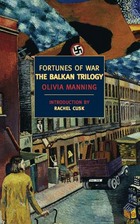
From the Archives: Olivia Manning, The Fortunes of War

One of the many enticing volumes in the NYRB Classics series is Olivia Manning’s The Balkan Trilogy. I wish this nice edition had been available when I went on a quest for The Balkan Trilogy and its sequel, The Levant Trilogy, to read a couple of years ago; I had to settle for musty second-hand copy of the old Penguin editions. They proved well worth looking for, though, despite (or perhaps because of) not being at all what I expected. My write-up of the series follows; for further reading, the NYRB edition of The Balkan Trilogy comes with a very perceptive introduction by Rachel Cusk:

Indifference, injustice, cruelty, hatred, neglect: in The Balkan Trilogy these are the constituents both of personal memory and of social reality, of private unhappiness and of public violence. In Olivia Manning’s analogy, war is the work of unhappy children; but while Harriet embodies the darkness of this perception, she represents too the individual struggle to refute it.

After reading and then writing about this series, I went looking for critical work on Manning and found very little. Perhaps this release of The Balkan Trilogy, as well as her earlier novel School for Love, will turn more attention her way.


This two-volume set is actually a sextet of shorter novels, the first three comprising The Balkan Trilogy, the second The Levant Trilogy. According to my Penguin editions, Anthony Burgess described this series as “the finest fictional record of the war produced by a British writer.” The war in question is, of course, the second World War, but if Burgess’s remark leads you to expect a sweeping war-time saga full of action, heroism, drama and suspense, you’ll be surprised–as I was. In the first volume, set first in Romania and then in Greece, our protagonists are at the periphery of the conflict, which is spreading through Europe and gradually encroaches on their lives without ever directly reaching it, as they leave both Bucharest and then Athens on the eve of German occupation. All of the motley array of characters are versions of Rosencrantz and Guildenstern, bit players with no important part to play in the real story, except that theirs is the story, and it’s not comic–or tragic, either. (Some textual evidence that Manning herself conceived of her characters in this way comes in the Coda to The Levant Trilogy, in which she compares them to “the stray figures left on the stage at the end of a great tragedy”). The novels unfold in a strangely muted register that matches the characters’ global insignificance even as the interest, and pathos of their circumstances and their endearing and irritating individual characteristics eventually win us over to believing in and caring about them.

I was fascinated with the picture Manning offers of the British abroad in this particular historical moment; the novels are highly autobiographical, or at any rate follow closely the historical and geographical situations she and her husband experienced, and Manning was clearly an astute observer of the both the local and the expatriat cultures she participated in. She is particularly understated and yet pointed (if that’s not too paradoxical a description) about the anti-Semitism in Romania, illustrating its character and effects while keeping its worst realities just off-stage. The horrible truths are shown most explicitly through the story of the banker Drucker, whose son Sasha the Pringles eventually shelter in their flat. Imprisoned by the Romanians ostensibly for trading in currency on the black market but really, it is clear, for the crime of being a rich Jew, he is eventually released for trial, and Harriet Pringle goes on Sasha’s behalf to get a look at how he has fared:

Harriet, who had seen Drucker only once, ten months before, remembered him as a man in fresh middle age, tall, weighty, elegant, handsome, who had welcomed her with a warm gaze of admiration.

What appeared was an elderly stooping skeleton, a cripple who descended the steps by dropping the same foot each time and dragging the other after. The murmurs of ‘Drucker’ told her that, whether she could believe it or not, this was he. Then she recognised the suit of English tweed he had been wearing when he had entertained the Pringles to luncheon. The suit was scarcely a suit at all now….

From the bottom step he half-smiled, as if in apology, at his audience, then, seeing Harriet, the only woman present, he looked puzzled. He paused and one of the warders gave him a kick that sent him sprawling over the narrow pavement. As he picked himself up, there came from him a stench like the stench of a carrion bird. The warder kicked at him again and he fell forward, clutching at the van steps and murmuring “Da, da,” in zealous obedience.

Harriet’s specific emotional response is not elaborated on, and why should it be? We have, presumably, shared it, and we understand her decision, arriving home, to “deceive Sasha. He was never likely to see his father again.” She reports only “‘Your father looked very well,'” and that kind, protective lie speaks eloquently of the destructive inhumanity of the truth. Key moments of high suspense or emotion are treated in this cool, matter-of-fact way throughout, as when the Pringles arrive home to find that Sasha has been taken in a raid:

The bed-covers were on the floor, and as Harriet piled them back on to the bed, the mouth-organ fell from among them. She handed it to Guy as proof that he had been taken, and forcibly. Under the bed-covers was the forged passport, torn in half – derisively, it seemed.

Remembering her childhood pets whose deaths had broken her heart, she said: “They’ll murder him, of course.”

The next day, “Harriet [is] surprised that she felt nothing.” The risk, in both her consciousness and the narrative, seems to be that, in such circumstances, the only options are feeling nothing or being overwhelmed with feeling. Cumulatively, though, for this reader anyway, the effect of the persistent resistance to melodrama is a story nearly stripped of its human essentials and thus of a sense of what the novels stand for in the face of totalitarianism. Towards the end of their stay in Athens, for example, a major character whose quirks and (mis)fortunes we have followed since the first pages is unexpectedly and unnecessarily shot, more or less accidentally and at random. Is it because destruction and death are always at the margins of their lives, because the war has taken normalcy from them, that his companions feel more inconvenienced than anything else?

The manager agreed to let the body rest for the night in one of the hotel bathrooms. The four friends followed as it was carried away from the terrace and placed on a bathroom floor. As the door was locked upon it, the all clear sounded. The manager, offering his commiserations, shook hands all round and the English party left the hotel. Alan, hourly expecting an evacuation order, had decided to spend the night in his office. Ben Phipps, on his way to Psychico, dropped the Pringles off at the academy.

Pop psychology terms like “coping strategies” come to mind: these non-combatants are struggling for survival themselves, but their enemies are not the Nazis so much as the moral and social rootlessness they experience, with military victory, and thus the survival of their ‘home’ countries and values, uncertain, and with reminders of their own mortality and insignificance nearly constant.

In this context, Guy Pringle is a fascinating figure (though I don’t see why he’s the one Burgess highlights as “one of the major characters in modern fiction,” given the much greater priority given to the experience and perspective of his wife). Guy is a lecturer in English literature notable for his expansive energy, which in The Balkan Trilogy he invests in two major theatrical productions. The one treated in most detail is an amateur production of Shakespeare’s Troilus and Cressida, a project for which he recruits many of the other major characters–but, tellingly, not Harriet, with whom he declares he cannot work, because she will not take him or his effort seriously enough. His goals include raising the morale of the British residents and their friends in Bucharest as well as asserting the importance of British culture and history in the face of the military setbacks that have eroded the nation’s stature abroad–they are, after all, on the losing side at this point. The German Propaganda Bureau keeps a map in its window indicating German advances across France with “broad arrows.” “For Bucharest,” we are told, “the fall of France was the fall of civilization….With France lost, there would be no stay or force against savagery….the victory of Nazi Germany would be the victory of darkness.” In this context, Guy’s preoccupation with his play is suggestive of fiddling while Rome burns, and yet at the same time it seems defiant, an assertion of the value of art and beauty and imagination. Emerging from the theatre, the audience learns that Paris has fallen: “Chastened, they emerged into the summer night and met reality, avoiding each others’ eyes, guilty because they had escaped the last calamitous hours.” They have been experiencing freedom of the mind, the kind of freedom that these novels make you feel is the most to be cherished in wartime. And yet where is the heroism in going to the theatre while around you suffer millions unable to escape in the most literal way?

Ambivalence to Guy’s cultural projects, and indeed to Guy more generally, intensifies in The Levant Trilogy, written more than a decade after The Balkan Trilogy but picking up the story of most of the same characters as they move through another phase of displacement, this time in Egypt. Harriet’s relationship with Guy has always been strained by his inability to put her needs even on the same level as the demands placed on him by everyone else he knows, as well as by his own obsession with his work. Harriet’s discontent takes concrete form occasionally, as in a near-romance that evolves in Athens in the third novel of The Balkan Trilogy. In The Levant Trilogy, we see more of Harriet’s efforts to develop an independent identity in the face of Guy’s physical and emotional absence. In this series, though the war is brought much closer, through the character of Simon Boulderstone (is the redundancy of his surname significant?), with whom we travel to the front at last. Simon comes literally face to face with the horrors of the desert campaign:

Before him was a flat expanse of desert where the light was rolling out like a wave across the sand. Two tanks stood in the middle distance and imagining they had stopped for a morning brew-up, he decided to cross to them and ask if they had seen anything of the patrol or the batman’s truck. It was too far to walk so he went by car, following the track till he was level with the tanks, then walking across the mardam. A man was standing in one of the turrets, motionless, as if unaware of Simon’s approach. Simon stopped at a few yards’ distance to observe the figure, then saw it was not a man. It was a man-shaped cinder that faced him with white and perfect teeth set in a charred black skull. He could make out the eye-sockets and the triangle that had once supported a nose then, returning at a run, he swung the car round and drove back between the batteries, so stunned that for a little while his own private anxiety was forgotten.

We see, too, that the violence of war has the capacity to reach ‘civilians’ with no easing of its horrors. Very early in this volume, for instance, a child is brought in who has been killed by the explosion of a hand grenade he picked up while playing in the desert. In what may be the most surrealistically gruesome and disturbing scene I’ve ever read, his distraught parents refuse to interpret the signs that he has been fatally wounded and attempt to revive him by pouring gruel into a hole blown into his cheek: “The gruel poured out again. This happened three times before Sir Desmond gave up and, gathering the child into his arms, said, ‘He wants to sleep. I’ll take him to his room.'” His death prompts Harriet to think of “all the other boys who were dying in the desert before they had had a chance to live. And yet, though there was so much death at hand, she felt the boy’s death was a death apart.” Suffering was nearby throughout The Balkan Trilogy, but here we live in a community of the physically and spiritually wounded.

Yet even as the action and emotion of this trilogy had an intensity not often displayed in the earlier volume, it also seemed to me more directed at the unfolding of interior dramas for the characters, many of whom are struggling to define themselves against the expectations of others, or in the absence of well-defined or well-understood roles for themselves in the war-time conditions and foreign locations they are negotiating: Simon himself, for example, who has come to Egypt in part to follow in his brother’s footsteps, or Harriet, who eventually hitches a lift into Syria in an attempt to claim some meaning for herself beyond being Guy’s wife. Guy’s obtuseness about Harriet’s independent needs is highlighted more specifically here and his incessant busyness seems more irresponsible than it did in the first volume, perhaps because it’s not seen as serving any greater purpose. The one major cultural event ends…unexpectedly…without any of the triumphant possibilities of Troilus and Cressida, though perhaps it has as much symbolic significance of its own, maybe even marking a rejection of the idealism that Guy represented.

I haven’t really reached many interpretive conclusions about these books, but I have a lot of lingering questions. How far, for instance, do these books seek simply to chronicle how people lived through the exile from home and from normalcy imposed by the war, and how far do they prompt us to think about the global conflict as a reflection, an externalization, of abstract forces and values playing out on a personal scale as well? Is Manning’s understated style itself some kind of statement about the limitations of aesthetic responses to catastrophe, or about the necessity we are under of living life on our own small scale, however grand the larger narrative? Is Guy offered up as the embodiment of some essentially British quality, and if so, how far is it critiqued and how far accepted or encouraged?

This Week in My Classes (March 22, 2010)

This week I have the pleasure, if also the challenge, of starting up work on two tremendously interesting and intelligent novels. In British Literature Since 1800, we are turning to Ian McEwan’s Atonement; in my graduate seminar, it’s time for Daniel Deronda. Reading the first instalments over the past few days, I’m reminded how thrilling it is to know you are in the hands of a skilled writer, someone with not just ideas, but the craft to support them formally. As often happens through this kind of serendipitous juxtapotion, I’m also struck by the unexpected connections between them. In particular, both deal with female protagonists bent on shaping the world to their will–though the more literal willfulness of Gwendolen Harleth, eager to fulfill a destiny worthy of a heroic narrative, becomes, in Atonement, the more characteristically modern preoccupation with the writing process, with Briony desiring control over the story itself.

It’s Gwendolen who is most on my mind tonight, with the seminar meeting tomorrow morning. After reading four other novels by George Eliot in fairly quick succession, it’s hard to escape the feeling that the characters are all close kin to each other–cousins, perhaps. We have been fretting, in our recent class discussions, about the emphasis Eliot places on submission and resignation. “Grant me at least a new servitude!” Jane Eyre cries, but we know, as she does, that her rebellious spirit can never be content with submission. Dinah, Maggie, Romola, and Dorothea, however, have in common a tendency to subordination; when they resist, they are likely to be chastened, as Maggie is (fatally) for even drifting away towards the gratification of her individual desires, as Romola is by Savonarola’s chiding voice calling her back to “her place,” or as Dorothea is by the gradual realization that the same ardent sympathy that elevates her above the common run of men or women inhibits her from claiming too much for herself. Egotism must be beaten back, is the incessant lesson–though Dorothea, at least, is able to seize happiness for herself. Egotists are the villains: Hetty, whose child pays the ultimate price for her inability to look away from the mirror to the window; Tito, whose hatred of anything unpleasant leads him step by compromised step away from the ties to the past that would steady his conscience; and Rosomand, flower of Miss Lemon’s Academy whose steadfast self-love crushes her ardent husband (who will eventually call her his “basil plant”–because basil, he says, flourishes on a dead man’s brains).

But in Daniel Deronda, we lead off with Gwendolen, whose governing principle is to do as she likes, whose sense of entitlement overpowers many of those around her so that, for instance, her mother cannot bear to deny her the horse she considers her right even when money is tight. Gwendolen aspires to mastery, though (unlike Rosamond) not through marriage, which she views, due to her mother’s sad experience, as a “dreary” option:

her thoughts never dwelt on marriage as the fulfilment of her ambition; the dramas in which she imagined herself a heroine were not wrought up to that close. . . . Her observation of matrimony ha dinclined her to think it rather a dreary state, in which a woman could not do what she liked, had more children than were desirable, was consequently dull, and became irrevocably immersed in humdrum.

Yet she is well aware that “marriage was social promotion,” and when the eligible bachelor Mr. Mallinger Grandcourt moves into the neighbourhood, she (and everyone else) can hardly avoid the expectation that a match will soon follow. There’s a nice wry allusion to Pride and Prejudice in the set-up:

Some readers of this history will doubtless regard it as incredible that people should construct matrimonial prospects on the mere report that a bachelor of good fortune and possibilities was coming within reach…

The evil twist that Eliot puts on this familiar story–in addition to making Gwendolen as sassy, but not nearly as honorable or upright as Lizzie Bennet–is in making Grandcourt every bit as determined on mastery as Gwendolen (“ah,” exclaims the narrator as their courtship reaches a climax, “piteous equality in the need to dominate!”). Against Gwendolen’s fierce ambition to rule at least herself, if not all those around her, is pitted the truly chilling will to power of a cold-blooded man (he is described as a “lizard”) whose interest in her increases as (even, because) she resists the lure of his wealth. Even before she has any particular reason, she is wary of commitment, uneasy at the prospect of “subjection to a possible self, a self not to be absolutely predicted.” This is the wariness we wish Dorothea had shown, especially in retrospect when we, and she, experience the soul-numbing effects of the actual self to whom she has, indeed, chosen subjection! And so Gwendolen’s resistance, though it seems to those around her, including Grandcourt, mere “coquettishness,” feels like more, like resistance, perhaps, to the inevitability of the marriage plot. Perhaps here, at last, is someone, however faulty, who is equipped to make a different life for herself. Faced with facts about Grandcourt’s past that make accepting his offer uncomfortable, maybe even immoral, she turns her back on him and heads off to Europe.

But we already know, because Eliot manipulates the chronology of the novel, that she is turned back by the collapse of the family fortunes. And so the long process of chastening begins. Reality will not accommodate her fantasies of control; life does not bend itself to her imperious will. Back in her modest home, soon to relocate to even shabbier quarters, Gwendolen faces humiliation: life as a governess, provided, of course, that she proves satisfactory at the interview (“The idea of presenting herself before Mrs Mompert in the first instance, to be approved or disapproved, came as pressure on an already painful bruise”). She is unable to keep her hopes up despite the model of Jane Eyre:

Some beautiful girls who, like her, had read romances where even plain governesses are centres of attraction and are sought in marriage, might have solaced themselves a little by transporting such plans into their own future . . . [but] her heart was too much oppressed . . .

But she is young, and beautiful, and accustomed to praise for her music, and so it occurs to her to try for a career on the stage:

The inmost fold of her questioning now, was whether she need take a husband at all–whether she could not achieve substantiality for herself and know gratified ambition without bondage.

That’s it! That’s what we have been wanting for these women; that’s what many feminist critics have blamed Eliot for not providing. After all, she achieved her own substantiality; she gratified her ambition! But no, the slapping down continues. The musical genius Herr Klesmer, called in to consult, refuses Gwendolen the easy satisfaction of praise, instead breaking down her shallow, superficial vanity. She has no talent, no discipline, no vocation. Being, as he says, a “beautiful and charming young lady” is not, after all, a qualification for success in the arduous life of an artist. Nothing seems to be left, after all, but resignation: “Things cannot be altered, and who cares?” she says to her mother; “It makes no difference to any one else what we do.”

When Mr Grandcourt re-enters, then, it seems to her  like a great chance to regain control: “she had the white reins in her hands again,” she feels. What follows is one of the most disturbing proposal scenes I know from this period. It only looks conventional: “any one seeing them as a picture would have concluded that they were in some stage of love-making suspense,” but it’s a game of a different kind, thinly disgused as “love-making.” Even the narrator seems uncomfortable at the end: “Was there ever before such a way of accepting the bliss-giving ‘Yes’?” And it’s a relief, not just for Gwendolen, but for all of us, that “she [has] no alarm lest he meant to kiss her.” She still hopes to rule, looking out the window at Grandcourt’s fine horses, for instance, and seeing them as “the symbols of command and luxury.” “Everything is to be as I like,” she reports triumphantly to her mother–but we can hardly believe that, knowing what we know. It’s the beginning of a marriage that will be truly a contest of wills, unlike the two disastrous examples in Middlemarch of a greater person (weak through the capacity for sympathy) being morally compelled into submission to a lesser one (stronger through unreflective egotism). Gwendolen and Grandcourt are like gladiators entering the ring.

And we can root for her, though with reservations, because she is not, in fact, monstrous quite as Tito or Rosamond is monstrous. Her wilfullness has a childish quality to it, a certain artifice or even pretense:

She rejoiced to feel herself exceptional; but her horizon was that of the genteel romance where the heroine’s soul poured out in her journal is full of vague power, originality, and general rebellion, while her life moves strictly in the sphere of fashion; and if she wanders into a swamp, the pathos lies partly, so to speak in her having on her satin shoes.

Ouch! There’s a sting in that last bit reminiscent of Eliot’s barbed analyses of Rosamond. But Rosamond doesn’t get any bits like this:

Solitude in any wide scene impressed her with an undefined feeling of immeasurable existence aloof from her, in the midst of which she was helplessly incapable of asserting herself. The little astronomy taught her at school used sometimes to set her imagination at work in a way that made her tremble; but always when some one joined her she recovered her indifference to the vastness in which she seemed an exile; she found again her usual world in which her will was of some avail. . . .

It seems likely that, in accepting Grandcourt, she is heading into a different kind of vastness, one in which her will may be of little avail. That experience will no doubt be morally salutary–but then, it seems, we’re back in familiar territory, giving up hope of dominating or even deciding our own lot, facing the uncaring blankness of existence with our only hope of grace being submission to our inevitable failure to do just as we like.

I’ll have to leave Briony for another time!

Happy to Be Here!

Though I’ve been blogging for over three years now, today’s post is my first as a member of the Open Letters family. So I’d like to use it, first, to thank my hosts for the invitation to join them here–they’re a great bunch of readers and writers, and I’m happy to become a regular part of the excellent fare they offer at Open Letters.

My plan is to go on doing pretty much what I’ve been doing; those of you who have kept up with Novel Readings so far, then, should feel at home here despite the new address. For new readers, here’s a quick introduction to me and to Novel Readings. From the beginning, my blog has reflected my identity as both an academic (I’m an English professr) and an avid reader.These are not always roles that go comfortably together. In fact, one of the main reasons I began blogging was to experiment with a style of criticism that might reconcile my two selves. Academic criticism can feel claustrophobic, because of its intense specialization and its dissociation from the concerns and experiences of ‘common’ readers (though there are some good reasons for this, and some good results from it); at the same time, clubby book chat (pleasurable, even valuable, though it is for us personally) can be distressingly solipsistic and indifferent to both the details of the words on the page and important literary, historical, and political contexts. I thought it would be a good thing to participate in critical conversations that crossed those boundaries: that respected both expertise and love, that relished insight as well as different points of view. Blogging makes these conversations possible to an unprecedented extent–and the comment box makes sure they are conversations, not just pronouncements.

I didn’t realize all of this about blogging at first, mind you. I had to feel my way, through an unfamiliar medium, out into the wider world. This was not a movement that came easily: although in some ways the academy  is one of the most intellectually rigorous environments imaginable, it’s also very insular. Even in our most public activity, teaching, we’re alone in the classroom with our students, rarely exposed to the judgmental eye of our peers, much less the general public. We debate each other under very particular conditions: Robert’s Rules of Order, for instance, for internal governance (including curriculum debates), or the well-established etiquette of seminar rooms and conference panels. The often ruthless process of peer review is carried on anonymously–and without the opportunity to reply to your judges. Blogging is different! You put yourself out there–your ideas not always fully formed, your readings often still provisional, your audience diverse, unpredictable, and armed with the “Leave a Comment” option. (At least in blogging, I always have the option to reply!)  Writing up reviews of my recent reading (often of books far outside my official “field,” which is Victorian literature) has therefore been both nerve-wracking and exhilirating. Happily, in my experience, most blog readers are there for the same reason I am: they like developing ideas about books and reading. It’s not a competitive sport! And while I enjoy the exchange of views that sometimes follows a review, one of the main benefits is the intrinsic value of having thought hard about a book before putting it back on the shelf.

Because I am both a reader and an academic, I do post about both kinds of things. As I’ve puttered along, in fact, one idea that grew on me was that another good use of this form could be to make my academic work more transparent. One of my longest-running series, with the unimaginative label “This Week in My Classes,” was inspired by disturbing hostilities I encountered to the very idea of English professors. It has never been an overtly polemical series, though: it’s just a record of my week’s work with my students, with associated musings. I’ve come to value the exercise a lot, for reasons I explain in this post. I’ve also written a number of posts about general academic issues, and some about academic literary criticism–what it is, what it could be, why it sometimes irks or bores me, what’s at stake in it. I’ve done a series of posts looking specifically at books about books aimed at non-academic audiences, too, because I wanted to get a clearer sense of how else, or why else, people read. If you’re interested, that material is  all in the archives, or can be retrieved by searching the list of categories, if you’re interested. I’m sure I’ll be posting more on those topics in the future, too.

And so, on to that future! I look forward to writing more about the things I read and the work I do, with the occasional digression into whatever else catches my interest or makes me want to post about it. I will probably try a few new things here, inspired by the general atmosphere of change that comes with the new site (I’ve been thinking, for instance, about an occasional series on old favorites, or what I think of as “comfort reading”–or what about an “ask the English professor” thread once or twice? if I don’t know the answer, I probably know someone who does!). I thought I might also furnish my new home here with some familiar pieces by re-posting a few things from deep in the archives–maybe just to air them out, or perhaps with some updates, to give them a fresh new look. We’ll see. I hope you’ll stop by and read, and I especially hope you’ll contribute to the conversation.

This Afternoon in My Class (March 19, 2010): Seamus Heaney

As a brief follow-up to my previous post, which discussed a certain flagging of enthusiasm for one of my classes, I’ll just report that I thoroughly enjoyed this afternoon’s tutorial meeting on Seamus Heaney. The best thing about it was that it was the first time I can remember this term that a significant number of students were genuinely enthusiastic about a poem: that is, often students will contribute, thoughtfully, to discussion, but today even the body language was different, with people leaning forward into the discussion and smiling and nodding at each other as they talked. The poem that got this reaction was Seamus Heaney’s “Digging”:

Between my finger and my thumb
The squat pen rests; snug as a gun.

Under my window, a clean rasping sound
When the spade sinks into gravelly ground:
My father, digging. I look down

Till his straining rump among the flowerbeds
Bends low, comes up twenty years away
Stooping in rhythm through potato drills
Where he was digging.

The coarse boot nestled on the lug, the shaft
Against the inside knee was levered firmly.
He rooted out tall tops, buried the bright edge deep
To scatter new potatoes that we picked
Loving their cool hardness in our hands.

By God, the old man could handle a spade.
Just like his old man.

My grandfather cut more turf in a day
Than any other man on Toner’s bog.
Once I carried him milk in a bottle
Corked sloppily with paper. He straightened up
To drink it, then fell to right away
Nicking and slicing neatly, heaving sods
Over his shoulder, going down and down
For the good turf. Digging.

The cold smell of potato mould, the squelch and slap
Of soggy peat, the curt cuts of an edge
Through living roots awakens in my head.
But I’ve no spade to follow men like them.

Between my finger and my thumb
The squat pen rests.
I’ll dig with it.

I opened by asking about the pen as a gun: why make that particular comparison? What is the risk or the threat of his pen? Pretty quickly we were talking about the difficulty of the poet son, who has broken from the tradition of his father and grandfather, writing about them and their work without condescending to them or, at the other extreme, sentimentalizing them. It turned out (and I think that this is why the discussion became so animated) that many of them understood the anxiety, or perhaps just self-consciousness, of that kind of break from tradition because they have been through it themselves, coming from mining or farming or military backgrounds, sometimes themselves among the first in their families to go to university, or to study something like English, or to want to be writers. One student also pointed to the “sloppily” corked milk bottle, a sign, he suggested (and many agreed) that it speaks to an anxiety also about the manliness or practical value of choosing poetry: there’s an ideal of the “man of the house,” good with his hands, tough, physical, that the speaker can’t reach (“I’ve no spade to follow men like them”). Though he looks down on his father from his window, he isn’t looking down on him otherwise, we thought, but rather seeing him clearly, seeing the dignity of his skill and hard work. He puts his pen to work, in turn, digging up memories (which “awaken in [his] head”) and making something himself that (as another student suggested) his father would understand–it’s not difficult poetry, there are no unusual words in it, it’s hardly “poetic” at all, but direct, colloquial, even (sorry) earthy. And yet for all its seeming simplicity, as we dug into it, we found more and more of interest, even before we moved into the more abstract idea of poetry and/as archeology (another of our poems was “The Grauballe Man”).

Though we all hate the reduction of literary value to what is ” relatable” (a coinage many students seem unable to resist), and though I’m a big believer in stretching ourselves and our students into what is unfamiliar, there was a great energy today that came from this poem having meaning for them–meaning of its own, that they could appreciate, but also meaning for their own lives.

This Week in My Classs (March 18, 2010)

This week is nearly over already! Whew. It hasn’t been a particularly intense week in my classes (relatively “light” reading, for instance, in both of my undergraduate classes, plus the final books of Middlemarch for my graduate seminar, which I know well enough by now not to have to reread every word–though, as a matter of fact, I did reread almost all of it anyway, because who wouldn’t, given the excuse?). But it’s March Break, which means some schedule juggling, and then my poor daughter came down with a violent stomach flu, which derailed her camp plans. We are fortunate to have a lot of flexibility in our working hours, but I find that as I get older I find it harder to make up in the evenings for reading or marking that I couldn’t get done during the day. Happily, anyway, she’s on the mend, if sipping a little ginger ale means anything, and by Monday we’ll all be back to our usual routine.

So, what have I been doing, when I could? In Mystery and Detective Fiction, we’re on to our unit on ‘the contemporary police procedural, with short stories by Ed McBain, Peter Robinson, and Ian Rankin. I haven’t actually read any of McBain’s 87th Precinct series, only a few short stories in the various anthologies I’ve used over the years, which have felt to me a bit too much like reading episodes of Law & Order. It’s just not my favourite style, though maybe I just haven’t read the best examples. I generally enjoy Robinson’s Inspector Banks series, but our story was actually a one-off, a historical mystery that is not really (as my students quickly discerned) a police procedural proper, as its detective is only a “special constable” and has the usual run-ins with the official officers of the law that we expect of the amateur detective or private eye. Set in September 1939, the story (“Missing in Action”) evokes a feeling of civilization spiraling out of control; vigilante justice, justified in hard-boiled detection as the only way for Our Hero, however morally questionable, to fight for The Right in a corrupt world, is shown in a darker light here, reminding us of why we need to rely on formal systems of law and evidence, even if the outcomes are not always satisfactory. Tomorrow, it’s Rankin’s “The Dean Curse,” which sets us up well for Knots and Crosses next week, not only by introducing Rebus, but by making similar connections between military training and police work, and asking difficult questions about the moral responsibility of a military organization that (of necessity) trains men away from their humanity only to loose them on the world at the end of their service. Rankin is the best stylist of this group, for sure.

Having said that, I confess to feeling some impatience in the last week or so with the preponderance of mediocre-to-fine writers on that reading list. Though I wouldn’t accept any argument that genre fiction is inherently or inevitably less “literary,” it’s striking that the prose is so rarely excellent, even among the most popular or innovative mystery writers. “Workmanlike” is how I would describe, for instance, the writing in Paretsky’s Indemnity Only: important as her work is, for its contributions to breaking open the feminist potential of crime fiction, there’s no temptation to linger over the language at any point. In fact, only Chandler and Hammett much tempt me that way, this term, which may be one reason I’m missing P. D. James’s An Unsuitable Job for a Woman, removed from the syllabus because of its unpopularity with students over the years–James cares about language as well as story and character. When I go looking for new writers to include in this course, I usually tire of the exercise quite soon because however interesting the angle or scenario may be, so many are badly, even dreadfully, written (The Girl with the Dragon Tattoo, anyone?).

It’s only fair to say that bad or mediocre writing occurs in all forms, including self-consciously aspiring “literary” novels (The Mistress of Nothing, anyone?). But much of the time there’s no reason to teach a mediocre work. For a course on the contemporary novel, I don’t think Tracy Chevalier, for instance, would even be a contender for the syllabus. But when your criteria is not literary excellence but something else, then you do teach material that is “interesting” for other reasons, and I think what happens is that once you’ve gone through it a few times, it isn’t really that interesting to you anymore and you’re just reiterating stuff about its relationship to conventions and social / political issues and so on, reading it symptomatically, for what it is, rather than (dare I say) lovingly, for what it specifically says, or, as important, how it says it. I know, I know: “literary excellence”–what does it mean? But surely one defensible measure of excellence is “bearing up well under repeated, attentive readings.” It might be intellectual qualities or aesthetic qualities that achieve this quality of endurance, and there are certainly many, many ways of being excellent, but a book that eventually lies flat before me like a deflated balloon because there’s really nothing else to discover in it is not excellent, I feel pretty sure about that. I routinely teach some pretty bad books (Aurora Floyd, anyone?)–but so far, some of them do continue to bear up, maybe because they are so odd and unfamiliar that they resist deflation despite everything. But I think I’m going to start purging my teaching life of the ones that have become perfunctory. That may mean giving up the mystery and detective course, at least for a while. I know I still make the books interesting for students coming to them for the first time, but I’d really rather those same students were getting excited and interested in better books, books that will survive to become real literary friends of theirs and/or that will encourage them to set their sights higher. In spending a lot of time explaining what’s interesting about not-very-good books, it sometimes seems I am implicitly allowing that it’s OK to settle for them.

I wonder if I’m fretting over this problem this term because of the contrast with the readings for the Brit Lit survey: because there I have had to be so selective, I often feel overwhelmed with the fabulousness of our readings. This week, for instance, we’ve done Auden, Dylan Thomas, and Seamus Heaney, all writers who seem to me to offer the whole package.

And having said all that, I started rereading Daniel Deronda last night and I’m very excited about going through it again, with all of its challenges and rewards.

Reading Tolstoy

I’m not, but these posts really make me wish I were. It was Early Tolstoy Week recently at Wuthering Expectations, beginning with Chldhood, Boyhood, Youth:

It’s Tolstoy’s first novel, yet is so Tolstoyan. The obsession with death, for example, the way death mingles with life. In Chapter 23 of Boyhood the children are all sent on a surprise sleigh-ride. What a lark!:

As we drew up to the house on the way back I open my mouth to make a fine face at [my sister] when my eyes are startled by a black coffin-lid leaning against one panel of our front door, and my mouth remains fixed in its distorted grimace.

‘Votre grand’mère est morte!’ says St-Jérome with a pale face, coming out to meet us.

Yes, the novel has a healthy sprinkling of the untranslated French that we all loved in War and Peace. The Sevastopol Sketches, written at the same time, contain untranslated Polish, so count your blessings, I say.

The single great touch, though, the art of that passage, is the boy’s frozen mouth.

The series continues here, here (“He makes peers like Balzac or Dickens, whatever their strengths, seem so convention-bound. Tolstoy wrote in the service of Truth. His integrity is bracing. Thank goodness, though, not everyone writes like him”), and here (with “Sevastopol Sketches”–“Many passages…would not seem out of place in War and Peace. It all sounds like Tolstoy. What a powerful writer”).

And at The Millions, Kevin Hartnett writes beautifully about reading War and Peace:

In the end, though, the reason I read novels is not because I can talk about them with other people, or because I’m looking for ideas to explain the world. I read them for the pure aesthetic moment that comes from seeing life perfectly distilled into words. In this respect, I don’t think there is a more able book than War and Peace. Tolstoy’s singular genius is to be able to take the torrent of conscious experience and master it. There are countless moments in the book where this happens, but the one that left me reeling was Tolstoy’s long, exquisite depiction of the Battle of Borodino, which was the deciding battle in the war and one of the bloodiest in history.

The night I finished reading about Borodino, it was plainly obvious that I had just read something great. Yet here I was sitting in a corner of my couch, just the same as I had been an hour before. I thought about the question with which I opened—what is it that greatness does? An encounter with greatness, I would say, is like a bright light fixed in time, a marker that defines memory and makes it clearer than it otherwise might have been, that we were here.

I’ve been feeling dissatisfied with much of my recent reading, much of which has been second-rate, but under the pressure of a term with lots of assigned books I’m wary about picking up something that deserves my full attention and probably can’t get it. I think I’ll put my copy of War and Peace out where I can see it, as a promise to myself that there are better things ahead.