Well Marked

A couple of weeks ago, Nigel Beale posted some tips from Mortimer Adler on ‘How to Mark Your Books “Fruitfully and Intelligently.”‘ The recommendations sounded pretty familiar, though understandably there’s no mention of my own must-have accessory, the Post-It Note. I think anyone who teaches literature has to get over any initial reservations about making a mess on the page; a large part of what we want to convey to our students is that reading is an active process, for one thing, and writing on the text is one way to make sure you are actually engaging with it. Textual annotations can also serve as prompts and guides for lecture and discussion. As someone who mostly teaches ‘loose baggy monsters,’ I also feel that one of my primary responsibilities is just being able to find important passages to help students make their observations and analyses specific. Herewith, some samples of a well-used teaching copy of Middlemarch, marked up Maitzen style.

First, the Big Picture Post-It Index and Finder’s Guide.


Next, the Inside Cover Index to Essential Information:

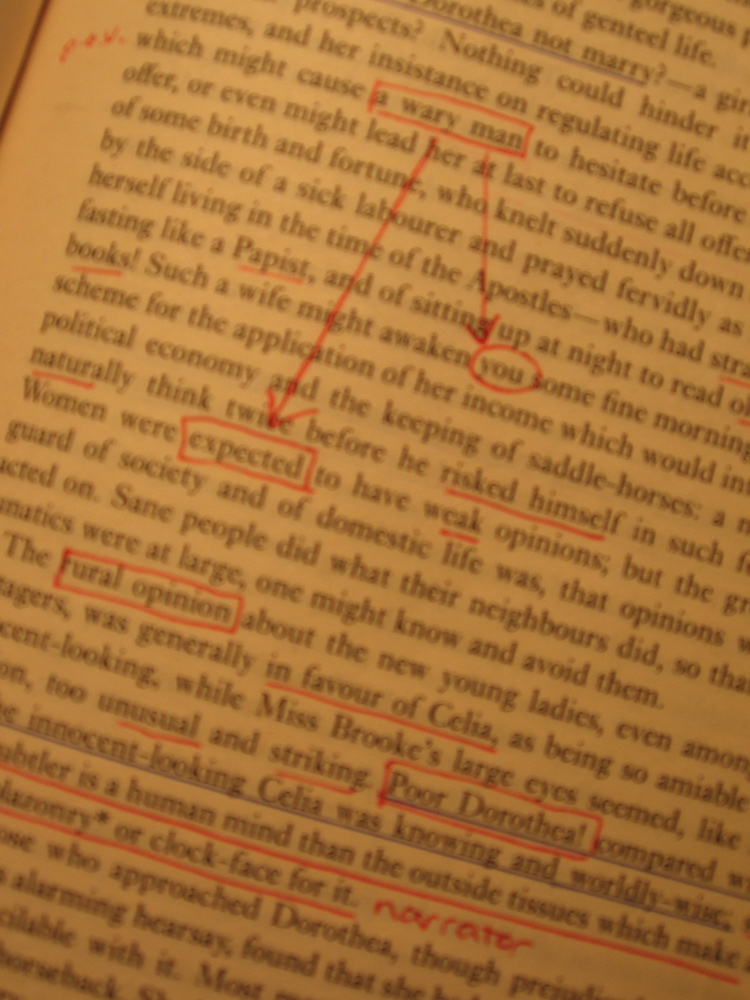
Here’s a sample of a key passage annotated for teaching point of view and free indirect discourse:


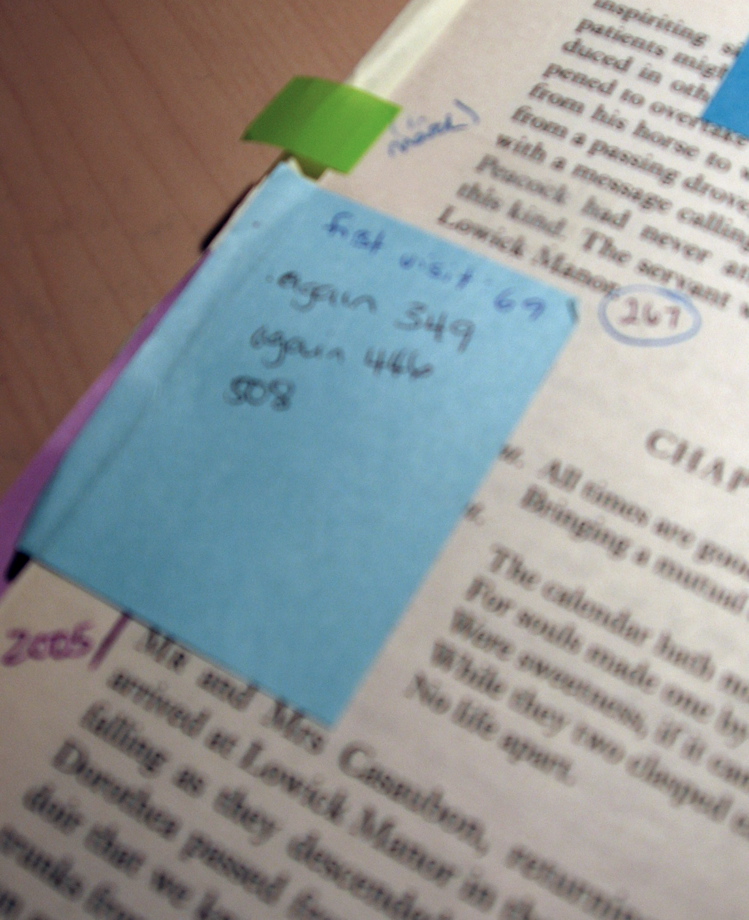
And a sample of a Cross-Referencing Post-It–probably the most important kind (it’s blue because it marks the blue-green boudoir passages, of course!):


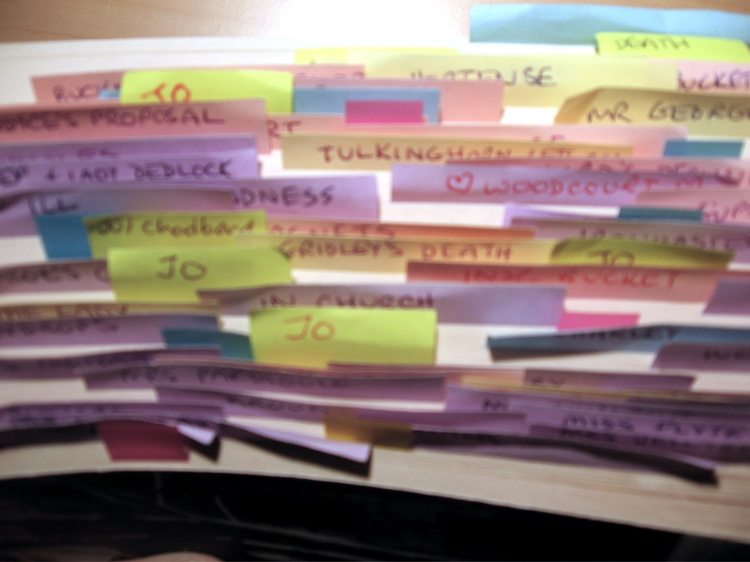
Here’s this year’s Post-It opus:


See how you can track Jo through the novel? And the hot pink tabs point to the clues to Lady Dedlock’s past. Hmmm. It starts to look a little obsessive, doesn’t it?

This Week in My Classes (November 25, 2008)

It’s the last full week of classes–unbelievable, how fast the term goes by. That means it is wrapping up time. It would be nice if the end of a course could feel like a culmination and a triumph. Instead, it’s always a struggle to keep the momentum (and the attendance) up and the focus on the intrinsic interest and merits of our work. In my new-found cynicism, I now always save one “surprise” quiz for the last day of class, to maximize the number of students who will actually be there for my closing perorations. I do think there is more at stake than what will be on the exam, and I like to take a little time during our last meeting to say a few things about that; it’s disheartening if nobody is there to listen! So coercion is my little helper.

In Introduction to Prose and Fiction, the students’ final papers are due next week. As it is a designated Writing Requirement course, we are supposed to spend time explicitly on writing, so I have scheduled two class hours this week for editing workshops. Last time, they did peer editing. I always have to fight my fear that peer editing is simply a case of the blind leading the blind; I have almost never seen evidence on their drafts or worksheets that I’m wrong about this, but I remain committed to the principle that it is good to read and edit other people’s work, and also that it is excellent to finish a full draft a week before the final due date so that you have at least the opportunity to improve it before you submit it. This time I am asking them to edit their own essays. I think this is an even harder task, and yet in many ways, for a writer, nothing is more important than learning to look critically on your own writing, to achieve enough distance to identify weaknesses in your arguments or evidence, and to develop the fortitude to mess with something you worked hard to produce in the first place. Their worksheet includes a “reverse outline” exercise: the idea is to produce an outline working backwards from the draft, checking as you go whether you have in fact put all the parts in place that you need. One small detail I have come to see as important, though it often seems trivial at first, is whether they have a strong title for the paper. In my experience, a bland (“English Essay”), vague (“Interpreting The Remains of the Day), or simply missing title is a symptom of an essay without a strong organizing idea. We’ll see how it goes. At the very least, again, they have won themselves a few days to reconsider their first try. Many of them will not take advantage of the time they have to rewrite (they tend to tinker with individual words, rather than move pieces around, reconsider their thesis, or choose better examples). But those who are motivated and listening to our advice will end up with much better essays, which ultimately makes our work of grading them more pleasant too.

In The Nineteenth-Century Novel, we are nearly through The Mill on the Floss. After emphasizing last week how important the long, detailed account of Maggie and Tom’s childhood is because it prepares us (and them) for the complexities of their adult decisions, now we are getting to the moral heart of the book: Maggie’s struggle with the conflict between her own needs and desires, and the demands of her conscience and her duty to family and her past. So far this week we’ve focused on the limitations of available stories or narratives for Maggie (helped along by Carolyn Heilbrun, in Writing a Woman’s Life, for instance, and Nancy Miller’s “Emphasis Added: Plots and Plausibilities in Women’s Ficton”). We can take this issue up fairly literally by considering Maggie’s reading of Thomas a Kempis, and a bit more literarily by considering the significance of the Scott novels with which Philip courts her, and which lead to her famous resolution to “read no more books where the blond-haired women carry away all the happiness.” Sadly, of course, her quest to read, much less live, a story “where the dark woman triumphs,” “to avenge Rebecca and Flora MacIvor, and Minna and all the rest of the dark unhappy ones,” is doomed. To help explain why, I’ve handed around copies of George Eliot’s essay “The Antigone and Its Moral: the analysis she offers of the intractable opposition of competing goods clarifies at least one way of understanding the structure of the novel’s ending, though we’ll have to get into specifics of Maggie’s choices to see just what goods are in opposition for her and why she can’t come up with a better resolution (and here “she” could refer with equal reason to Maggie or George Eliot, I’d say).

It is a treat to be reading The Mill on the Floss. Much as I love Dickens’s verbal acrobatics and all the other qualities that make Bleak House one of my top 3 Victorian novels, the combination of intelligence, philosophical breadth, social and historical insight, humour, and charity in George Eliot’s narration is enormously stimulating, and her language, so very different from Dickens’s, has its own aesthetic as well as intellectual beauty. Here (because it’s my blog and I can!) is a long and wonderful passage from a chapter with the unpromising title, “A Variation of Protestantism Unknown to Bossuet.” Bossuet, the notes tell those of us who wouldn’t otherwise know, was a 17th-century French bishop who wrote a history of Protestantism; the unknown variation belongs to Tom and Maggie’s family and “consist[s] in revering whatever was customary and respectable’–it is based on convention and habit, on material and social habits and expectations, rather than on any grand spiritual notions. The Dodsons and Tullivers invite, deserved, and get plenty of satirical treatment and criticism, but, characteristically, George Eliot is concerned to contextualize both their “theory of life” and her own analysis of it, and to prepare us for how their beliefs in turn provide a crucial constraining context for the ardent efforts of her protagonists. I’ve copied the text from this nice searchable e-text.

JOURNEYING down the Rhone on a summer’s day, you have perhaps felt the sunshine made dreary by those ruined villages which stud the banks in certain parts of its course, telling how the swift river once rose, like an angry, destroying god sweeping down the feeble generations whose breath is in their nostrils’ and making their dwellings a desolation. Strange contrast, you may have thought, between the effect produced on us by these dismal remnants of commonplace houses, which in their best days were but the sign of a sordid life, belonging in all its details to our own vulgar era – and the effect produced by those ruins on the castled Rhine which have crumbled and mellowed into such harmony with the green and rocky steeps, that they seem to have a natural fitness, like the mountain pine: nay, even in the day when they were built they must have had this fitness, as if they had been raised by an earth-born race who had inherited from their mighty parent a sublime instinct of form. And that was a day of romance! If those robber barons were somewhat grim and drunken ogres, they had a certain grandeur of the wild beast in them – they were forest boars with tusks tearing and rending, not the ordinary domestic grunter: they represented the demon forces for ever in collision with beauty, virtue, and the gentle uses of life: they made a fine contrast in the picture with the wandering minstrel, the soft-lipped princess, the pious recluse and the timid Israelite. That was a time of colour when the sunlight fell on glancing steel and floating banners: a time of adventure and fierce struggle – nay, of living, religious art and religious enthusiasm; for were not cathedrals built in those days and did not great emperors leave their western palaces to die before the infidel strongholds in the sacred east? Therefore it is that these Rhine castles thrill me with a sense of poetry: they belong to the grand historic life of humanity, and raise up for me the vision of an epoch. But these dead-tinted, hollow-eyed, angular skeletons of villages on the Rhone, oppress me with the feeling that human life – very much of it – is a narrow, ugly, grovelling existence, which even calamity does not elevate, but rather tends to exhibit in all its bare vulgarity of conception; and I have a cruel conviction that the lives these ruins are the traces of were part of a gross sum of obscure vitality, that will be swept into the same oblivion with the generations of ants and beavers.

Perhaps something akin to this oppressive feeling may have weighed upon you in watching this old-fashioned family life on the banks of the Floss, which even sorrow hardly suffices to lift above the level of the tragi-comic. It is a sordid life, you say, this of the Tullivers and Dodsons – irradiated by no sublime principles, no romantic visions, no active, self-renouncing faith – moved by none of those wild, uncontrollable passions which create the dark shadows of misery and crime – without that primitive rough simplicity of wants, that hard submissive ill-paid toil, that child-like spelling-out of what nature has written, which gives its poetry to peasant life. Here, one has conventional worldly notions and habits without instruction and without polish – surely the most prosaic form of human life: proud respectability in a gig of unfashionable build: worldliness without side-dishes. Observing these people narrowly, even when the iron hand of misfortune has shaken them from their unquestioning hold on the world, one sees little trace of religion, still less of a distinctively Christian creed. Their belief in the unseen, so far as it manifests itself at all, seems to be rather of a pagan kind: their moral notions, though held with strong tenacity, seem to have no standard beyond hereditary custom. You could not live among such people; you are stifled for want of an outlet towards something beautiful, great, or noble: you are irritated with these dull men and women, as a kind of population out of keeping with the earth on which they live – with this rich plain where the great river flows for ever onward and links the small pulse of the old English town with the beatings of the world’s mighty heart. A vigorous superstition that lashes its gods or lashes its own back, seems to be more congruous with the mystery of the human lot, than the mental condition of these emmet-like Dodsons and Tullivers.

I share with you this sense of oppressive narrowness; but it is necessary that we should feel it, if we care to understand how it acted on the lives of Tom and Maggie – how it has acted on young natures in many generations, that in the onward tendency of human things have risen above the mental level of the generation before them, to which they have been nevertheless tied by the strongest fibres of their hearts. The suffering, whether of martyr or victim, which belongs to every historical advance of mankind, is represented in this way in every town and by hundreds of obscure hearths: and we need not shrink from this comparison of small things with great; for does not science tell us that its highest striving is after the ascertainment of a unity which shall bind the smallest things with the greatest? In natural science, I have understood, there is nothing petty to the mind that has a large vision of relations, and to which every single object suggests a vast sum of conditions. It is surely the same with the observation of human life.

Who wouldn’t want to spend more time in this company, at once erudite and ironic, astutely critical and warmly compassionate? The demands are many, but the rewards are too.

Milton Marathon

The Chronicle of Higher Education chronicles Professor Richard DuRocher’s experiment in a Milton Marathon: a “straight-through, out-loud reading of John Milton’s Paradise Lost — all 12 books of it, from Satan’s fall to Adam and Eve’s eviction from the Garden of Eden.” From the article:

Here are some of the things you learn when you participate in a Milton marathon:

  1. Milton is not as boring as you think. Paradise Lost has something for everyone: Hot but innocent sex! (You thought Adam and Eve spent all their time in Eden gardening?) Descriptions of hellfire that would make The Lord of the Rings‘ archfiend, Sauron, weep with envy! Epic battles, with angels hurling mountains at their demonic foes! This is edge-of-your-seat material. “It’s a really cool story, which I wasn’t expecting,” said Anna Coffey, a sophomore who took part in the reading to get a jump on her homework for a “Great Conversations” core-curriculum course.
  2. Milton is not that hard to read out loud. As Mr. DuRocher pointed out in a set of “Guidelines for Reciting” he handed out before the marathon, “Paradise Lost is written in modern English.” Compared with Beowulf, Paradise Lost is a walk in the park.
  3. Milton is really hard to read out loud. Very few people get words like “puissance” right on the first try. Milton loved a runaway sentence and just about any now-obscure classical or geographical reference he could get his hands on, many of them polysyllabic nightmares. Partway through Book VI, Mr. DuRocher offered advice to the tongue-tied. “Whenever you encounter a word you don’t know, that’s a word to pronounce with special certainty,” he said. “It’s probably best to mispronounce demonic names anyway.”
  4. It’s worth it. “It’s really a good poem,” said Mr. Goodroad. “It’s a lot better to hear it than to read it.”

This venture is not as original as it may sound. Many years ago (in 1990, to be precise), the members of UBC professor Lee Johnson’s Honours Milton seminar decided the best way to prepare for their final exam was to do the same thing. We started at 9:00 a.m. and read for the whole day. It was a tremendous experience, and one that got better as the day (and the poem) went along. I think those who got to read Satan’s speeches had the most fun. I would second all four points above, particularly that it is a better poem to hear (or to proclaim), not just to read. And I would add that the whole experience goes better when fuelled by mimosas… Ah, to be a keen undergraduate again.

Posner on the “Decline of Literary Criticism”

In the most recent issue of Philosophy and Literature, Richard Posner reviews Ronan McDonald’s The Death of the Critic (discussed previously here):

The problem with “criticism conceived as magistrate”—the problem that McDonald not only does not solve, but does not acknowledge—is that there are no objective criteria of aesthetic distinction. The reason is that there is nothing that all great works of literature have in common but lesser works of literature do not. When critics propose criteria that they think will distinguish the great from the non-great, they end up narrowing the canon of great literature in arbitrary ways, as T. S. Eliot attempted to do with Milton and Shelley. There is no need to develop a litmus test for great literature. Critics can point to the features of literary works that they like or dislike without assuming the authority to tell people what they should read. And Croce was right: you don’t need evaluative critics in order to have a “canon” of great literature. The canon evolves in Darwinian fashion; writers compete, and the works that are best adapted to the cultural environment flourish.

I fear that McDonald has succumbed to the cliché that the enemy of my enemy is my friend: the cultural studies crowd is against evaluative criticism, so McDonald is for it, provided it is objective—but he does not show how literary criticism can be objective. But the problem is not that modern-day literary criticism is not evaluative; it is that literary criticism aimed at increasing the readership of great literature has been displaced by literary theory, on the one hand, and by literary scholarship for literary scholars only . . . on the other hand.

Though I might take issue with some of Posner’s specific points, I agree with him that “the dearth of evaluative criticism” is not what accounts for the diminished significance of literary criticism. He concludes that “If there were less pretentious literary theory and no evaluative criticism, but more readable literary criticism in the style of Cleanth Brooks or F. R. Leavis, the literary culture would be in a lot better shape than it is.” I’ve been reading a fair number of books that attempt to offer “readable literary criticism“; it’s not that such books aren’t out there, but perhaps that often they aren’t often as intellectually challenging or rhetorically exhilirating as the examples Posner gives–often they seem to me to underestimate their intendend audience. The two books I’m reviewing on the 19th-century novel (Case & Shaw and Levine) are actually pretty good options of this kind, but they are overtly aimed at a student audience and so unlikely, I’m guessing, to reach very far out into the world. I admit, “readable literary criticism” with the effects Posner describes (work that “quickens” the reader’s interest in reading literary works) is pretty much the kind I would like to write one day… “literary criticism that helps people understand and enjoy serious literature,” which is why the kinds of debates he and McDonald are engaged in are of such interest to me.

This Week in My Classes (November 19, 2008)

We’ll be working on The Remains of the Day until the end of term in Introduction to Prose and Fiction. Today I highlighted the problem of politics in the novel, looking at the many moments in the novel when Stevens expresses pride in his own indirect contribution to society through his service to Lord Darlington. One of the most comic, yet piognant, examples is the long section on how his finely polished silver “made a small, but significant contribution towards the easing of relations between Lord Halifax and Herr Ribbentrop” during a meeting at Darlington Hall: “Lord Darlington himself suggested that the silver might have been at least a small factor in the change in his guest’s mood that evening, and it is perhaps not absurd to think back to such instances with a glow of satisfaction.” Perhaps. Stevens’s insistence that he reflects on these moments with pride and satisfaction is clearly in tension with his repressed awareness that Lord Darlington’s commitments during this period are problematic, to put it mildly, and thus his own belief in the dignity of his life of loyal service is severely compromised.

We also looked at the links between Stevens’s own political self-effacement–his frequent admissions that international affairs are “over [his] head” or not for “the likes of us”–and the anti-democratic arguments of Lord Darlington and his cronies. In particularly painful scene, Stevens called on, ostensibly to answer a series of questions about current affairs, but really (as he and we quickly see) to demonstrate his own limitations as a political participant. His only response to each question, that he is “unable to be of assistance on this matter,” is wholly in keeping, of course, with his identity as a butler, and thus Ishiguro is able to draw us along from the inadequacies of that role on a personal level to its inadequacies as a model for a democratic citizen. Lord Darlington and his friends use Stevens’s subservience and ignorance as arguments against democracy; as Lord Darlington explains, “Democracy is something for a bygone era. . . Germany and Italy have set their houses in order by acting. . . . Look at Germany and Italy, Stevens. See what strong leadership can do if it’s allowed to act. None of this universal suffrage nonsense there. . . . The man in the street can’t be expected to know enough about politics, economics, world commerce and what have you.” Translated, that is, from a household to a nation, Stevens’s idea of dignity as defined by submission and service to the will and needs of another leads direct to fascist dictatorship.

The proclamations of Harry Smith about “the privileges of being born English” including the right to “express your opinion freely, and vote in your member of parliament or vote him out” set up the grounds for resistance to tyranny and a very different standard of dignity. I’m interested in the relationship of this conflict between repression and self-expression, service and independence, fascism and democratic liberty, and the novel’s narration. On the one hand, the first-person narration is in a way a direct counter to Stevens’s own reluctance to accept his role as the main character in his own life. He has seen himself as a secondary character, telling Miss Kenton,”my vocation will not be fulfilled until I have done all I can to see his lordship through the great tasks he has set himself.” In telling his own story here in the novel, he is forced to see his life a different way, with himself, rather than his master, at the “hub” of things; one result of this shift in perspective is, of course, his realization (or acknowledgment) of his own failures. But he does at least, and at last, speak for himself. Isn’t a fundamental principle of democracy that each voice deserves to be heard, as each vote deserves to be cast? And yet Stevens is hardly a poster child for democracy, precisely because of how badly he has lived his life, how flawed his judgment has been, how unreliable he is. How can we feel good about trusting our wellbeing as a collectivity to individuals as flawed, self-deceived, and ignorant as Stevens’s own voice shows him to be? This is a good conversation starter, anyway, and as a classroom question, it helpfully draws our attention to relationships between the form of the the novel and the ideas it is so clearly but complexly engaged with about what dignity really means and what democracy really requires and entails.

In 19th-Century Fiction, we’ve just started our work on The Mill on the Floss. I always begin a George Eliot ‘unit’ with a survey of her life and philosophical and fictional principles, with an emphasis on her interest in providing a secular alternative to Christianity as a framework for morality, on the relationship she theorizes between realism, sympathy, and morality, and on her interest in and ideas about determinism–so that’s what I did on Monday. Today, though, we will get going on the particulars of this remarkable novel. It’s an enormous shift, stylistically, from Bleak House: the prose is so balanced and philosophicaly, the story so overtly grounded in historical and social analysis, the characters so psychologically complex. I’m loving the humour of it especially, this time. The first couple of chapters, with Mr Tulliver puzzling over how to set Tom up for an education that will serve Mr Tulliver’s desire to get the better of rascally lawyers are hilarious: “I want him to know figures, and write like print, and see into things quick, and know what folks mean, and how to wrap things up in words as aren’t actionable. It’s an uncommon fine thing, that is, . . . when you can let a man know what you think of him without paying for it.” He’s just as unintentionally funny about the great mystery of breeding, which has led him to the puzzling situation of having a daughter who is far more ” ‘cute” (accute) than her brother:

“It’s a pity but what she’d been the lad–she’d ha’ been a match for the lawyers, she would. It’s the wonderful’st thing”–here he lowered his voice–“as I picked the mother because she wasn’t o’er ‘cute–bein’ a good-looking woman too, an’ come of a rare family for managing; but I picked her from her sisters o’ purpose, ’cause she was a bit weak, like; for I wasn’t agoin’ to be told the rights of things by my own fireside. But you see when a man’s got brains himself, there’s no knowing where they’ll run to; an’ a pleasant sort o’ soft woman may go on breeding you stupid lads and ‘cute wenches, till it’s like as if the world was turned topsy-turvy. It’s an uncommon puzzlin’ thing.”

Like his listener Mr Riley, we may find our “gravity [give] way” here! And yet of course there’s nothing really funny about Maggie’s experience of being a “small mistake of nature” in this way, and much of the first few chapters is also devoted to showing her painful encounters with the limits set on her development because she is, as Tom points out, “only a girl.” There are many memorable incidents in the first volume: Maggie smashing the head of her doll, for instance (into which in the past, we’re told, Maggie has often hammered nails to “commemorat[e] . . . crises in Maggie’s nine years of earthly struggle); Maggie trying, and failing, to share the jam puff with Tom in a way that will meet his perverse but rigid standard of what’s right; Maggie chopping off her recalcitrant hair to free herself from the censure of her carping relatives–only to repent; Maggie pushing Lucy in the mud and then running away to the gypsies in hope of finally being “in harmony with circumstances.” Eliot is particularly good at evoking the “bitter sorrows of childhood,” the “strangely perspectiveless conception of life” that gives childhood suffering its special “intensity.” She also writes beautifully about the special relationship we have to the landscapes of our childhood, where the scenery is infused with memories and so speaks to us of who we once were and who we might have been:

We could never have loved the earth so well if we had had no childhood in it, – if it were not the earth where the same flowers come up again every spring that we used to gather with our tiny fingers as we sat lisping to ourselves on the grass – the same hips and haws on the autumn hedgerows – the same redbreasts that we used to call ‘God’s birds’ because they did no harm to the precious crops. What novelty is worth that sweet monotony where everything is known and loved because it is known?

The wood I walk in on this mild May day, with the young yellow-brown foliage of the oaks between me and the blue sky, the white star-flowers and the blue-eyed speedwell and the ground ivy at my feet – what grove of tropic palms, what strange ferns or splendid broad-petalled blossoms, could ever thrill such deep and delicate fibres within me as this home-scene? These familiar flowers, these well-remembered bird-notes, this sky with its fitful brightness, these furrowed and grassy fields, each with a sort of personality given to it by the capricious hedgerows – such things as these are the mother tongue of our imagination, the language that is laden with all the subtle inextricable associations the fleeting hours of our childhood left behind them. Our delight in the sunshine on the deep bladed grass today, might be no more than the faint perception of wearied souls, if it were not for the sunshine and the grass in the far-off years, which still live in us and transform our perception into love.

This Week in My Classes (November 14, 2008)

(cross-posted, slightly expanded, at The Valve)

This is a great week for me because in both of my classes I am teaching books I am really passionate about. In Introduction to Prose and Fiction, we have started Ishiguro’s The Remains of the Day, and in 19th-Century Fiction, we are just finishing up Bleak House. It’s hard to imagine books more stylistically different: Dickens offers a teeming overabundance of words, characters, and plots, while Ishiguro at once models and thematizes restraint and understatement. Yet both are immensely moving and humane; their artistry is both intellectually and emotionally demanding, and their beauties are at once aesthetic and ethical. If, as Leslie Stephen said, we “measure the worth of a book by the worth of the friend it reveals to [us],” both offer us companionship of an inspiring kind. Wayne Booth proposes we consider what “kind of desirer” we become if we cooperate with the implied author of a text: “Is the pattern of life that this would-be friend offers one that friends might well pursue together?” The best literary “friends” are identified by “the irresistable invitation they extend to live during these moments a richer and fuller life than I could manage on my own.” (All quotations from from Booth’s The Company We Keep: an Ethics of Fiction, the only critical work I’ve read in a decade or more that I know has had a profound impact on how I imagine and articulate the task of criticism.) ions */ @font-face {font-family:”Bookman Old Style”; panose-1:2 5 6 4 5 5 5 2 2 4; mso-font-charset:0; mso-generic-font-family:roman; mso-font-pitch:variable; mso-font-signature:647 0 0 0 159 0;} /* Style Definitions */ p.MsoNormal, li.MsoNormal, div.MsoNormal {mso-style-parent:””; margin:0in; margin-bottom:.0001pt; mso-pagination:widow-orphan; font-size:12.0pt; font-family:”Bookman Old Style”; mso-fareast-font-family:”Times New Roman”; mso-bidi-font-family:”Times New Roman”; mso-ansi-language:EN-CA;} @page Section1 {size:8.5in 11.0in; margin:1.0in 1.25in 1.0in 1.25in; mso-header-margin:.5in; mso-footer-margin:.5in; mso-paper-source:0;} div.Section1 {page:Section1;=By these standards, I think both The Remains of the Day and Bleak House are among the very best.

Still, the devil is always in the details. So here’s what I tried to get done this week.

In Intro to Prose and Fiction, the topic today was first-person narration–again, since we have already spent two classes talking about that. A major interest of mine is helping them work with the concept of unreliability so that they can talk about it with some precision. For instance, it is important to control the urge, once you recognize that a narrator is not altogether to be trusted, to assume that you can’t believe anything they say and can just speculate wildly about what really happens. Point A: there is no “really happens”–there’s only what’s in the novel. Point B: unreliability works as a fictional device because there are limits to it. In “The Yellow Wallpaper,” for instance, we believe in the basic elements of the story: there is a house, there is a husband, there is a room with hideous patterned wallpaper. What we don’t believe is that there are women trapped in the wallpaper, or crawling in the garden, etc. I’m fascinated by the artistic feat of presenting two (at least) very different versions of one story with just one set of words, so I usually spend a lot of time on this issue. More specifically, we have been talking about Stevens’s ‘butlerspeak’ and how the tone and diction of his language helps us understand his character, including its problems and limits. We have begun making connections between the inadequacy of his language for expressing the human qualities of his life and the inadequacy of his values more generally. We’ve watched some excerpts of an interview with Ishiguro in which he remarks that he had an idea, working on the book, that “most of us [are] butlers–politically, and morally, perhaps, too.” This idea about what it means to be a metaphorical butler will be important to our discussions next week, when we will have moved further along in the book.

In 19th-Century Fiction, we spent Monday’s class and part of Wednesday’s considering the novel’s two narrators–Bleak House is unique among Dickens’s novels (as far as I know, among Victorian novels) in dividing our attention in quite this way, and the dramatic differences between the prophetic sage-like voice of the 3rd-person narrator and Esther’s almost excessively self-effacing and evasive voice invite careful consideration about why both approaches are necessary to achieve the novel’s goals. (One theory we worked on: to solve the social problems he focuses on, you need both breadth of analysis and perspective, and depth–sensitivity to the personal implications.) On Wednesday I also talked about the theme of infection, about ways we can read Jo’s illness metaphorically, for instance, as a symptom of the broader spiritual disease Dickens sees plaguing his society. It’s illuminating to compare the depiction of poverty and social decay in a more literal novel, like Gaskell’s Mary Barton, to Dickens’s handling of Tom-All-Alone’s. It rapidly becomes clear that literal, material, social, or economic causes are not Dickens’s primary interest. Like his philosophical mentor (and the dedicatee of Hard Times), Thomas Carlyle, Dickens tends to present the tangible aspects of poverty as manifestations of an underlying spiritual malaise or failure–of human fellowship or compassion. We looked at the ‘Irish Widow’ excerpt from “Past and Present” and discussed the ways in which infection literalizes the premise of Bleak House that everything, and everyone, is connected, even if you can’t see or anticipate how.

For some reason, on this reading I found the work Dickens does with Sir Leicester especially moving. It’s interesting to consider that in his own way, Sir Leicester becomes a charity case in the novel, as much in need of our compassion and sympathy as Jo ever is, and deserving of them, too, because he proves capable of a moral transformation through love. Here are the affecting descriptions of him after the discovery of Lady Dedlock’s guilty secret:

Sir Leicester, left alone, remains in the same attitude, as though he were still listening and his attention were still occupied. At length he gazes round the empty room, and finding it deserted, rises unsteadily to his feet, pushes back his chair, and walks a few steps, supporting himself by the table. Then he stops, and with more of those inarticulate sounds, lifts up his eyes and seems to stare at something.

Heaven knows what he sees. The green, green woods of Chesney Wold, the noble house, the pictures of his forefathers, strangers defacing them, officers of police coarsely handling his most precious heirlooms, thousands of fingers pointing at him, thousands of faces sneering at him. But if such shadows flit before him to his bewilderment, there is one other shadow which he can name with something like distinctness even yet and to which alone he addresses his tearing of his white hair and his extended arms.

It is she in association with whom, saving that she has been for years a main fibre of the root of his dignity and pride, he has never had a selfish thought. It is she whom he has loved, admired, honoured, and set up for the world to respect. It is she who, at the core of all the constrained formalities and conventionalities of his life, has been a stock of living tenderness and love, susceptible as nothing else is of being struck with the agony he feels. He sees her, almost to the exclusion of himself, and cannot bear to look upon her cast down from the high place she has graced so well.

And even to the point of his sinking on the ground, oblivious of his suffering, he can yet pronounce her name with something like distinctness in the midst of those intrusive sounds, and in a tone of mourning and compassion rather than reproach.

And just a bit later,

“My Lady is too high in position, too handsome, too accomplished, too superior in most respects to the best of those by whom she is surrounded, not to have her enemies and traducers, I dare say. Let it be known to them, as I make it known to you, that being of sound mind, memory, and understanding, I revoke no disposition I have made in her favour. I abridge nothing I have ever bestowed upon her. I am on unaltered terms with her, and I recall—having the full power to do it if I were so disposed, as you see—no act I have done for her advantage and happiness.”

His formal array of words might have at any other time, as it has often had, something ludicrous in it, but at this time it is serious and affecting. His noble earnestness, his fidelity, his gallant shielding of her, his generous conquest of his own wrong and his own pride for her sake, are simply honourable, manly, and true. Nothing less worthy can be seen through the lustre of such qualities in the commonest mechanic, nothing less worthy can be seen in the best–born gentleman. In such a light both aspire alike, both rise alike, both children of the dust shine equally.

Today, as we wrapped up our too-short time for the novel, I emphasized the importance of affect, pathos, and sentimentality in Dickens’s project of fiction as an agent of social reform. Though there are many respects in which I think Bleak House exemplifies self-contained aesthetic possibilities, in its formal structure and thematic coherence, its unifying metaphors, and so on, there’s no mistaking Dickens’s intention to shake us out of our complacence about the state of our world and our own responsibility for those who suffer. I can’t think of a novelist today who could do this and not sound ridiculous:

The light is come upon the dark benighted way. Dead!

Dead, your Majesty. Dead, my lords and gentlemen. Dead, right reverends and wrong reverends of every order. Dead, men and women, born with heavenly compassion in your hearts. And dying thus around us every day.

What makes this an impossible move today? Many things, I suppose, from the fragmentation of our sense of audience, or of readers (who is included in “you” or “us” these days?), to changing theories about the role of art in society. But for Dickens, there’s nothing inartistic about reaching out from his text in this way. His novels have nothing in common with the kind of literary artefacts meant to sit, like golden bowls on a mantlepiece, and be admired. At the end of Hard Times, he’s even more direct:

Dear reader! It rests with you and me, whether, in our two fields of action, similar things shall be or not. Let them be! We shall sit with lighter bosoms on the hearth, to see the ashes of our fires turn gray and cold.

And here is where I feel the two novels I’m teaching converging. Both inspire reflections on how we might look at what remains of our own days and how we will judge our contributions to a wider world, as well as to ourselves.

Dear CBC Radio 2,

It’s me again. I tuned in this morning and once again I have cause to thank you: I am so happy that finally there’s a radio station giving air time to such commercially unsuccessful artists as James Blunt and the Barenaked Ladies. My tax dollars should definitely go to making sure they get heard, and not to something as culturally peripheral as, say, the CBC Radio Orchestra. It’s a relief, also, especially in the morning, not to get those jarring contrasts we used to get when switching from commercial top-40-oriented radio stations to Radio 2. All those violins and harpsichords that would just come out of nowhere, interrupting the flow of banal lyrics!

Sincerely,

RM

PS James Blunt? Seriously?!

PPS Nothing against the Ladies, really.

Score One for Our Team!

It’s easy to get discouraged when you’re teaching first-year English. A lot of people in the room don’t really want to be there and don’t see why they should care much about the course, except that they need to fufill a writing requirement. Sometimes they even tell you as much. That can make you cranky, defensive, or even a little bit sad. Still, you show up with your game face on and do the best you can to show them reasons to care. You try not to let your own commitment or enthusiasm flag. You teach as if they are all with you, because that’s the highest compliment you know how to pay them, as well as the only way to face coming to class again and again. And of course many of them are with you: they are basically well-meaning and open-minded kids, and even if they do see your class primarily as a requirement, they’ll put in the effort and see what they learn from it. Still, you’re always aware of those lurking skeptics, which is why it is especially nice to hear, from the very student whose earlier words rankled so, “I’m changing my major … to English.”

Fiction and Development

Recently The Telegraph reported on the contribution fiction can make to international development, as examined by a study done by a team of scholars at Manchester University and the London School of Economics:

[Dr. Rodgers, of Manchester University’s Brooks World Poverty Institude] said: “Despite the regular flow of academic studies, expert reports, and policy position papers, it is arguably novelists who do as good a job – if not a better one – of representing and communicating the realities of international development.

“While fiction may not always show a set of presentable research findings, it does not compromise on complexity, politics or readability in the way that academic literature sometimes does.

“And fiction often reaches a much larger and diverse audience than academic work and may therefore be more influential in shaping public knowledge and understanding of development issues.”

Khaled Hosseini’s The Kite Runner “has arguably done more to educate Western readers about the realities of daily life in Afghanistan under the Taliban and thereafter than any government media campaign, advocacy organisation report, or social science research”, said the report. (read the rest here)

I actually supervised an honours thesis in Dalhousie’s International Development Studies program that examined Elizabeth Gaskell’s North and South for its implicit and explicit contributions to theories of development. One source we found useful in setting up the project was Martha Nussbaum’s Poetic Justice, which makes a related case for the potential value of literature and the “literary imagination” in developing public policy; another was an essay by Richard Horton in the TLS called “Mr. Thornton’s Experiments.” The risk of such analyses is that they risk reducing literary works to their social or historical content. What I’ve always liked about Nussbaum’s work in theory is that she aspires to consider literary form, rather than to abstract social or political messages from her texts. In practice, I don’t think she always manages to do this, but the idea that literary form is itself expressive of philosophical and other ideas seems to me a case she (and others including Wayne Booth) make quite convincingly. The IDS student I worked with did a good job at incorporating explicit consideration of genre and form into her analysis.

(via.)